Archives
Category: Uncategorized
Japan - China
May — December 2024Movement but Minimal Progress
Signs of a possible improvement in Sino-Japanese relations followed a meeting between newly elected Prime Minister Ishiba Shigeru and Xi Jinping on the sidelines of Asia-Pacific Economic Cooperation (APEC) gathering in Peru on November, with the two exchanging vague promises of cooperation. Separately, China softened its position on various issues, saying that an unexpected obstruction had accidentally pushed its spy plane into Japanese airspace, allowing the resumption of imports of Nishikigoi tropical fish that had been suspended since November 2023 and reinstating visa-free entry that had been suspended in the wake of CovidCOVID. The government also indicated that it will gradually resume imports of Japanese seafood and remove a buoy in what Japan considers its exclusive economic zone, though neither has happened yet. Japanese skeptics pointed out that with no resolution on these and a number of other issues such as the detention of Japanese nationals on vaguely worded charges and sporadic violent attacks against Japanese children, it is premature to speak of Xi’s long-postponed state visit to Tokyo.
Political
While the hopeful signs mentioned above led optimistic sources in both countries to conclude that the time for improved Sino-Japanese relations had arrived, contraindications abounded. Chinese ships and planes continued to fly and sail in contested areas, and in May it was announced that a US State Department officer would be deployed to the embassy in Tokyo to work under the State’s Office of China Coordination, informally known as China House, to monitor Chinese “problematic” behavior and consider countermeasures. The position’s duties include cooperation with the Japanese government to collect more information about China’s coercive activities.

Figure 1 Japanese Foreign Minister Yoko Kamikawa, on the left, shakes hands with Chinese counterpart, Wang Yi. Photo: Japanese Foreign Ministry
On China’s part, and also in May it was announced that the Hong Kong Museum of Coastal Defense was to be converted into the Hong Kong Museum of the War of Resistance & Coastal Defense with the inauguration taking place on Sept. 3, the date marking victory in the Chinese People’s War of Resistance against Japanese Aggression (1931-45). The four existing exhibition galleries about the War of Resistance against Japanese Aggression in the HKMCD cover different parts of war history such as the Japanese invasion of China, the fall of Hong Kong, the Hong Kong and Kowloon Independent Brigade of the East River Column behind enemy lines and the fighters’ contributions, and the surrender of Japan. Such efforts, plus the attention given to Japanese behavior during World War II in school curricula are believed to be instrumental in attacks on Japanese in China. The killing of a 10-year-old Japanese boy on his way to school occurred on Sept. 18, the anniversary of the 1931 Mukden/Shenyang incident and an earlier attack on a Japanese mother and child in front of a bus taking Japanese children to school are attributed to such actions, with the Chinese government responding to criticism by saying it as simply recounting what had happened. However, the government also vitriolically condemned anti-Japanese social media with an editorial in the official Renmin Ribao stating “We will .. not accept the hype of ‘xenophobia’ and hate speech by individuals…this is unacceptable to mainstream Chinese society and to us Chinese.” Still, verbal attacks are ongoing and those netizens who attributed blame to their own government’s teachings had their posts removed from social media.
In May Chinese milk tea brand Xiang Piao Piao saw a 400% surge on its live-streaming sales in China after a netizen discovered that MECO fruit tea, a Xiang Piao Piao brand, sold products in a store in Japan with slogans on their cup sleeves showing “the ocean is not Japan’s sewer” and “0.1% of the land pollutes 70% of the ocean.” The picture was then exposed on Chinese media social platforms. In October, China’s ultra-nationalist “little pinks” called for a boycott of major milk powder company Feihe following reports that it signed a letter of intent to develop a lactoferrin-based infant formula product with Japan’s Kyowa Hakko Biochemical Co. Yet Chinese state media lined up to support Feihe, which is listed as a key research and development company in China’s 14th Five Year Plan, with a Xinhua op-ed claiming that Feihe had been “unreasonably slandered.” The conclusion was that although China has long used nationalism as a tool to build “unity” in the face of a foreign opponent, there appear to be limits on how far Beijing will allow it to go.
In a gesture of goodwill applauded by Beijing’s nationalistic Global Times, in August a Japanese foundation began Project Dongwang Xigui (“looking east, returning west”) announcing an initiative to promote the return of Chinese cultural artifacts scattered in Japan to China. Japanese musicians are increasingly popular on Chinese stages, though the driving force behind this trend is not so much popularity but a disparity in appearance fees, since Japanese artists typically command lower fees than their Chinese counterparts. Nonetheless, according to Nikkei, this suits Japan’s ambitions to tap into the lucrative Chinese market. A delegation from Fujian led by the province’s party head in July, said to be acting on the consensus reached between their respective state leaders, was described as continuing traditional friendships, further deepening the exchanges of sister-city relationships, and making new contributions to the comprehensive bilateral relationship. Japan is Fujian’s sixth-largest trading partner, fifth-largest export market and an important source of foreign investment.
In October, China and Japan held their 17th round of high-level consultations on maritime affairs in Tokyo, agreeing to make the East China Sea a sea of peace, cooperation, and friendship.

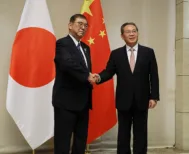
Figure 2 Prime Minister Shigeru Ishiba, left, and Chinese Premier Li Qiang shake hands before their meeting in Vientiane, Laos, on Oct. 10. Photo The Asahi Shimbun
Each side argued its case during foreign trips with, for example, separate visits to Paris by then-Prime Minister Kishida Fumio and Xi Jinping. French expert Celine Pajon characterized Xi Jinping’s visit to Paris as lacking substance, contrasting it with Kishida’s success in securing agreements on supply chains for critical minerals and beginning negotiations for a reciprocal access agreement to facilitate joint military training and exercises. She opined that although French officials tend to perceive Japan as overly aligned with the US and too assertive toward China, Japanese counterparts regard France as sometimes too yielding toward Beijing, with Pajon believing that it would make sense for France and Japan to embrace each other more closely, given the alignment of their positions. Pajon noted that Japan’s multifaceted approach toward China, which includes deterrence, counterbalancing, and conditional cooperation against a backdrop of guarding its economic security shares many similarities with the French and European de-risking stance that views China as a partner, competitor, and systemic rival.
In August, as part of a plan to diversify Central Asian states’ dependence on China and Russia, Kishida visited Central Asia in mid-August. meeting with the leaders of Kazakhstan, Uzbekistan, Kyrgyzstan, Tajikistan, and Turkmenistan. At a summit in Kazakhstan, he signaled Japan’s support for regional efforts to achieve carbon neutrality, offering technology from Japanese companies such as fossil-fuel power plants with low carbon emissions and helping the countries manufacture value-added exports, such as hydrogen and fertilizer produced with natural gas. Kishida’s agenda included discussions on a Caspian Sea shipping route linking Central Asia and Europe that bypasses Russia, which Central Asian nations have favored since Russia’s 2022 invasion of Ukraine. Japan will also provide intangible assistance such as implementing digital technology in customs procedures and encouraging countries to make use of Japan’s skilled worker program to train talent and promote person-to-person exchanges. As the report period closed, the government announced that such items as radars for vigilance and surveillance would be provided free of charge to the Philippines, Indonesia, Mongolia, and Djibouti.
According to the Wall Street Journal, many wealthy Chinese who are attracted by the low prices occasioned by Japan’s weak yen, declining economic growth in the PRC, and frustrated with Beijing’s autocratic political system, are moving to Japan. At the end of 2023, Japan had 822,000 Chinese residents, up 60,000 from 2022 this being the biggest jump in recent years. People who invest the equivalent of at least $32,000 in a Japanese business that has a permanent office and two or more employees can get a business-management visa. Beijing restricts how much its residents can take out of the country, but many Chinese buyers own companies with international operations or have overseas investments. Many have bank accounts in Hong Kong or Singapore from which they can wire money or can mobilize friends and relatives to carry cash little by little over a few months. While most are not political, Chinese officials are aware that in the early 20th century an exile group led by Sun Yat-sen attempted to mobilize support to overthrow the Qing dynasty, and worry that the current community might do the same. In November, Human Rights Watch reported that Chinese authorities are targeting and intimidating expatriates in Japan. Most of those interviewed said they had been contacted by Chinese police, who pressured them to end their activities in Japan. Some reported receiving calls from authorities through their relatives back home, while others were approached at the Chinese embassy in Tokyo. The report states that several Tibetans said they faced pressure from the Chinese government after engaging in activities to promote Tibetan culture in Japan. One Tibetan individual told HRW that when they went to the Chinese embassy in Tokyo to renew their passport, embassy officials told them they needed to return to Tibet to do so. The person said they rejected the embassy’s recommendation, fearing they would be detained or face punishment.
In November Japanese national security adviser Akiba Takeo visited China seeking to lay the groundwork for a meeting between the leaders of the two countries’ leaders though critics argued that given the outstanding issues between their countries, such a meeting was premature.
Economic
Both countries’ economies are described as fragile. The Japanese economy expanded by an annualized 0.9% in Q3 highlighting Japan’s tepid economic recovery, as domestic demand has not fully picked up while a growing risk of a slowdown in the US and further weakness in China’s economy could weigh on exports ahead. China’s economy expanded 4.6% year on year in the third quarter, slower than in the previous three months—significantly below the government’s target for full-year growth of 5%—and underlining faltering growth as Beijing stepped up efforts to boost the economy as sluggish consumption and a property slump weighed on household sentiment. In September Beijing announced its biggest monetary stimulus since the pandemic and followed up with promises of heavy fiscal spending, with economists doubting that it would have the desired effect.
Japanese investment into China declined. A survey by Japan’s Ministry of Economy, Trade, and Industry reported that Japanese companies were pulling away from China, with capital investments by local subsidiaries declining for the seventh consecutive quarter in April-June and falling below the amount invested in Europe. Reasons for the decline included the slowdown in the Chinese economy, increased competition from indigenous Chinese brands, concerns for safety after the detention of Japanese businesspeople on vaguely defined charges, and related uncertainty about the application of China’s espionage law. Employees at four Japanese companies told Asahi that some big firms had given Japanese employees and their families the option to be relocated home at the company’s expense, or are considering doing so. The executive and the employees declined to give any further details, and it is not known how many plan to take advantage of the offer.

Figure 3 Gen Nakatani and EU Foreign Policy Chief, Josep Borrel. Photo: Japan Times
In September, Mitsubishi chief executive officer Nakanishi Katsuya called for a more active strategy from the government to help Japanese companies counter increasing Chinese competition in their traditional stronghold of Southeast Asia. His comments echoed the alarm privately expressed by other executives and government officials, who fear Japanese market share in Southeast Asia is being eroded as Chinese companies increase exports and investment. Still, Mitsubishi, with $6.4 billion in annual profits, remains one of the biggest of the sogo shosha, or general trading houses, with a long history of navigating complicated geopolitical situations.
Distressed Japanese businesses provide opportunities for Chinese interests. Sovereign wealth fund China Investment Corporation was reported targeting undervalued small and midsize Japanese businesses, many of them unlisted, with the potential to thrive in China’s massive market. CIC has created an international advisory council that includes former and current executives from American and European financial institutions to show transparency but the fund provides very limited information about the companies in which it invests and there are concerns that Chinese money might eventually pose an economic security risk to Japan.
Despite continuing to lose market share to China, Japanese auto manufacturers plan to stay. Aiming to secure a 30% share of the global software-defined vehicle (SDV) sales market, against leading US and Chinese manufacturers in automotive technologies, Toyota, Honda, and Nissan agreed to promote collaboration on developing in-car software and are considering standardizing specifications for functions of car computers such as window opening and wiper movement. SDVs are next-generation cars that can add new functions and enhance abilities by updating software via the internet. Hence, they enable the company to earn money even after selling the cars, with China already boosting the development of leading-edge technologies by the standardizing application programming interface (API) that serves as the link between the software and other systems.
Large Japanese corporations with outlets in several countries were able to weather losses and regroup. Major clothing retailer Uniqlo whose parent Fast Retailing reported a large profit fall in China and Hong Kong during the three months through May by July, described itself as at a turning point with its store-opening strategy in China. Uniqlo plans a “scrap and build” policy in the PRC, closing stores with low monthly sales and opening larger ones in better locations. Meanwhile Fast Retailing nonetheless recorded a 13.5% increase in sales from a year earlier, helped by a 19.4% rise in overseas sales driven by Europe and North America.
Frosty government-to-government relations notwithstanding, both sides are aware of the interlinked nature of their economic prosperity. In May, Jiji reported that while state-level exchanges between the two remained almost halted local government were actively interacting with each other to enhance trade. There were winners and losers in the competition. In July, Nippon Steel announced that it would withdraw from a joint venture with Baoshan Iron & Steel, marking a turning point in a 21-year relationship that was a symbol of China’s progress in modernizing its steel industry. This will result in a 70% reduction in Nippon Steel’s steel production capacity in China. Chinese steelmakers, who continue to produce at high levels despite falling demand for their products as the domestic economy slows, present stiff price and quality competition, as the shift to EVs reduces Chinese demand for Japanese cars. On the other hand, factory automation supplier Fanuc raised its annual net profit outlook by $117 million on a recovery in orders from China, where government subsidies drove demand despite a sluggish economy. Demand also grew for Fanuc’s metalworking Robodrills which are used for making smartphone bodies. This occurred as Fanuc’s sales fell worldwide due to lackluster demand in Europe and Japan.
Competition did not preclude cooperation where it was mutually beneficial. On October, the People’s Bank of China (PBOC) and the Bank of Japan agreed to renew their bilateral currency swap deal amounting to 200 billion yuan (about $28.13 billion), or 3.4 trillion Japanese yen. The agreement, which aims to stabilize the financial markets of both countries and support bilateral economic and financial activities, will be valid for a three-year period and can be extended by mutual consent. In early Nov. in its first visit to China in eight years, a delegation of the Japan Association of Corporate Executives (Keizai Doyukai) asked China to exempt short-term visitors from visa requirements (later granted) and called for China’s active participation in the 2025 Osaka-Kansai Expo. Regional organizations also visited. As the report period closed, a delegation from Kansai Economic Federation (Kankeiren) visited. While affirming its desire to trade also advised China to learn from the deflation that Japan experienced over the past 30 years and asked that China expand domestic demand to improve its business environment.
Defense

Figure 4 Defense Minister Gen Nakatani attends the NATO defense ministers’ meeting held in Brussels on Oct. 17. Photo: The Asahi Shimbun, Nen Satomi
Both sides advanced their military capabilities with China facing resistance over its claims in the East China and South China seas and Taiwan and Japan principally worried about its control over the Diaoyu/Senkaku Islands and the effect that a PRC invasion of Taiwan would have for it.
Chinese media touted the debut of its J-35A stealth jet at the Zhuhai airshow. A variant, the J-35, is designed for use on aircraft carriers. With the J-35A joining the J-20 in service, China became only the second nation in the world to operate two different fifth-generation stealthy fighters: the US flies the F-22A Raptor and F-35 Lightning II. A variety of other weapons including a 10-ton drone mothership said to be capable of launching drones in mid-air and then managing them to carry out operations was also exhibited. Further raising anxieties was the expansion of the PRC’s nuclear arsenal, now believed to total 500 warheads with over a thousand expected by 2030.
In May the Japanese government announced the creation of a new Japanese research center to develop both transformational breakthrough technologies and civilian applications for defense technologies during peacetime. Modeled on institutions such as the US Defense Advanced Research Projects Agency (DARPA) and the Defense Innovation Unit based in Silicon Valley, the center will research new, more sensitive methods to detect submarines from a distance using subatomic particles and electromagnetic waves, since conventional sonar has become less effective following technological improvements that have made subs quieter.
Japan’s 2024 Defense White Paper stated inter alia, that Japan is facing the most severe and complex security environment since the end of World War II, and that it could not be ruled out that a serious situation similar to Russia’s aggression against Ukraine may occur in the Indo-Pacific region, particularly in East Asia, adding that China was intensifying its activities across the entire region surrounding Japan, including in the East China Sea, particularly in the area around the Senkaku Islands, the Sea of Japan, and the western Pacific Ocean and extending beyond the so-called first island chain to the second island chain.
In terms of weapons upgrades, in Sept. the Japanese defense ministry signed contracts for two Aegis-equipped vessels, to play a central role in ballistic missile defense. They are also expected to carry an improved version of the Type 12 surface-to-ship guided missiles to provide powerful counterattack capabilities, as well as missiles that can intercept hypersonic glide vehicle weapons. The ministry also plans to build a satellite constellation network for guided missiles to replace the current satellites which cannot be used to lock onto moving targets. The intent is to strengthen the nation’s information-gathering capabilities. Japan also aims to enhance production capabilities of hypersonic guided missiles and to acquire an improved version of the Type 12 surface-to-ship guided missiles. Deployment of US-made Tomahawk cruise missiles and other new weapons will begin in fiscal 2025. Other budget requests will enhance production capabilities for hypersonic guided missiles and acquire an improved version of the Type 12 surface-to-ship guided missiles. And, to improve its ability to deal with Chinese encroachments in the East China Sea including the area around the Senkaku Islands, the coast guard is to construct its largest-ever multipurpose patrol vessel, to function as an offshore base capable of carrying a number of small boats and to deter incursions onto the islands. However, Japan’s military capabilities continue to be bedeviled by personnel problems. Despite generous enhancements to enlist, the SDFs recruitment in 2023 was barely over half the desired number.
With far fewer financial resources to commit to defense than China and hindered by vocal, though diminishing, voices of opposition on military budgets, Japan reached out to like-minded countries for partnerships. Principal among these was the United States. At the end of July, warning that China’s aggressive posture posed the “greatest strategic challenge” in the Indo-Pacific region and beyond, the US and Japan outlined the most significant upgrade to their joint military alliance since 1960. Coordination between the allies had long been hampered because, although roughly 50,000 US military personnel are based in Japan, US Forces Japan lacked command and control authority, with its authority limited to supervising Japan-US joint training exercises and managing troops. Tokyo had to deal with the US Indo-Pacific Command in Hawaii, which is 19 hours behind Tokyo and 6,500 km away. The upgrade involves placing a three-star commander with accompanying staff in Japan, and the USFJ will be reconstituted as a joint force headquarters to allow the two militaries to co-operate and plan more seamlessly, particularly in a crisis such as a Taiwan conflict. Japan had requested a four-star commander but since US military units based in Hawaii and Guam would be the main force in the event of a crisis such as a Taiwan contingency, the ultimate command authority for US forces in Japan will remain with the Indo-Pacific Command, whose commander will likely be the counterpart of the head of the Japan’s SDF Joint Operations Command. The Kishida administration, wanting to demonstrate the strength of the Japan-US alliance in response to developments in China and North Korea, expressed satisfaction that the operative commander who is responsible for Japan’s defense will actually be stationed in Japan.
Strengthening ties with multinational organizations was also on Japan’s agenda. To China’s displeasure, Kishida attended the annual NATO meeting, with Foreign Ministry spokesperson Lin Jian saying that Japan must not interfere in China’s domestic affairs and act as a “vanguard” of NATO’s Asia-Pacific expansion. Japan has also hinted that it would like to join the Five Eyes intelligence sharing agreement of Australia, Britain, Canada, New Zealand, and the US. However, apart from Japan becoming the only non-Anglophone member, there are concerns about its ability to safeguard secrets. As Kishida’s successor, Ishiba has come out in favor of the formation of an Asian NATO. though Biden administration officials reacted coolly with Daniel Kritenbrink, assistant secretary of State for East Asia and Pacific affairs, saying “it’s too early to talk about collective security” in the region…“We’re continuing to build this network of formal and informal relationships and then we’ll see where that goes to.” Ishiba has also suggested that Japan could be added to ANZUS as JANZUS.
Support from other countries continues to be sought. In May, a meeting of the defense chiefs of Australia, Japan, the Philippines, and the US issued a joint statement expressing serious concern over China’s “repeated obstruction of…freedom of navigation” in the South China Sea. Japan and the Philippines are discussing a reciprocal access agreement (RAA) that will facilitate exchanges between their militaries similar to an agreement concluded last year between Japan and Australia. At the same time, Kishida met French President Emmanuel Macron and agreed to start formal talks on a reciprocal troop access deal and strengthening military cooperation amid rising maritime tensions in the Indo-Pacific region and the war in Ukraine. Reciprocal access agreements (RAAs) make the entry of foreign personnel and equipment easier for the visiting force. France has territories in the Indo-Pacific and stations armed forces in the region, where it has sought to develop its presence, and wants to can play a bigger role in Japan’s defense industry as Kishida adopts a more muscular military policy in the region. The Italian Navy’s aircraft carrier Cavour and frigate Alpino arrived at the MSDF base in Yokosuka to conduct joint training exercises with the MSDF in response to China’s increasing maritime presence In August, ships from Canada, New Zealand, Singapore, Italy, called at the Yokosuka base. Germany also expressed concerns, with Rear Adm. Axel Schulz, commander of the German navy’s 2nd Flotilla, telling Nikkei that although Germany has no overseas territories, a conflict in the Asia-Pacific would have massive adverse consequences since it is a major export nation, and that it intended to strengthen ties with Japan.
Japan also reached out to support smaller nations to resist Chinese encroachment. It has sent the Maritime Self-Defense Force and coast guard to the Marshall Islands to help improve the Marshallese coast guard’s capabilities through joint drills and other activities. This marked the first time that the MSDF and the JCG jointly landed on a Pacific island nation to offer such assistance. The China-leaning South China Morning Post described then-Foreign Minister Kamikawa Yoko’s 10-day tour to Madagascar, Ivory Coast, Nigeria, Sri Lanka, and Nepal as aimed at selling itself as the Global South’s China counterweight against China’s aggressive maritime expansion. Among other results was an announcement that the Japanese government will provide Sri Lanka with a vessel and sonar system worth about ¥1 billion ($6.6 million) in total as Kamikawa emphasized Japan’s position on realizing a free and open Indo-Pacific and demonstrated support for Sri Lanka, which sits in a strategic position along sea lanes. China has been making advances into the Indian Ocean in recent years.
The Future

Figure 5 LDP Diet member Nikai Toshiro shakes hands with Zhao Leji, chairman of the Standing Committee of the National People’s Congress, in Beijing on Aug. 28. Credit: Kyodo, accessed at Nikkei, Aug. 28, 2024.
Whether these hopeful signs will result in warmer Sino-Japanese relations remains to be seen. Even if Xi Jinping pays the state visit that Tokyo has long desired, Ishiba, due to his party and its coalition partner losing their majority in the Diet, will be in a weak negotiating position. He is known as a defense hawk which will give Xi little incentive to remove the offensive buoy, resume seafood imports, or reduce even temporarily the tempo of Chinese encroachments in the East China Sea. Conversely, Ishiba has little leeway to concede to China on territorial issues and Taiwan. The most likely outcome is a continuation of efforts to manage tensions rather than resolve underlying issues.
Japan - Korea
May — December 2024Trump 2.0, South Korea’s Martial Law, and Future of Seoul-Tokyo Relations
The year 2025 marks the 60th anniversary of the normalization of diplomatic relations between Seoul and Tokyo. It was originally expected to be a milestone year for bilateral ties and a fitting culmination of nearly three years of hard work by two leaders: President Yoon Suk Yeol and former Prime Minister Kishida Fumio. But that outlook now seems hung in the balance, with new unknowns on the horizon—both expected and unexpected. In this final issue on Japan-Korea relations, we discuss the key factors that are likely to impact the future of bilateral ties and the Camp David trilateral in four major areas: 1) Trump 2.0, 2) political uncertainty in Seoul, 3) weak political support in Tokyo, and 4) resurfacing history issues. The final months of 2024 have brought new unknowns in the shape of leadership changes in the United States, Japan, and potentially South Korea. It is now possible that come January 2025, the leadership trio—President Biden, Prime Minister Kishida, and President Yoon that has made the Korea-Japan rapprochement and the unprecedented trilateral partnership possible will be gone from office.
What happens next is impossible to predict, but one hopes that the hard-fought and laboriously planned institutionalization of bilateral and trilateral ties will withstand these changes in leadership. This will be the first true test for Seoul-Tokyo-Washington trilateral partnership since the Camp David summit in August 2023.
Japan’s new prime minister, Ishiba Shigeru, and President Yoon agreed in mid-November to “further elevate the bilateral relationship to new heights” towards 2025 and to promote comprehensive cooperation in areas such as “politics, security, economy, culture and social security.” However, following President Yoon’s declaration of martial law on Dec. 3, the future of Seoul-Tokyo relations faces a great deal of uncertainty. Given that it was President Yoon’s political will that initially facilitated rapproachment, depending on what happens to his political future and who comes into office in South Korea, Seoul-Tokyo relations may experience challenges. While conflicts over long-standing history issues have been consciously minimized during this period of rapproachment, they have not gone away, as demonstrated by their inability to reach a consensus on a joint event on the controversial Sado mine.
Trump 2.0 and US alliances with Seoul and Tokyo
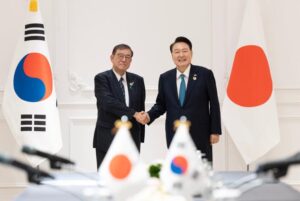
Figure 1 President Yoon Suk Yeol shakes hands with Japanese Prime Minister Shigeru Ishiba during a bilateral meeting at a hotel in Vientiane, Laos, Thursday. Photo: Yonhap
When thinking about the future of Japan-Korea relations, the most important events in 2024 revolve around (potential) changes in leadership—one expected (the US), one mostly unexpected (Japan), and one possible yet totally unexpected (South Korea). The 2024 US presidential election and the re-election of Donald Trump has re-introduced uncertainty into the region, casting a shadow of anxiety not only over bilateral Japan-Korea relations but also the future of trilateral cooperation. Foreign policy did not play a big role in this election. But candidates presented starkly different visions regarding US priorities and values. These differences would ultimately influence the fate of the liberal international order, within which the Camp David trilateral cooperation drives its significance.
Despite the unexpected withdrawal of President Biden from re-election, Kamala Harris’ candidacy was largely seen as a continuation of his administration’s key policies—the institutionalization of trilateral US-Korea-Japan relations and the strengthening of Washington’s traditional alliances with Japan and South Korea. In contrast, no one truly knows what the former President Trump will do. If history is any guide, hiss approach is likely to make these relations more transactional, with less focus on common values.
At the end of the Cold War, a major debate emerged within the US over whether to continue stationing American forces in Asia. Some questioned why the US should bear the cost of defending wealthy Asian countries. Ultimately, the US maintained its presence, guided by the famous rationale put forward by Joseph Nye, then assistant secretary of defense for international security affairs, who argued that “security is like oxygen—you tend not to notice it until you begin to lose it, but once that occurs, there is nothing else you will think about.” Fundamentally, Trump does not share this perspective on security. Instead, he views it as just another business transaction.
For both Tokyo and Seoul, there is growing concern about being in Trump’s crosshairs, as they may fail to meet two of his sacrosanct priorities—defense spending and trade balance. In the words of one expert, both countries are in the “danger zone” because they have large trade surpluses with the US, and spend less than 3% of their GDP on defense. This belief has been consistent with Trump’s worldview since the 1990s, with a clear message that it does not matter whether you are an ally or an adversary, it’s America first. There are concerns he will ask for the allies to pay more. Furthermore, according to another expert privy to conversations with Japanese officials in Tokyo, the new Trump team might even add two more conditions: how many US Treasury securities they have purchased and whether they manipulate their currency.
If Trump’s first term is any clues about his second, US alliances with Seoul and Tokyo are likely to experience the “fear of abandonment”—the anxiety that Washington might not be a reliable ally for their national security. Strong deterrence against North Korea is a key area that has repeatedly united Seoul, Tokyo, and Washington. But this may not be taken for granted under a Trump 2.0 administration. In the near term, trilateral multidomain military exercises like the newly-introduced Freedom Edge may be curtailed or stopped because it is expensive.
A remote but plausible development under a Trump 2.0 administration is an intensified discussion of US troop withdrawals from South Korea. In an interview with a South Korean news outlet Yonhap, Elbridge Colby, former deputy assistant secretary of defense for strategy and force development during Trump’s first term—who is being discussed as a potential defense secretary—said, “South Korea is going to have to take primary, essentially overwhelming responsibility for its own self-defense against North Korea because we don’t have a military that can fight North Korea and then be ready to fight China.” He further noted, “The fundamental fact is that North Korea is not a primary threat to the US. It would not be rational to lose multiple American cities to just deal with North Korea.”
If Washington under Trump 2.0 sends a signal reflecting this stance, this could possibly push South Korea to search for alternative security arrangements. Such alternatives may ultimately result in less optimal outcomes from the perspective of the US-South Korea alliance. Another issue is more political. Trump said little about North Korea during his campaign. But if he chooses to directly engage with Kim Jong Un, while sidelining South Korea, this is not a good signal from the perspective of alliance management.
Therefore, Trump’s victory on Nov. 5 immediately created some consternation in both Seoul and Tokyo, with both sides scrambling to find ways to reach the re-elected president’s orbit and to brush up on their personal charm. Planning for the return of Trump to the White House has been at the top of every world leader’s mind since the election. Without the effective Trump whisperer Abe Shinzo, Japan might find it harder the second time around. But Prime Minister Ishiba may find a way to connect with Trump enough to make sure Japanese equities for the next four years are protected. And over in South Korea, President Yoon Suk Yeol reportedly restarted practicing golf in an attempt to connect personally with Trump, an avid golfer.
Martial Law and Political Uncertainty in South Korea
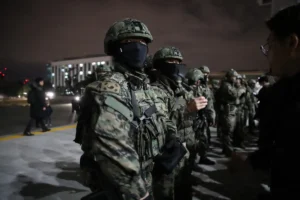
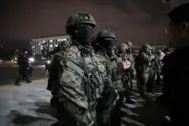
Figure 2 South Korean soldiers outside the National Assembly in Seoul in the early hours of Wednesday. Images Photo: Chung Sung-Jun/Getty
The most unexpected development is the inexplicable and short-lived martial law on Dec. 3 in South Korea. In and outside the country, people are genuinely baffled as to why President Yoon suddenly declared martial law, as there was no apparent reason that the public can understand as a basis for such a drastic move. Martial law, introduced in 1948, was last imposed in 1979 before South Korea’s democratization. For many South Koreans, martial law is a reminder of the country’s authoritarian past, thus prompting many to ask “Are we back to the 1970s before democratization?” Having achieved democratization through years of grassroots struggle, the move caused strong negative reactions against the backdrop of immense pride that South Koreans have for their democracy. Prior to Yoon’s declaration of maritial law, criticism of his leadership has been mounting within South Korea, largely driven by scandals. Now, impeachment discussions have intensified. Calls for his resignation have grown louder. His political future is highly uncertain.
Yoon’s action, which was purely aimed at a domestic issue—the opposition—has created consequences that reverberates far beyond the peninsula, at a time when the regional threat from China, North Korea, and Russia continues to grow. The reverberating effects of that event have left Seoul incapacitated at a critical time not just in domestic politics but in regional relations, with new governments in both Washington and Tokyo. While the quick overturning of the martial law is a resounding victory for democracy and the democratic process, the policy and leadership paralysis as Korea figures out a way forward can lead to “Korea passing” as other regional actors move ahead on critical issues in the new year.
With the political uncertainty in Seoul, all this leads to the pressing question of who will shepherd this very important but prickly bilateral relationship moving forward. The recent improvement in Seoul-Tokyo relations was largely the work of President Yoon, which also laid the groundwork for the Camp David trilateral cooperation. Without him in the picture, the future of Japan-Korea relations becomes highly uncertain. In a hypothetical scenario where South Korea’s main opposition leader, Lee Jae-myung, assumes office, the rapprochement between Seoul and Tokyo would likely come to an end. Lee and his supporters would be expected to prioritize demands for Japan to address unresolved historical issues, potentially undoing recent progress in bilateral relations.
In particular, beneath the public debate over the constitutionality, rationale, and implications of the short-lived martial law declaration, there was one paragraph that caught our and others’ attention in the conclusion of the first impeachment motion submitted by the six South Korean opposition parties on Dec. 4. The paragraph read as follows:
“In addition, under the guise of so-called “value diplomacy,” Yoon has neglected geopolitical balance, antagonizing North Korea, China, and Russia, adhering to a bizarre Japan-centered foreign policy, and appointing pro-Japan individuals to key government positions, thereby causing isolation in Northeast Asia and triggering a crisis of war, abandoning his duty to protect national security and the people.”
The line “bizarre Japan-centered” foreign policy and references to “pro-Japan individuals” clearly illustrates what the opposition party thinks about Yoon’s policy to improve relations with Tokyo. This has been a long-standing criticism of Yoon’s foreign policy, for being too pro-Japan, overly dependent on the US, and too anti-China and anti-North Korea. We have pointed out before that Yoon’s “low-reward unpopular decision” to reconcile with Japan required a lot of political capital, but it is still very stark to see a disagreement over foreign policy be included in a lengthy impeachment bill focused primarily on domestic issues.
While this paragraph is no longer present in the second impeachment motion, it gave us a preview into what an opposition-run South Korean presidency might do in terms of foreign policy. If the current front-runner and Democratic Party leader Lee Jae-myung wins, we might see a reversal in key positions on China, Japan, North Korea, and the US.
Based on his previous public statements, we cannot discount the possibility of an abrogation of the budding US-Korea-Japan trilateral (which might have happened anyway under Trump 2.0), a bypassing of Japan, and a more balanced and even conciliatory approach to China and North Korea. Lee has in the past called a trilateral military alliance “unnecessary” because its exacerbates instability on the peninsula and forces North Korea-China-Russia to align more closely, and have argued forcefully for a more “pragmatic” approach in US-China competition. Lee could possibly come into office in 2025 with a very different geopolitical environment than Yoon’s in 2022, with a revived North Korea-China-Russia axis, a de facto military alliance between its two neighbors in North Korea and Russia, and a retrenched United States.
All of this does not bode well for Japan and South Korea, especially with the speed at which the returning US president might shake things up at the start of his second term. People who are worried about the first 100 days of the Trump presidency might now need to buckle up for the first 100 hours as there are now expectations that the changes coming out of the White House will be breakneck and immediate. For South Korea, unfortunately, there might not be a leader definitively in charge on Jan. 21 to be able to respond to Trump’s actions, or to make that all-important personal connection with him.
As of this writing, President Yoon have vowed to “fight to the end” for a chance to make his case in court during an impeachment hearing. Under this timeline, the impeachment process can take up to six months to resolve in court (to remove or reinstate him), and then a two-month period before a presidential election can be held. We are potentially looking at a dire situation where Korea might be politically unstable and leaderless until August 2025. That’s a long time in any political calendar, and for Seoul, even if it successfully defends its democracy, it might re-emerge much weaker regionally and internationally as the rest of the world moves on.
Ishiba and Weak Political Support in Japan
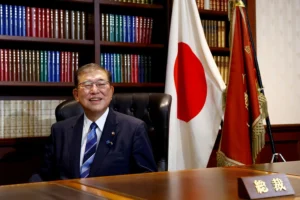
Figure 3 Shigeru Ishiba, the newly elected leader of Japan’s ruling party, the Liberal Democratic Party (LDP) poses in the party leader’s office after the LDP leadership election Photo: REUTERS/Kim Kyung-Hoon/Pool
Another change is the decision by Kishida Fumio to resign in mid-August ahead of the LDP party election in September. The result was not a total surprise, given a series of domestic setbacks for him this year: political fundraising scandal, electoral defeats and consistently poor approval ratings (below 30%). After nearly three years as Prime Minister, Kishida is leaving behind a clear foreign and security policy legacy—increasing defense spending to nearly 2%, reorienting efforts to improve Japan’s security environment, delivering strong support for Ukraine, and most importantly, pushing for rapprochement with Korea. This legacy was apropos of someone who served as Japan’s longest serving foreign minister in the postwar period. As we have discussed often, leaders dictate policy, and it takes two leaders to tango. Kishida’s support for improving prickly Japan-Korea relations—coupled with like-mindedness from Yoon—made Camp David and rapprochement possible. While regional relations lost a stalwart champion in Kishida this fall, his replacement—the longtime LDP politician and former defense minister Ishiba—is likely to follow a similar well-trodden path in foreign policy.
Ishiba Shigeru, a man who famously ran for LDP leadership four times before succeeding on the fifth try, came into office in October 2024 after winning a closely-contested leadership contest with a well-documented track record as a defense hawk and some interesting ideas for North Korea and regional relations. While early talks of an “Asian version of NATO” and nuclear sharing has subsided after initial pushback—his idea of working with Pyongyang directly might gain some traction if President Trump resumes his bromance with Kim Jong Un. His plan to establish liaison offices in both capitals, while not novel, has seen some opposition from families of abductees. For the time being however, the liaison office idea has also been placed on the backburner, as he reaffirmed during a November 2024 national rally on the abduction issue the standard Japanese policy of normalizing relations with North Korea by first resolving the outstanding abduction, nuclear and missile issues. During that speech, he also reiterated his openness to a summit with the North Korean leader and even implored Kim Jong Un “not to miss this opportunity.”
Before the political debacle in South Korea, Ishiba had already signaled his intention to continue the shuttle diplomacy of his predecessor and to press ahead with efforts to further improve bilateral relations. Ishiba and Yoon have already met twice, once on the sidelines of the ASEAN summit in Laos, and again on the sidelines of the APEC Summit in Peru—plus holding the first and last trilateral in the current leader configuration. During their October and November meetings, the two leaders had agreed to “further elevate” the bilateral relations in preparation for the important 2025 anniversary. In late November, there were rumblings of a potential January 2025 visit to Seoul by Ishiba. This early visit would have kickstarted an important year for the bilateral relations, the 60th anniversary of normalization. There were already speculations earlier this year that the two leaders—then Kishida and Yoon—might make a “future-oriented” joint statement to commemorate the occasion. Furthermore, there were additional plans for senior Japanese officials to visit Korea in December, including a bipartisan group of lawmakers from the Korea-Japan Parliamentary Federation in mid-December to be led by former Prime Minister Suga Yoshihide, and an end of the year visit by Japanese Defense Minister Nakatani Gen, which would have been the first visit in nine years.
But all those plans were unceremoniously shelved after the shocking situation in Seoul, with Prime Minister Ishiba saying he is watching the developments with “particular and grave” concern. US Secretary of Defense Lloyd Austin similarly cancelled a planned stop in Korea—part of his last Asia trip with stops in both Tokyo and Seoul to reassure and commit to trilateralism before a Trump transition. Other trilateral efforts planned for December were also casualties of this “unforeseen circumstance,” including a session of the Nuclear Consultative Group (plus a related exercise) and a trilateral forum on women’s economic empowerment. With Ishiba’s January visit called off at the time of this writing, there are increasingly growing concerns that shuttle diplomacy between the two neighbors will become difficult for the time being until the domestic situation in Seoul is resolved. While it is too early to rule out any breakthroughs for 2025, what is certain now is that the political turmoil in Seoul has thrown off course a carefully calibrated transition and shifted tailwinds into headwinds for the foreseeable future.
Resurfacing History Issues
A kerfuffle over the commemoration of the controversial Sado mine in November revealed the limits of foreign policy objectives over deep rooted historical grievances. The two sides were unable to reach a consensus on a joint event, and instead held two separate events. Moreover, ritual offerings by Japanese leaders to the controversial Yasukuni Shrine remains a perennial problem, though the decision by Ishiba to send an offering, instead of visiting in person in October revealed that he will likely be more cautious in this aspect, unlike what some more conversative members of his party such as Takaichi Sanae—who visited in person—might want from him. Experts have pointed out that other historical problems, including the potential depletion of third-party reimbursement for forced labor victims might resurface in the coming year. As we pointed out last year, a binational survey showed that there remain three major problems for a true “future-oriented” relations, all of which revolved around the question of history: resolving historical disputes; addressing Dokdo/Takeshima; and improving historical perceptions and education.

Figure 4 President Yoon Suk Yeol hold hands with Japanese Prime Minister Shigeru Ishiba, fourth from right, and Chinese Premier Li Qiang, second from right, during the 27th ASEAN Plus Three Summit held at the National Convention Center in Vientiane, Laos, Thursday. From left are Thai Prime Minister Srettha Thavisin, Vietnamese Prime Minister Pham Minh Chinh, President Yoon, Ishiba, Laotian Prime Minister Sonexay Siphandone, Li and Malaysian Prime Minister Anwar Ibrahim. Photo: Yonhap
And finally, Prime Minister Ishiba will meander into the new year with weak political support, losing a majority in the October parliamentary election, and surviving a rare November run-off. The results meant that for the time being, Ishiba will need to focus inwardly on fixing the Japanese economy and addressing voters’ concerns over political scandals. He will not have the wherewithal to focus outwardly anyway because without a parliamentary majority, it would have been difficult to pass some of his bolder foreign policies. The situation in Korea also makes it much harder for any positive developments on either side, setting up an unfortunate lost opportunity in an anniversary year in 2025.
China - Russia
May — December 2024Moscow and Beijing at the Dawn of A Grave New World of Trump 2.0
The election of Donald Trump as the 47th US president changed the chemistry between Washington, Moscow, and Beijing so much and yet so little. It was so much because the war-ending rhetoric of the president-elect was in sharp contrast to his predecessor’s steadfast support of Ukraine. It was so little because the war in Ukraine not only continued but even escalated after Trump’s decisive electoral win in early November as the Biden administration rushed arms to Ukraine with much relaxed restrictions (on ATACMS, etc.). Meanwhile, Beijing-Moscow relations continued to broaden and deepen throughout 2024 despite Trump’s repeated vows to split the Russia-China entente. Xi and Putin met three times in six months (May, July, and October). Their joint enterprises (SCO, BRICS, etc.) also expanded steadily while experiencing growing pains. Meanwhile, the two large powers considerably stepped up their mil-mil interactions with more exercises, exchanges, and joint patrols. It remains to be seen how Trump would operationalize his campaign rhetorics not just to capture a pivotal position within the Moscow-Beijing-Washington triangle, but more importantly, to avert the Kissingerian dark prophecy of a grave new world of WMD and AI racing toward World War III.
Putin 5.0 and Russia’s China-Pivot
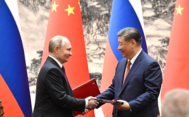
In his first 2024 campaign rally in March 2023, Trump blamed Biden for the devastating war in Ukraine, “casual talk” about nuclear war with Russia, and a China-Russia unity to “carve up the world.” A year later, Putin won his fifth term and then found himself in China, the first foreign visit of his fifth term in the presidency. It was also his first official visit since the outbreak of the Ukraine War in February 2022 (his October 2023 trip was defined as a “working visit” for the annual BRICS summit). 2024 was also a time of the 75th anniversary of China-Russian/Soviet diplomatic ties.
Despite the war, Moscow and Beijing managed to maintain and even deepen their bilateral ties. This time, Putin brought with him almost the entire Russian government (except the prime minister) to China, including six deputy prime ministers and heads of various governmental departments (foreign affairs, defense, national security, finance, economics, nuclear power, aerial space, railroad, nuclear power, etc.). These senior officials and their staff, along with hundreds of Russian businesspeople, filled up more than 20 large aircraft.
In Beijing, Xi and Putin held several hours of “sincere and cordial meetings covering many topics.” A joint statement was issued after the meeting. The 10,000-word document stressed the principles of nonalignment and equality in bilateral relations for a world order of “multipolarity and democracy” (Part I). As two large powers who suffered the most in WWII, the two sides said they would strongly defend the post-WWII world order by opposing distortion of war history and any effort to revive Nazism/militarism.
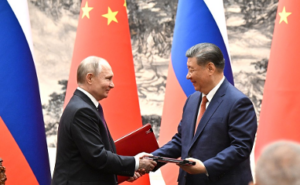
Figure 1 Following the talks, Putin and Xi signed a Joint Statement. Photo: Sergei Savostyanov
The statement covers nine functional areas for cooperation: security (parts II, VII, and X), economics (III), societal exchange (IV), multilateralism including the UN, Shanghai Cooperation Organization, BRICS (V, VI), the environment (VIII), and Ukraine (IV). Part III on economics listed 20 sub-areas for cooperation including the “Bilateral Investment Cooperation Planning Outline” (pending), the key to China’s large investment in Russia. The document has two noticeable additions: setting up an Arctic route cooperation subcommittee and a trilateral dialogue with North Korea regarding Chinese vessels’ access to the sea via the lower reaches of the Tumen River. While the former would open much of the Russia-controlled northern sea route and port facilities to China, the latter would play a key role in revitalizing China’s northeastern provinces.
The bulk of the joint statement (three parts) was about security. Part II, for example, called for “steady development for defense cooperation for both regional and global security.” The two sides needed to “deepen mutual trust and coordination,” and expand joint exercises and joint naval/aerial patrol. Communication and dialogue at various levels should be enhanced, the statement read, as well as coordination in multilateral forums (UN, SCO, BRICS) for anti-terror, law enforcement, and emergency management coordination. Part VII highlighted the danger of nuclear war, proliferation, militarization of outer space, weak international regulations on chemical/biological weapons, AI, and US deployment of intermediate-range missiles in the Asia-Pacific.
The emphasis on security was further underscored in Parts V (UN), VI (regional forums), VIII (environment), and IV (Ukraine) in which security issues were considered paramount for a just and enduring security for all. Lengthy joint statements between the two sides are not uncommon. The tone of the document, however, indicated a much stronger and more direct criticism of Washington’s “unilateralism” and rule-breaking behavior across all issue areas.
Is it Still the Economy…
Despite the war, Russia remained the world’s 4th largest economy in 2023 in PPP terms, and 11th in nominal GDP. Meanwhile, massive Western sanctions on Russia led to a marked increase in Russia-China economic transactions. In 2023, bilateral trade reached $240 billion, up from $108 billion in 2020. While China’s import of Russia’s oil increased by 24% to 107 million tons, China’s 553,000 vehicles exported to Russia accounted for 49% of Russia’s auto market, up from 19% in 2022. Bilateral trade was “not only developing but also flourishing,” remarked Putin in his meeting with visiting Chinese Premier Li Qiang on Aug. 21.
At the 29th prime ministerial meeting in Moscow, Li and Russian PM Mikhail Mishustin conducted “a detailed discussion on the entire range of trade, economic and humanitarian cooperation issues.” Eighteen documents were signed, including one to upgrade the outline of an investment cooperation plan to be finalized by the yearend. For many Chinese business leaders, Russia’s domestic law and regulations for foreign investment were quite “complicated,” and the sweeping Western sanctions made it worse. A new version of the investment plan would facilitate China’s 86 large investment projects in Russia totaling $200 billion. While most of these projects would be in the “traditional areas” such as energy, transportation, agriculture, auto industry, and home electronics, Premier Li stressed the need to “explore new areas of technological and industrial cooperation,” including digital economy, biomedicine, green development, etc.
For decades, economic and trade relations were the weakest links between China and Russia, as both tried to integrate into the West-dominated global trading system. The Ukraine War and the tightening of their strategic space led to a marked broadening and deepening of their economic intercourse.
Moscow and Beijing had so far refrained from moving to a formal alliance. Yet for Washington, Zbigniew Brzezinski’s 1997 warning regarding the emergence of a dominant and antagonistic Eurasian power is now descending across the vast Eurasian continent. The potential for a “marriage,” convenient or not, between the world’s energy/raw material and manufacturing giants seemed “unlimited” in both geoeconomic and geopolitical terms.
Multilateralism to Go
One key area of China-Russian cooperation in 2024 was to manage the “growing pains” of the SCO and BRICS against the ever-changing and more complex world. Xi and Putin met twice on the sidelines of the annual summits of the SCO in Astana (July) and BRICS in Kasan (October).
In Astana, they agreed to enhance cooperation for regional security. While Xi called for more “strategic coordination,” Putin echoed that Russian-Chinese cooperation in global affairs served as “a main stabilizing factor.” Both vowed to strengthen the SCO for regional stability. Twenty-four agreements were inked, including a development strategy until 2035, several cooperation programs to combat terrorism, separatism, and extremism for 2025-2027, an anti-drug strategy for the next five years, and its corresponding action program. As for global issues, participants endorsed the “Initiative On World Unity for a Just Peace, Harmony and Development” proposed by Kazakhstan for a new, democratic, and equitable international order.
This global vision of the regional security group got an instant boost in Astana as Belarus officially ascended became the SCO’s 10th member. A few days after the Astana summit, more than 100 PLA special forces were airlifted to Belarus for an 11-day “anti-terrorist” exercise (code-named “Attacking Falcon 2024,” July 8-19) in areas close to Poland and Ukraine. Despite its label as anti-terrorist, it was carried out by the regular PLA unit from the 80th Group Army of the Northern Theater Command at the time of heightened tension between Belarus and Ukraine.
Despite these institutional gains, there was a growing gap between the SCO’s numerous adopted agreements/declarations and its ability to implement them, according to Professor Pan Guang, a prominent scholar on Central Asia in China. Part of the problem was SCO’s unanimity-based decision-making mechanism, which frequently led to inaction. SCO’s small and weak institutional setup (Secretariat in Beijing and the Regional Anti-Terrorist Structure in Tashkent, Uzbekistan), too, badly needs an update.
Perhaps more than anything else, Russia’s influence in Central Asia steadily declined largely because of its preoccupation with the Ukraine war. A case in point was the final agreement in June 2024 regarding the China-Kyrgyzstan-Uzbekistan (CKU) railroad that had been put on hold for 30 years by disagreement over its finance and Moscow’s hesitation. With a projected annual capacity of 15 million tons of cargo, CKU represents the shortest route between Shanghai and Paris. In the foreseeable future, Russia may have to live with a more proactive China in its traditional backyard. Alternatively, Washington and its allies will make further inroads into the post-Soviet space where de-Russianization was already irreversible.
More “Breaks” onto BRICS
As the SCO moved beyond its regional confine, BRICS also added more strategic and global dimensions. Putin and Xi met again in Kazan (Russia) prior to the BRICS group summit. Their “in-depth exchange of views on major international and regional issues of common concern” was described as “a key moment” of the annual summit, said Chinese FM Wang Yi. Both leaders spoke highly of the bilateral ties. While Putin described it as “a paradigm of how inter-state relations should be constructed,” Xi emphasized the principles of non-alignment, non-confrontation, and non-direction against third parties.
With the theme “Strengthening Multilateralism for Just Global Development and Security,” the Kazan summit was the first enlarged BRICS gathering with five new members (Iran, Egypt, Ethiopia, the United Arab Emirates, and Saudi Arabia). As BRICS’ rotating host, Russia organized more than 200 events. Thirty-six countries, including 22 heads of government/state and UN Secretary-General Antonio Guterres, joined the annual gathering. BRICS Business Forum also attracted more than a thousand participants.
In his speech to the BRICS business forum, Putin noted that the 10-member group now had 46% of the global population, 36% of the world’s landmass, and 45% of oil output. But even before its expansion, BRICS had overtaken the G7 in PPP terms (37.4% vs 29.3%).
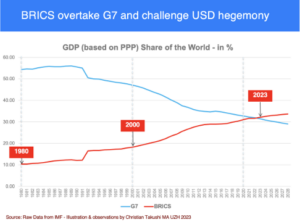
Figure 2 Illustration and Observation by Christian Taiushi MA UZH Source: Raw Data from IMF
The BRICS summit ended with the signing of the Kazan Declaration, a 134-clause document covering every conceivable area of global issues. The long document “is a declaration for a new global order,” according to Andrey Kortunov of the Russian International Affairs Council and Professor Zhao Huashen of Fudan University in Shanghai. BRICS did not merely add new members but was becoming a platform for the entire Global South, noted Kortunov and Zhao in a jointly penned article. Four areas of cooperation were emphasized: multilateralism (Articles 6-23), global/regional stability and security (Articles 24-56), economic/financial development (Articles 57-118), and societal exchange (Articles119-132). Of these areas, security and development were highly interdependent, noted Kortunov and Zhao.
Ukraine was briefly mentioned in Article 26, stressing the need to comply with the UN principles and make all efforts to end the conflict. The bulk of the security section dealt with conflicts and challenges around the world, particularly in the Middle East including the Israeli-Palestinian conflict, which reflected the views of the BRICS four new Islamic members (Iran, Egypt, the United Arab Emirates, and Saudi Arabia).
While multilateralism was a platform, the three functional areas of security, development, and cultural/humanitarian exchanges largely reflected the three “proposals” outlined by Chinese President Xi Jinping in the past few years for global development (2021), global security (2022), and civilizational dialogue and coexistence. This was also the theme of Xi’s speech in Kazan. China’s vision for the BRICS future, therefore, was largely accepted by its diverse members.
BRICS’ trajectory, however, was not to rival, but to parallel the existing global system dominated by the West. It does, however, serve the interests of the Global South, argued Kortunov and Zhao. At a minimum, BRICS’ highly diverse constituents are fundamentally different from the largely exclusive Western institutions such as G7, the European Union, and NATO, whose members are similar in political, economic, and cultural/religious construct. Hence the need for an interface for the diverse interests of its vastly different members.
Enhanced Mil-Mil Ties
In his meeting with Putin in Kazan, President Xi described the world undergoing “unprecedented tectonic transformation” and “serious changes and upheaval…unseen for centuries.” 2024 witnessed a significant increase in Russia-China mil-mil interactions. In July-September, for example, several large-scale joint exercises/operations even overlap with one another:
- July 2-16: Three Chinese naval ships and one Russian corvette conducted a 15-day joint patrol of the Western Pacific and the South China Sea, the fourth joint patrol since 2021.
- July 12-17: the annual (since 2012) “Exercise Joint Sea-2024” was held off the Zhanjiang naval port in southern China. Seven Chinese and Russian naval vessels joined the drill for “maritime security threats.”
- In late July, Chinese naval ships were present in both St Petersburg and Vladivostok for the 328th anniversary of the Russian Navy.
- July 24: Russian and Chinese strategic bombers carried out a joint patrol of Far East Russia and the Bering Sea near Alaska, the 8th strategic aerial patrol by the two militaries since 2019. For the first time, the joint patrol reached international airspace near Alaska.
August was quiet with only one military exchange: commander of the PLA Ground Forces Gen. Li Qiaoming led a delegation to the annual “Army-2024 Forum” outside Moscow. He held talks with Russian Ground Forces’ Commander-in-Chief Oleg Salyukov. By September, the high-frequency exercise mode returned:
- On Sept. 10-15, China launched the first phase of the annual “Northern/Interaction-2024” naval exercises with Russia. Unlike the 2023 series primarily in the Sea of Japan, the 2024 version extended to the Sea of Okhotsk which had been carefully guarded as an “internal sea,” or “Russia’s Great Lake,” by Soviet/Russian authorities since the end of WWII. The Chinese press referred to Russia’s “fortified waters” (堡垒海域) presumably for deploying Soviet/Russia’s strategic nuclear submarines for second/retaliatory strikes.
- On the same day (Sept.10), Russia began its “Ocean 2024” strategic command-and-staff exercises. Some 90,000 troops and more than 500 ships and aircraft drilled across the Pacific and Arctic Oceans, and the Mediterranean, Caspian and Baltic seas. China was the only country that participated in the exercise.
- The “recess” between the two phases of China’s “Northern/Interaction-2024” was not wasted. Between Sept. 16 and 20, Chinese and Russian coast guard ships held a joint drill near Peter the Great Bay off Vladivostok. This was followed by a first-ever joint patrol of the northern Pacific beginning Sept. 21. By Oct. 1, the patrol ships reached the Arctic Ocean, which was a first for the Chinese Coast Guard ships.
- No sooner had the Coast Guard ships departed from the northern Pacific than the second phase of the Northern/Interaction-2024 joint exercise began on Sept. 21. This was immediately followed by the 5th joint patrol of the northern Pacific by the same naval vessels of the two navies, which was the first time for the two sides to conduct two joint maritime patrols within one year.
The high frequency and intensity of the Sino-Russian interactions occurred against a backdrop of heightened tension in the West Pacific. From late June to early August, the US-led Rim of the Pacific 2024 exercises (RIMPAC 2024), the largest in the world, drilled around the Hawaiian Islands with 40 surface ships, three submarines, 14 national land forces, over 150 aircraft, and more than 25,000 personnel from 29 countries.
It was during the multi-nation “Sama Sama” exercises that the PLA launched a 13-hour massive Joint Sword-2024B drill around Taiwan on Oct. 14. The exercise was a simulated blockade of the island shortly after Lai Ching-te’s speech on Oct. 10 (ROC’s national day), which was deemed as “provocative and dangerous” and aimed toward nominal independence. On the same day, Russian Defense Minister Andrei Belousov traveled to Beijing and held talks with Chinese counterpart Dong Jun. Military cooperation between Russia and China was important in safeguarding global and regional peace and stability, said Belousov.
While exercises came and went, the US deployment of an intermediate-range missile system in Japan and the Philippines was considered a long-term grave threat to China and Russia. “[L]and-based intermediate-range missiles in the Asia-Pacific region will pose the biggest security threat to the region,” TASS cited PLA’s Lt. Gen. He Lei on Sept. 12. The 1987 Intermediate-Range Nuclear Forces (INF) Treaty prohibited the deployment of intermediate-range missiles but Washington withdrew from it in 2019.
Amidst these heightened military activities in 2024 was China’s effort to elevate/demonstrate its nuclear capabilities, with or without Russian cooperation. On Sept. 25, China tested, for the first time in 44 years, an ICBM (DF-31AG with a range of 12,000 km) from Hainan Island to the South Pacific. To this, Russian Presidential Spokesman Dmitry Peskov remarked “[T]his is China’s sovereign right… We respect [this].” In the Nov. 29-30 ninth joint strategic aerial patrol with Russia, China dispatched, for the first time, two long-range H-9N strategic bombers with refueling capabilities for a combat radius of 6,500 km. The nuclear-capable bomber could carry YJ-12 supersonic antiship missiles, CJ-100 cruise missiles, and even an air-launched variant of the hypersonic (Mach 10) DF-21 anti-ship ballistic missiles (see photo below). Many in China viewed this as a crucial step toward China’s first credible and operational airborne strategic deterrence.
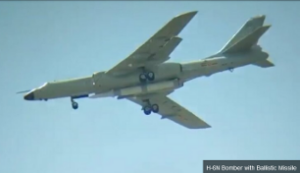
Figure 3 H-6N Bomber with Ballistic Missile Photo: Military Watch Magazine
Intensified China-Russian mil-mil interactions occurred when Russia continued to be bogged down on its western front. Its vast east and Pacific regions were increasingly exposed despite Putin’s 2023 declaration that “the Far East is Russia’s strategic priority for the 21st century.” Enhanced military interactions with China were therefore highly desirable given China’s growing military capabilities.
For the PLA, Russia remained the sole source of real combat experience regardless of Russia’s battle performance in Ukraine. At the operational level, interoperability between the two militaries in 2024 meant more access to each other’s facilities for refueling and resupply. In the case of the joint bomber patrols of the northern Pacific, the flying range was much shorter for China’s H-6 bombers to reach their intended area off Alaska as they took off from an airfield in northeast Russia. Some Chinese military experts were speculating that a shorter route via Russia’s Arctic air space would make China’s strategic bombers a more viable and flexible deterrent than PLA’s land and sea options.
Embracing Trump “Shock-n-Awe” 2.0
Although Putin remarked jokingly in early September that he wanted the Democratic candidate Harris to win, he was clearly avoiding comments on Trump’s win at the annual Valdai Forum on November 7. The Russian president nonetheless said Trump “impressed” him as a “courageous man” in “extraordinary conditions” (the assassination). Meanwhile, Trump’s words about ending the Ukraine conflict and improving relations with Russia “deserve attention.”
As to Trump’s repeated rhetoric of splitting the Beijing-Moscow partnership, Putin said that Russia would not team up with the US in dealing with China. Relations with China “have reached a historical high and are based on mutual trust, which is something we lack in our relations with other countries, above all with Western countries,” Putin replied to a question from Prof. Feng Shaolei, a top Russologist in China. He further suggested that “everyone would win and there would be no losers if the United States … treats both Russia and China by moving away from its double containment policy towards a trilateral cooperation framework.”
There were good reasons for Russia to be more careful with Trump’s huge win, given the highly charged US domestic chemistry and two assassination attempts against candidate Trump. “I believe he is still not entirely safe,” remarked Putin in late November. Meanwhile, Trump’s Cabinet picks reportedly received multiple threats against them. Even under the best circumstances, converting Trump’s campaign rhetoric into policies would be difficult.
While Russia could afford to adopt a wait-and-see posture regarding Trump, Beijing perceived Trump’s return with visible unease for at least four reasons. One was Trump’s solid record of “China-heavy-and-Russia-lite” in both words and deeds in the previous eight years. And there has been no indication of any deviation from that.
Second, Biden’s China policy, which was seen as bad enough—“endless trouble, endless frictions, and endless struggles” (麻烦不断 摩擦不断 斗争不断) according to Wu Xinbo, director of American Studies Center of the prestigious Fudan University in Shanghai—would have to be interrupted if not disrupted given the gathering of China hawks under Trump. In this “you-go-low-I-go-lower” “China race,” Taiwan and the South China Sea could be the next flash points between Washington and Beijing.
Third, the US trade war with China, which was started by Trump in 2018, will likely escalate rapidly, further disrupting the already fragile supply chains of the world trading system. In contrast to Russia’s raw-material-based economic structure (oil, gas, grain, etc.), China’s globalized production chains, extensive energy supplies, and trading/shipping networks are far more vulnerable to sanctions and disturbances than Russia even under normal circumstances.
Last, a growing number of China’s foreign policy analysts came to see an eerily yet persistent “civilizational” factor permeating the Trump camp, in that white communism of the Soviet type and its post-Soviet variant were seen in a far more favorable light than “a great power competitor (China) that is not Caucasian” (words by Kiron Skinner, director of policy planning at the State Department during Trump’s first term). To China’s surprise and perplexity, Skinner herself is African-American. No matter how much Russia is demonized, Putin, and particularly his “healthy conservatism,” always has a strong appeal among conservative segments in the US/West. Such a sense of racial hierarchy may help explain why recent polls continuously show that more Americans view China as a greater enemy than Russia despite Russia’s war-prone propensity and China’s zero record of use of force in the past 45 years.
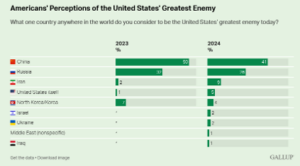
Figure 4 Americans’ Perceptions of of the United States’ Greatest Enemy. Photo: GALLUP
Moscow and Beijing, despite their long-term strategic partnership and being targets of Washington’s “dual containment” strategies, assume very different cultural/racial identities in the US domestic scene. It remains to be seen how far this genre of US identity politics will find its way to policies toward Moscow and Beijing under Trump 2.0.
End the War or the World?
Trump made his historic comeback a year after the passing of Henry Kissinger in November 2023. In their 2017 meeting in the White House, Trump described his “long-time” friend (Kissinger) as “a man of immense talent, experience, and knowledge.”
Despite the huge difference between the world’s most powerful salesman and the realpolitik thinker/practitioner, both men showed strong aversions to the Ukraine conflict. That said, the biggest difference between them is how the conflict may end. For more than six months, Trump repeatedly promised to end it in 24 hours.” Kissinger, however, warned that ending a conflict was far more difficult than starting one. “The test of policy is how it ends, not how it begins,” argued Kissinger shortly after the 2014 Crimea crisis.
For Beijing, the Trump-Kissinger discourse, regardless of the outcome, would put China between a rock and a hard place. As a profoundly conservative country, the ending of the Ukraine war, or any war, is good for China’s sprouting business around the world, particularly its Belt and Road Initiative now in its second decade with more than 150 countries. Such a prospect, however, would divert more attention and resources to America’s “China issue.”
Regardless, the Ukraine war was moving steadily toward a breaking point in the waning days of the Biden administration. On Nov. 17, Biden authorized Ukraine to use long-range ATACMS missiles (300-mile range) for deeper strikes into Russia, which Ukraine did two days later. On the same day, Putin approved changes to Russia’s nuclear doctrine. Now an attack from a non-nuclear state, if backed by a nuclear power, would be treated as a joint assault on Russia. On Nov. 21, the Ukrainian city Dnipro was struck by Russia’s newest nuclear-capable intermediate-range hypersonic (Mach 10) ballistic missile code-named Oreshnik (or “Hazel Bush”) with six independently-guided warheads.
Moscow and Beijing reacted very differently to this escalation. For Russia, it was “a qualitatively new round of escalation of tensions and a qualitatively new situation…in this conflict,” remarked the Kremlin spokesman Dmitry Peskov. Meanwhile, Beijing urged all sides to de-escalate and find a political solution. The strongest reaction came from Trump’s supporters who almost unanimously depicted the ATACMS reversal as an “escalation move” toward WWIII. “It’s another step up the escalation ladder and nobody knows where this is going,” said Trump’s incoming national security adviser, Florida Rep. Mike Waltz.
Just a few days after Biden’s ATACMS decision, the New York Times reported that some officials of the Biden administration floated the idea of returning nuclear weapons to Ukraine as a deterrent against Russia. Although this was dismissed a few days later by National Security Adviser Jake Sullivan, the 21st-century version of the 1983 made-for-TV film The Day After was rapidly unfolding as Newsweek published a series of simulated impacts of nuclear blasts on major metropolitan centers in Europe, North America, Russia, China, and North Korea.
Russia’s reaction, or lack of reaction, to the Newsweek extravaganza may be uncharacteristic. Or it was exactly what Russia wanted. In contrast, China’s netizens erupted with disbelief and anger at Newsweek’s “coldblooded calculation” “reducing the untold human cost to lifeless statistics.”
For incoming US President Donald Trump ending the war in Ukraine is now a far more complex and difficult, if not impossible, issue. Meanwhile, time is limited for Trump, and perhaps for all other world leaders, to avert what Henry Kissinger warned, 11 months before his passing, was a global catastrophe (WWIII) in a grave new world of WMD and AI.
Australia-US/East Asia
October 2023 — November 2024Voters Consider, Trump Comes, China Coercion Cools
Australia’s politicians prepare for the national election that must be held by May. In judging the first term of Anthony Albanese’s Labor government, the key concern for Australia voters is the cost of living, while international issues are bracketed by the United States and China—the return of President Donald Trump and the cooling of China’s trade coercion of Australia. The Albanese government tells Australians they face “fraught and fragile global conditions” in a “a time of great global uncertainty,” in “the most complex and challenging strategic environment since the Second World War.” Canberra’s approach to the Trump administration will emphasize traditional alliance ties while reinforcing new elements: AUKUS nuclear submarines, the Quad, the increase of US forces on Australian soil, and steps toward free trade in defense equipment and technology to achieve more integration between US and Australian industries.
Australia’s Election, Trump’s US Election
One of the many unusual impacts of Trump’s return to the presidency is the influence he will have on the federal election Australia will hold by May 2025. Prime Minister Albanese choses the day, but the three-year federal election cycle means the latest date for the vote on the House of Representatives and half the Senate is May 17, 2025. The parliamentary sitting calendar for 2025 is shaped by the election deadline. Australia’s annual budget is usually presented to Parliament in May. But the date for the 2025 budget is brought forward to March 25, 2025. An early budget and then a May federal poll is the same timetable used by Scott Morrison’s Liberal-National Coalition government in the previous elections in 2019 and 2022.
Issues that resonated in the US election will echo in Australia—the cost of living, housing, and migration levels. The opposition leader Peter Dutton will mobilize an Australian version of the question Trump asked US voters: “Are you better off than you were three years ago?” Labor’s response will be to ask voters: “Who is going to make you better off in the next three years?”
Figure 1 U.S. President Donald Trump speaks during a joint news conference with Australia’s Prime Minister Scott Morrison in the White House in Washington on September 20, 2019. Photo: Jonathan Ernst/Reuters
In the lower house of Parliament, where governments are formed, Labor goes to the voters holding the thinnest of majorities—78 seats in the 151-seat House of Representatives (redistributions will reduce the House to 150 seats at the election). The possibility of Labor being pushed into minority government looms as an equal or even stronger possibility than Labor hanging on to its majority. The Liberal-National Coalition holds 55 seats, while independents and minor parties hold 18. The Coalition will need a net gain of 20 seats from Labor and the cross-benches to return to office. The global electoral trend to punish incumbent government means the Albanese government has lost its lead in the opinion polls. Polls now deliver a near 50-50 split in the two-party vote for Labor and the Coalition; the polling margin of error decides which side is leading in individual polls.
The doyen of the Canberra press gallery, Michelle Grattan, observes that Trump’s victory in the United States will affect the climate of Australia’s campaign: “One obvious point of debate would be how either leader would potentially handle an unpredictable Trump. A Trump presidency might [favor] Opposition Leader Peter Dutton’s national security focus. But an opposite view, held in Labor circles, is it could make people stick to the status quo. Trump’s triumph would also be fodder for the Greens in their attack on Labor’s closeness to the US. For its part, Labor would argue the Australia-US alliance is enduring regardless of individual US and Australian leaders and governments.”
Finishing her term in Canberra, US Ambassador Caroline Kennedy emphasized what will be a key Australian talking point to Trump as she pointed to “the continuity that has characterized this alliance for more than a century.” Kennedy expressed the great alliance story Australia will seek to tell Trump: “Australia may be a middle power, but to the United States, you are number one. We have no more trusted or capable ally. In every dimension of our relationship, I’ve seen the United States rely on Australian leadership and experience. Australia is no longer America’s ‘deputy sheriff’ or whatever the critics like to say. Australia is our partner and often our teacher as the United States navigates a multipolar world. That’s true in our bilateral relationship. It’s true in multilateral fora, and it is vital in this region.”
After phoning Trump to congratulate him the day after the US election, Prime Minister Albanese said they “talked about the importance of the alliance, and the strength of the Australia-US relationship in security, AUKUS, trade and investment. I look forward to working together in the interests of both our countries.”
Albanese told a press conference: “President Trump has run a campaign based on change and he’s made it clear he’s going to do things differently–so we shouldn’t be surprised as things change. But equally, we should be really confident in ourselves and our place in the world as well, and our ability to deliver on our interests together as Australians.”
Albanese denied any need to apologize for previous negative comments on Trump’s first presidency. The most notable example was in 2017, when Albanese was an opposition frontbencher. Asked then how he would deal with Trump, Albanese answered “with trepidation,” going on to say “he scares the s–t out of me and I think it’s of concern the leader of the Free World thinks that you can conduct politics through 140 characters on Twitter overnight.”
Now as prime minister, Albanese says he will work with Trump, adding that he has demonstrated “my ability to work with world leaders and to develop relationships with them which are positive.” Australia’s ambassador in Washington, the former Labor prime minister, Kevin Rudd, acted swiftly after the US election to delete his previous criticisms of Trump. Media turned up plenty of examples of Rudd attacks, calling Trump, “the village idiot” and “the most destructive president in history.” A statement from the Australian embassy announced Rudd’s clean-up:
“In his previous role as the head of an independent US-based think tank [the Asia Society], Mr. Rudd was a regular commentator on American politics. Out of respect for the office of President of the United States, and following the election of President Trump, Ambassador Rudd has now removed these past commentaries from his personal website and social media channels. This has been done to eliminate the possibility of such comments being misconstrued as reflecting his positions as Ambassador and, by extension, the views of the Australian Government. Ambassador Rudd looks forward to working with President Trump and his team to continue strengthening the US-Australia alliance.”
Rudd’s previous criticisms were quoted in an interview with Trump in March by the British politician, Nigel Farage. In response, Trump responded by calling Australia’s ambassador “a little bit nasty,” and “not the brightest bulb.” While saying that the ambassador “won’t be there long,” Trump ended his response to the question about Rudd by noting, “I don’t know much about him.” After Trump’s election, the Albanese government expressed full confidence in Rudd and said he would stay as ambassador. Foreign Minister Penny Wong noted that Trump is “a pretty robust individual” while the alliance “is bigger than any individual or past comments. And in terms of Kevin, Kevin Rudd’s been an excellent Ambassador. He’s delivered an enormous amount for Australia, and I have great confidence that he’ll continue to do so.”
Australia will use the same lines that worked with Trump in his first term. The US has a trade surplus with Australia; or, in Trump-speak, America gets a good deal out of Australia. The balance of trade in America’s favor helped Australia avoid Trump tariffs on Australian steel and aluminum last time round. Australia’s talking points to Trump will highlight the transactional wins the US gets from the relationship. The bilateral free trade treaty with the US, the Australia-United States Free Trade Agreement reaches its 20th birthday in January 2025. The US is Australia’s top foreign investment destination, while the US is Australia’s top foreign investor, as Australia’s Foreign Affairs Department outlines:
“The United States is our largest two-way investment partner, with two-way investment stock reaching A$2.3 trillion in 2023. The United States is by far the largest investor in Australia, with investment stock worth A$1.17 trillion at the end of 2023. The United States is our largest foreign investment destination, with outbound investments reaching A$1.196 trillion in 2023. The United States is our third largest trading partner and two-way trade stood at $98.7 billion in 2023.”
Australia’s tactics for Trump 1.0 will run again for Trump 2.0. When Canberra finds it hard to embrace Trump’s language or agenda, the focus will switch to the greatness of the US, the depth of the bilateral relationship, and the history of military alliance. The alliance narrative during Trump 1.0 was the idea of “100 years of mateship,” dating from 1918 when troops from the two nations fought side by side at the Battle of Hamel on France’s Western Front. Elements of tradition and transaction will be used with Trump 2.0. The alliance tradition will be the long history of mateship, while the transaction will be the promised growth in defense spending to show Australia is no military free rider. The economic pitch will always start from a business bottom line—Australia’s trade deficit means America is in profit.
Canberra’s script will follow the line Foreign Minister Penny Wong used after Trump’s victory: “We have an alliance that’s based on our values, on our history and on our shared strategic objectives. It is a timeless alliance, and we look forward to working with him.”
The US Alliance
“The Biden administration advanced the most consequential and ambitious bilateral security agenda with Australia since World War II.”
US Ambassador to Australia Caroline Kennedy, Nov. 19, 2024
Allowing for normal diplomatic gloss, the ambassador reflects new dimensions in an alliance that is shifting, not merely evolving. Responding to big geopolitical trends, Joe Biden deepened and broadened the alliance and gave it a sharper Australian focus. In its eighth decade, the alliance is coming to Australian soil. The ANZUS history has been Australia joining America’s wars (Vietnam, Afghanistan, Iraq and “the war on terror”). Now the commitment is what America is doing in, with, and for Australia in:
- the AUKUS nuclear submarine agreement;
- the evolution of the Quad grouping of Australia, India, Japan, and the US;
- America’s step-up in the South Pacific, as Washington declared a “renewed partnership with the Pacific Islands,” responding to Australia’s view that China’s challenge creates “a state of permanent contest in the Pacific”;
- the build-up of US military muscle in Australian soil in a new era of alliance integration, with more US troops, planes, and ships in Australia:
- the creation of a US-Australia combined intelligence center in Canberra;
- prepositioning in Australia of US stores, munitions and fuel:
- the lifting of US restriction to reach toward free trade in defense equipment and technology, to achieve more integration of US and Australian industries.
Canberra’s National Defense Strategy, issued in April 2024, said that Australia “must work even more closely with the US, our closest ally and principal strategic partner.” The US is increasing investment in “infrastructure, capability and equipment” on Australian soil, while Australian policy is to strengthen military engagement with the US to:
- focus joint exercises and capability rotations with the US on collective deterrence and force posture cooperation;
- collaborate on defense innovation, science and technology;
- drive interoperability and interchangeability with US systems and capabilities;
- “leverage Australia’s strong partnership with Japan” in the trilateral relationship with the US;
- speed reforms to US “export controls, procurement policy and information sharing to deliver a more integrated industrial base.”
In the words of a Washington Post headline in August, “Australia offers US a vast new military launchpad in China conflict.” On a visit to Darwin, the chairman of the US House of Representatives Foreign Affairs Committee, Michael McCaul, said: “This provides a central base of operations from which to project power.” Building that base means the “biggest expansion of the US military presence in Australia since World War II,” according to James Curran, international editor of the Australian Financial Review and professor of modern history at Sydney University.

Figure 2 Australian Prime Minister Anthony Albanese, U.S. President Joe Biden, and British Prime Minister Rishi Sunak hold a press conference during the AUKUS summit on March 13 in San Diego, California. Photo: Leon Neal/Getty Images
Curran writes that the change in America’s approach since “the mid-1990s has been nothing short of staggering.” After the election of John Howard’s Liberal-National government in 1996, he notes, Canberra offered the Washington training facilities for US marines in northern Australia. The US declined. As the times have changed, so the US has altered its view of the military worth of Australia’s geography. See the official start point for that shift as November 2011, when President Barack Obama announced agreement for an annual marine rotation through Darwin.
The US presence or “posture” in Australia has had bipartisan political support. Noting that political consensus, James Curran questions how the US role in Australia is shifting the alliance foundation from deterrence to offense. “For Australia, the US alliance has always been the critical deterrent – any power considering hostile action towards Australia at least has to keep the existence of the ANZUS treaty in mind,” Curran writes. The central issue for Curran is whether Australia is being transformed “into a base for offensive US operations into Asia. Government language stresses deterrence rather than projection, but the debate is on as to where that line now blurs.”
The elements of the increased US use of Australia’s geography are known as the US Force Posture Initiatives, driven by a bilateral working group formed in 2021. Australia’s Defense Department calls the force posture work “a key component of the alliance” and a “tangible demonstration of the strength of the alliance.” The initiatives involve:
- Enhanced air cooperation “to deepen air-to-air integration that allows for seamless operation” and delivers security and stability across the Indo-Pacific region. Major air bases at Darwin and Tindal (near Katherine) in the Northern Territory are being upgraded. Tindal will be able to house up to six US B-52 bombers. Surveys are being done for upgrades to two air bases in Western Australia and one in northern Queensland. The US pledges to “continue frequent rotations of bombers, fighter aircraft, and maritime patrol and reconnaissance aircraft.”
- Prepositioning: the US is working on the requirements for long-term positioning of Army equipment material in Australia, plus the creation of a logistics support area in Queensland.
- Enhanced land cooperation involves “complex, integrated and combined” exercises and training with allies and partners in the region. The US Army provides capabilities and personnel, fuel infrastructure and explosive ordnance storage.
- During Exercise Talisman Sabre 2025, the US and Australia will test “new operating assumptions” in exercises “across the breadth of Australia.”
- The US supports Australia’s planned infrastructure upgrades at the Cocos (Keeling) Islands, an Australian territory in the Indian Ocean midway between Australia and Sri Lanka.
- Enhanced maritime cooperation to lift the logistics and sustainment capabilities of US surface and subsurface vessels in Australia.
- In Perth, in August, the USS Hawaii, a Virginia-class submarine undertook a maintenance package, the first time that a US nuclear-powered submarine has had maintenance performed outside the US or a US base, or had such work performed by non-US citizens. The Hawaii starts the process of creating a submarine rotational force operating from Western Australia, from the Stirling naval base in Perth. The aim as early as 2027 is to have five conventionally armed, nuclear-powered submarines rotating through Stirling—one sub from the UK and four from the US.
Prime Minister Albanese says work on critical minerals and clean energy has become “a third pillar” to the alliance, to stand alongside security and economic cooperation. The “compact” signed by Albanese and President Biden established climate and clean energy as “a central pillar of the Australia-United States alliance.” The work will deepen collaboration on the “critical minerals and materials that are vital to clean energy as well as defense supply chains.” Australian public opinion about the US is still warm, but trust declines. In the lead-up to the 2024 US presidential election, the annual Lowy Institute poll on how Australians view the world found levels of trust in the United States dropped five points from 2023 to 56%. This continues the fall since 2022, the second year of the Biden presidency, when Australian trust in the US stood at 65%. Using a “feelings thermometer,” Lowy asked Australians about “feelings toward” the US. While still warm, the 2024 measure fell four degrees to 59°, its lowest reading in the 20-year history of the Lowy poll, and down from an all-time high of 73° in 2015.
AUKUS
Australia’s quest for AUKUS nuclear-powered submarines is a thought bubble that turned into a huge project, driven by ambition and beset by anxiety. Canberra’s instant political consensus is a striking element of how quickly the bubble became policy. The Labor-Liberal unity ticket was set at the moment the AUKUS vision was announced by Australia, the United Kingdom, and the United States in September 2021.
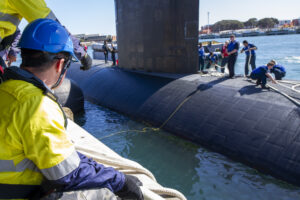
Figure 3 Navy Sailors assigned to the Los Angeles-class fast-attack submarine USS Annapolis (SSN-760) and HMAS Stirling Port Services crewmembers prepare the submarine to moor alongside Diamantina Pier at Fleet Base West in Rockingham, Western Australia, March 10, 2024. US Navy Photo
The distance covered in three years was emphasized by and Defense Minister Richard Marles when he told Parliament on Aug. 12: “When we came to power, AUKUS was really not much more than a thought bubble, but since then we have been turning it into a reality.” Marles says the thought is sailing along an “actual pathway,” steered by the Australian Submarine Agency, established last year. Some thought! Some bubble! Yet even the believers see an extraordinary journey—the Optimal Pathway, an outline plan for project execution, stretches out to 2053, with the first Australian-built AUKUS submarine due in “the early 2040s.” In August, a naval nuclear propulsion treaty was unveiled, providing the legal basis for AUKUS and the creation of an AUKUS trade zone for exchange of defense goods and technology. The treaty went to the Australian Parliament and US Congress in August and the UK Parliament in September. Marles signed the treaty in Washington on Aug. 5, describing it as “a foundational part of the legal underpinning” of building the nuclear-powered submarine.
The trilateral agreement will operate until 2075. The pact allows the transfer of nuclear propulsion plants to Australia, makes Australia responsible for “management, disposition, storage, and disposal of any spent nuclear fuel and radioactive waste” and gives an Australian indemnity to the US and Britain for any “liability, loss, costs, damage or injury” from nuclear risks. The treaty gives Britain and the US the right to terminate AUKUS and demand the return of nuclear material and equipment. The termination clause can be used if Australia seeks to reprocess nuclear material, builds a nuclear weapon, or breaches its obligations to the Non-Proliferation Treaty and the International Atomic Energy Agency. As part of its nonproliferation pledge, Australia is negotiating a treaty with the IAEA to meet its Article 14 comprehensive safeguards obligations.
In September, the three nations adopted an AUKUS zone for free trade of defense equipment and expertise. The exemptions remove licensing requirements for most controlled goods, technologies, and services. The AUKUS zone will have license-free trade for 70% of defense exports from the US to Australia that are subject to arms traffic regulations, and 80% of defense trade under US export regulations. The deal eliminates the need for 900 export permits covering Australian exports to the US and Britain, valued at $5 billion annually. Taking lessons from the AUKUS effort to cut red tape, the US has also set out principles to build an Indo-Pacific defense industry base.
Richard Marles says a license-free seamless defense industrial base for AUKUS will have “a profound impact,” describing it as one of the biggest reforms to defense trade in decades. In dealing with the new US administration from January, Canberra will push AUKUS as the top policy commitment it wants to reinforce with Trump. After Trump’s victory, Foreign Minister Penny Wong said “obviously we look to particularly prioritising AUKUS in our engagement, which is the thing that we have been most focussed on in the lead up to this election.”
Australia’s Strategy
Summing up foreign policy in a speech on Australia in the world, Albanese said Australia is investing in “deterrence and diplomacy,” transforming defense capability with the AUKUS pact, restoring relations in the South Pacific, revitalizing the Quad, taking a “patient, calibrated and deliberate approach” to China, and supporting the “fundamental guardrail” of US-China dialogue. In a stark view of strategic settings, Albanese and the deputy PM, Richard Marles, declared: “Australia faces the most complex and challenging strategic environment since the Second World War.” The Labor leaders offered that judgement on April 17, 2024, when releasing the National Defense Strategy. The strategy said: “While a major conflict is not inevitable, this new reality is making the pursuit of Australia’s interests more challenging.”
The strategy aims to double defense spending in the next 10 years to lift it from 2% to 2.4% of GDP by 2033-34. The increase in annual funding would see the defense budget grow to more than A$100 billion by 2033-34. The policy document described a strategic environment that continues to deteriorate:
“The optimism at the end of the Cold War has been replaced by the uncertainty and tensions of entrenched and increasing strategic competition between the US and China. This competition is being framed by an intense contest of narratives and values. The competition is playing out in military and non-military ways, including economic and diplomatic. It is accompanied by an unprecedented conventional and non-conventional military build-up in our region, taking place without strategic reassurance or transparency. The effects of this build-up are occurring closer to Australia than previously. This build-up is also increasing the risk of military escalation or miscalculation that could lead to a major conflict in the region.”
The Albanese government has scrapped the old “balanced force” model for the Australian Defense Force (ADF). The balanced force demanded lots of capabilities to keep options open. The balanced force could be adjusted to respond to whatever needs, contingencies, or dangers appeared on the horizon. An unbalanced future has arrived, and the balanced force is judged unfit for purpose. The ADF must become “an integrated, focused force” to face what Defense identifies as strategic risks that “have continued to deteriorate.” The new guidance to Defense from government is capitalized as “a Strategy of Denial,” calling for an ADF that can:
- defend Australia and our immediate region;
- deter through denial any adversary’s attempt to project power against Australia through our northern approaches;
- protect Australia’s economic connection to our region and the world;
- contribute with our partners to the collective security of the Indo-Pacific region;
- contribute to the maintenance of the global rules-based order.
A Strategy of Denial is appropriate for a nation that’s been through the stages of grieving for the disintegration of the liberal international order (denial, anger, bargaining, depression and acceptance).
Canberra proclaims it will take a “more focused approach to its international engagement.” The “focused” thinking can mean Australia is less willing to look beyond its region. Thus, in December, 2023, Canberra rejected Washington’s request to send an Australian Navy ship to the Red Sea as part of international efforts to safeguard cargo from attacks by Iranian-backed Houthi rebels. Richard Marles said Australia would not contribute a ship or plane to the Combined Maritime Forces that patrol the shipping route: “We need to be really clear around our strategic focus, and our strategic focus is our region—the northeast Indian Ocean, the South China Sea, the East China Sea, the Pacific.” The disappointed response from a US official was that Australia could not “pretend global problems don’t require global solutions.”
Australian responds to US-China competition as “a primary feature of our security environment,” a struggle over the global balance which will be “sharpest and most consequential in the Indo-Pacific.” The National Defense Strategy describes China’s expanding gray-zone activities and “coercive tactics” in its forceful handling of territorial disputes and unsafe intercepts of vessels and aircraft operating in international waters and airspace. China is improving its capabilities in all areas of warfare at a “pace and scale not seen in the world for nearly a century,” with no transparency about its strategic purpose, prompting this Canberra judgement: “The risk of a crisis or conflict in the Taiwan Strait is increasing, as well as at other flashpoints, including disputes in the South and East China Seas and on the border with India. There is increasing competition for access and influence across the Indian Ocean, including efforts to secure dominance over sea lanes and strategic ports. That said, US-China dialogue, both at the leader-level and military-level, is useful in preventing miscalculation and ensuring differences can be worked through in a way that supports stability.”
China: Seeking Balance as Economic Coercion Cools
“China does not see itself as a status quo power. It seeks a region and a world that is much more accommodating of its ambitions and its interests.”
Prime Minister Albanese, Dec. 20, 2023
“Over the past decade, we have made some progress in China-Australia relations and also witnessed some twists and turns. That trajectory has many inspirations to offer. Now, our relations have realised a turnaround and continues to grow, bringing tangible benefits to our two peoples.”
President Xi Jinping, Nov. 18, 2024.
Australia’s understanding of China’s future strategic pressure is shaped by Beijing’s recent unsuccessful, but costly, economic coercion. China’s trade sanctions on Australia have been wound back. Beijing’s refusal to talk to Australian leaders has ended. A relatively conventional diplomatic rhythm has resumed. Labor came to office in 2022 saying it would “stabilize” dealings with China, and stability has been achieved. China has scrapped its tariffs and unofficial customs bans on coal, barley, beef, wine, timber, lobsters, and cotton. Australia’s Trade Minister, Don Farrell, says nearly A$20 billion worth of “trade impediments on Australian exports to China have been removed.”
While defrosting with Beijing, the Albanese government kept getting warmer with Washington. The symbolic expression of this was in the prime minister’s back-to-back visits to the US and China. First, Albanese went to Washington at the end of October 2023. Then, a week later, he was in Beijing, the first visit by an Australian leader in seven years.
In Washington, Biden and Albanese proclaimed a new era of strategic cooperation to build what Albanese calls “an alliance for the future.”
As Australian journalists and TV crews gathered in the Oval office to record the grip-and-grin between Biden and Albanese, the president offered the Australians some unprompted remarks about the dragon in the room. “I was asked by Xi Jinping a couple of years ago why I was working so hard with your country,” Biden noted. “I said. ‘we’re a Pacific nation.’ He looked at me and I said, ‘Yeah, we’re a Pacific nation, the United States, and we’re going to stay that way’.”
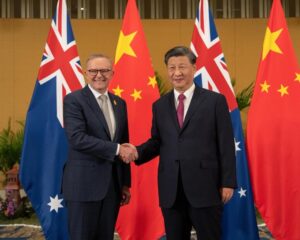
Figure 4 Anthony Albanese meets Xi Jinping in Beijing. Photo: Australian Strategic Policy Institute
China welcomed Albanese in November 2023, seeking to cement the reset in relations, blaming past troubles on Australia’s previous Liberal-National government. The official China Daily described the trip as “ice-breaking” after dialogue halted in 2016 “because of the previous Australian government’s adversarial stance toward China.” Part of the thaw has been an end to China’s ban on Australian journalists. In August, 2024, Will Glasgow, a correspondent for Rupert Murdoch’s paper, The Australian, returned to China, almost exactly four years since Australian correspondents fled the country. Glasgow wrote: “The beginning of the return of Australian media is another manifestation of the improvement in diplomatic relations with China under the Albanese government, which continues despite a host of ongoing disagreements…It is by no means an exclusively Australian problem. The size of the English-language foreign-media presence here is a fraction of what it was when I was based in Beijing for The Australian in the first half of 2020.”
One of the continuing disagreements is China’s suspended death sentence on the Australian citizen, Dr Yang Jun. The sentence was denounced by Foreign Minister Wong in February, saying Australia was “appalled” at the “harrowing news” The “many years of uncertainty” since Yang’s detention on national security charges in 2019 were “extraordinarily difficult,” Wong said, and Australia would protest “in the strongest terms.” In November, Wong attacked the sentencing of Australian citizen Gordon Ng in Hong Kong “for organising and participating in an election primary.” Wong said Australia is gravely concerned at China’s broad application of the national security law and its use against Australian citizens
In Australia, public sentiment toward China remains low. The Lowy Institute survey of Australian attitudes to the world found only 17% of Australians say they trust China “somewhat” or “a great deal” to act responsibly in the world (only Russia ranks lower in Australian opinion). This is steady from 2023 and a minor increase on 2022, when trust in China reached a record low (12%). The low numbers are a contrast with the figure just six years ago, when half (52%) of Australians trusted China. The suspicion of China reflects the icy years of trade coercion, and publicity about Chinese cyber-attacks on Australia.
Australia’s chief spy-catcher, Mike Burgess, acknowledges that all nations spy, but charges that China’s “behavior goes well beyond traditional espionage.” The director-general of security says: “The Chinese government is engaged in the most sustained, scaled and sophisticated theft of intellectual property and expertise in history. It is unprecedented and it is unacceptable. China has developed a ruthless business model to seize commercial advantage. Stealing intellectual property is the first step. Then they use talent programs, joint ventures and acquisitions to harvest the expertise required to exploit the intellectual property. Sometimes the technology is put to military use, often it’s given to favoured companies to mass produce it, under-cutting and undermining the innovator.”
Australia in Comparative Connections: 2009-2024
The first annual account of Australia’s connections with the US and East Asia appeared in this series in 2009. Thus, this year’s report is the 16th in the series I have written. My initial chat with the doyen of Pacific Forum, Ralph Cossa, set the scene for the warmest partnership any journalist could ask for. How long should my annual piece be? “Whatever it needs,” replied Ralph. Subject range, I asked? “Over to you,” responded Ralph. And so it has gone, ever since. Apart from Americanizing my spelling, the words have all be mine. Would that all editors were so generous of spirit, liberal about length, and open on content.
Looking back, that first 2009 effort offered two big themes that have endured. One pole was the continuity and comfort of the alliance fundamentals between Australia and the US. The other pole was the “tectonic effects being exerted by China’s rise. As with the rest of the Asia-Pacific, Australia is adjusting significant aspects of its foreign and security policy to the magnetic pull of China.” Official Australian usage is now “Indo-Pacific” not “Asia-Pacific.” But much else has endured, as one other line from that first effort observed: “For the first time in Australia’s history, its most important market is not also an alliance partner. Instead, it will be its major ally’s strategic competitor, perhaps even challenger.”
The 2011 report observed that Australia had decoupled from the US economy in ways unimaginable in the 20th century. In the first decade of the 21st century Australia did not follow the US into recession in 2001 and 2008. Asia’s business cycle now drives Australia’s economy: “Australia’s alliance commitment with the US no longer mirrors, as it once did, the economic ties to the US.” This annual series traced the 12-nation negotiations for the Trans-Pacific Partnership, launched in 2008, as the talks (and arm wrestling and haggling) crawled toward an ever-shifting finish line. In the arcane world of trade negotiators, the battle between the US and Japan was trench warfare lit by pyrotechnics. As Barack Obama observed, the TPP was an ambitious US effort to write the future trade rules of the Asia-Pacific, reflecting American interests in areas such as intellectual property rights, and labor and environmental standards.
The TPP was signed but then Australia watched in horror as the 2016 US presidential campaign trashed the agreement.” In the Australian interpretation,” I wrote in 2016, “a US that turns away from the TPP would also be turning away from Asia.” In his first week in office in 2017, Trump signed an executive order formally withdrawing the US from the TPP. Yet Washington commentary noted this was mere formality, because the treaty was already dead in Congress. My 2017 comment: “Can you create an enhanced trade structure to buttress the US strategic role in the Asia-Pacific if the US opts out of that trade pact?” A US turning protectionist is going to stress test the link between security and trade.
To end this round up of commentary/judgements, turn to the professionals in the game—the ambassadors (one Australian and two Americans) and an academic.
When an Australian jumps out of a New York taxi and prepares to make a dash across 5th Avenue, the habit of a lifetime is to look the wrong way for the traffic. Australia drives on the left; America drives on the right. It’s a simple metaphor for the many ways of looking and moving of the two nations. Rushing for a late-night drink in the city that never sleeps, Australia’s ambassador to the US, Joe Hockey (2016-2020), stopped his taxi by Central Park and dashed across the avenue, checking in the Australian direction. That “near-fatal error,” Hockey observed in his memoir, was “like so many who think they understand America.”
In 2010, the US and Australia marked the 70th anniversary of their formal diplomatic relationship. US Ambassador to Canberra, Jeffrey Bleich (2009-2013) said the relationship existed long before the 1940 treaty and extended far beyond words on paper: “Before there were diplomats in each other’s capitals, there were world-travelling whalers and miners, sailors of the Great White Fleet and their gracious Australian hosts, yanks and diggers hunkered down in trenches in World War I. We’ve trusted each other… We’ve valued each other’s freedom, self-reliance, open markets and sense of fair play. We’ve taken our work seriously, without taking ourselves too seriously. And when we’ve disagreed, we’ve done it without being disagreeable.”
During the 2013 Australian election, the American intellectual Francis Fukuyama visited and judged that the bitterness of Australian politics has not reached the intensity of the US: “Australia has got the fewest big long-term problems of any developed democracy I know. In policy terms, the fight within Labor, or even between Labor and the Liberals seem minor when compared to the things that [polarize] Americans, such as the legitimacy of taxation, dealing with the deficit, abortion and guns.”
Wrapping up her time in Canberra, the 27th US ambassador to Australia, Caroline Kennedy, used a farewell at the National Press Club in November to sketch what Australia means to her: “I will miss the Australian sense of humor and the fact that everyone has a nickname. I will miss the way Australians are up for anything and pitch in to help each other out. I will miss the amazing creatures here, from the magpies and whale sharks to my two new embassy sheep, Louie and Eli. I can’t wait to come back and visit. There is so much left to see and do. Most of all, I know the best days for our alliance are yet to come.”

Regional Overview
January — April 2024The “Year of Elections,” Take Two!
The “Year of Elections” is upon us and, notwithstanding a ripple or two, there have been no upsets. In Taiwan, the ruling Democratic Progressive Party (DPP) candidate won with roughly 40% of the vote, given the divided opposition. Incoming President William Lai Ching-te is expected to extend olive branches Beijing’s way when inaugurated on May 20 but the odds of Beijing being receptive are depressingly low. In Pakistan, candidates associated with former Prime Minister Imran Khan won the most seats but not enough to form a new government (or get Khan out of jail). In Indonesia, defense minister and retired army Gen. Prabowo Subianto won as expected, the only (minor) surprise being his first-round majority, avoiding a June runoff (and giving him lots of time to prepare for his October inauguration). In Russia, to no one’s surprise, Vladimir Putin emerged victorious, having neutered (if not murdered) any credible opposition. In South Korea, President Yoon Suk Yeol’s People Power Party failed to unseat the opposition in National Assembly elections, causing many to refer to him as a lame duck, despite three years remaining in his term. Prime Minister Narendra Modi is also expected to emerge victorious with India’s elections still underway.
US - Japan
January — April 2024Washington Welcomes Prime Minister Kishida
2024 began with a full agenda for the US and Japan. All eyes were on the January presidential election in Taiwan, and China’s reaction to it. The choice of William Lai Ching-te, who is currently vice president, cemented the hold of the Democratic Progressive Party (DPP) on power, with a third term for the party. Lai has close ties with Japan and has made no bones about his expectation that Japan, as well as the US, will figure prominently in his hopes for Taiwan’s future. The invitation to former Kuomintang (KMT) President Ma Ying-jeou to visit Beijing on April 10 made it clear that Beijing had a different preference than the people of Taiwan. The uptick in Chinese military pressure across the Strait as well as in the South China Sea also concerned the US and Japan. The People’s Liberation Army’s growing demonstration of pressure on Taiwan’s eastern islands continued in the months after Lai’s victory, as Taiwan prepared to inaugurate him as president on May 20. The US and Japan found common cause also in speaking out against China’s growing aggression against Philippine maritime forces at Second Thomas Shoal.
US - China
January — May 2024Ties Stabilize While Negative Undercurrents Deepen
US-China relations were marked by a paradox during the first trimester of 2024. On the one hand, a distinct stabilization was evident in ties. The two sides made concerted efforts to translate their leaders’ ‘San Francisco Vision’ into reality. Cabinet officials exchanged visits across the Pacific, working groups and dialogue mechanisms met in earnest and produced outcomes, functional cooperation was deepened, sensitive issues such as Taiwan were carefully managed, and effort was devoted to improving the relationship’s political optics. On the other hand, the negative tendencies in ties continued to deepen. Both sides introduced additional selective decoupling as well as cybersecurity measures in key information and communications technology and services sectors, with US actions bearing the signs of desinicization—rather than mere decoupling—of relevant supply chains. The chasm in strategic perception remained as wide as before. In sum, the “new normal” in US-China relations continued to take form, one piece at a time.

US - Korea
January — April 2024Right Where We Left It
The first reporting period of 2024 US-Korea relations was busy, both with managing ongoing issues (good and bad) and adapting to genuinely new evolutionary turns in US-Korea affairs. Concerning the former, US-South Korea relations continued on the same trajectory since President Yoon Suk Yeol assumed office in 2022: deepening bilateral alliance interoperability, enriching trilateral cooperation with Japan, increasing economic security policy convergence with the US. And this despite new foreign, defense, finance, and trade ministers in Seoul. Widely viewed as a referendum on Yoon, April National Assembly elections cast a shadow over much of his foreign and security policy during the reporting period. However, the crushing defeat of Yoon’s conservative People Power Party is unlikely to affect his approach to external affairs, where the president retains significant unilateral power. The “management” bucket also contains more threatening scenarios that have been building for months, years, decades. At the top of the list in importance is North Korea’s build-out of its nuclear and missile program, which continued apace in the January-April 2024 period, also providing more evidence of the essential hopelessness of international sanctions.

US-India
January — April 2024Weathering the Crisis
This chapter was made possible through a grant from the Hindu American Foundation.
For the US-India bilateral relationship, the first four months of 2024 was a repeat of the quarters of the last three years. Differences in attitudes toward Cold-War era partnerships surfaced and upset the calm in bilateral relations. Still, there were significant strides in the economic and trade front. The dispute over the killing in Canada of a Khalistan separatist designated a terrorist by India marred the security partnership. Still, Washington continued diplomatically to support India vis-à-vis China’s provocations such as bestowing Chinese names on Indian towns. Visits by top American military brass underscored the growing security cooperation between the two democracies. The nature of electoral democracy, though, created some diplomatic tension. While heated rhetoric and polemical campaign statements in India provided fodder for the Western press to question the supposed “values-based” partnership with India, President Joe Biden’s suggestion that Japan and India were as xenophobic and anti-immigrant as Russia and China angered many in India.
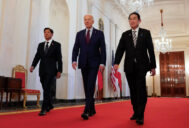
US - Southeast Asia
January — April 2024Small but Telling Shifts
Despite the current calm in broader US-China relations, and likely because of it, Chinese offensive actions around Second Thomas Shoal have kept security in the South China Sea as the organizing principle for Washington’s relations with the maritime Southeast Asian states, most notably the Philippines. In April President Biden hosted the first-ever trilateral summit with Japan, the Philippines, and the United States, on the margins of a major agreement to expand the US-Japan alliance that will reverberate in Southeast Asia. In Myanmar, the United States moved cautiously toward the provision of non-lethal aid to resistance forces as they made headway against the military. This aid will be limited, but it could put Washington in competition with China and Russia, both of which provide arms to the junta. Although Southeast Asian leaders continue to worry about US distraction in the face of wars in other regions and the November elections, Washington continued to act as a fulcrum in major multilateral exercises in the region. In Thailand, Cobra Gold was expanded to include cooperation in space, while the Balikatan exercises in the Philippines expanded to include new participants, most notably the French Navy.