Archives
Category: Uncategorized
China - Russia
January — April 2022Ukraine Conflict Déjà Vu and China’s Principled Neutrality
Perhaps more than any month in history, February 2022 will come to symbolize how the states of peace and war can flip-flop in a few days, with dire consequences for the global order. On Feb. 21, just one day after the closing ceremony of the Beijing Winter Olympics, Russia announced its official recognition of the independence of the two breakaway regions (Donetsk and Luhansk) of Ukraine. Three days later, Russia launched its “special military operation” in Ukraine to end the “total dominance” and “reckless expansion” of the United States on the world stage (in the words of Russian Foreign Minister Sergei Lavrov). As the West imposed sanctions on Russia and rushed arms into Ukraine, China carefully navigated between the warring parties with its independent posture of impartiality.
Japan - Southeast Asia
May 2021 — April 2022Normative Challenges in Southeast Asia and the Indo-Pacific
Despite the lingering effects of COVID-19 and another change in leadership in Tokyo, Japan and Southeast Asian states continued to strengthen their functional cooperation. To counter the negative impact of the pandemic, Japan continued to donate vaccines to ASEAN member states. Economically Japan and ASEAN, together with other regional states entered into the Regional Comprehensive Economic Partnership (RCEP) in January 2022. Militarily, Japan conducted the Indo-Pacific Deployment 2021 (IPD21) from August to November 2021, which has become a regularized defense deployment. Further, Japan had the very first bilateral Foreign and Defense Ministerial Meeting with the Philippines in April 2022. Diplomatically, Japan and ASEAN closely consulted with each other to enhance cooperation for the realization of Japan’s “Free and Open Indo-Pacific” (FOIP) vision and ASEAN’s “ASEAN Outlook on the Indo-Pacific” (AOIP). However, Japan-Southeast Asia relations now face new normative challenges regarding how their approach to liberal values, such as rule of law and democracy/human rights in the Indo-Pacific region because of the prolonged Myanmar political crisis and the 2022 Russo-Ukraine war.
Regional Overview
September — December 2021Multilateralism (Still) Matters, as New Indo-Pacific Strategy Emerges
While the Biden administration has yet to produce its own definitional strategy documents—the National Security Strategy, National Defense Strategy, Nuclear Policy Review, or Indo-Pacific Strategy Report—details are emerging that strongly suggest each will be generally consistent with the previous administration’s reports, but with an even heavier stress on alliances and multilateralism. Secretary of State Antony Blinken provided the most detailed description of the administration’s Indo-Pacific strategy during his swing through Southeast Asia in December, reaffirming the “cooperate, compete, confront” approach toward China that, with varying degrees of emphasis and intensity, has been consistent for at least the last three administrations. Meanwhile Secretary of Defense Lloyd Austin put some meat on the bones of his “integrated deterrence” concept, underscored by the first in-person (despite COVID) summit meeting of the four Quad heads of state from Australia, India, Japan, and the United States and the emergence of AUKUS, a technology-oriented defense arrangement involving Canberra, London, and Washington.
President Biden (virtually) attended the ASEAN-driven East Asia Summit and Asia Pacific Economic Cooperation (APEC) Leaders Meeting while focusing much of his attention on the broader-based Summit for Democracy. While the administration talked in general terms about its Asian economic strategy, the Comprehensive and Progressive Agreement on Trans-Pacific Partnership (CPTPP) and Regional Comprehensive Economic Partnership (RCEP) continued apace, sans Washington, with Beijing knocking on the former’s door and standing to be a prime beneficiary (along with Japan) of the latter. Overshadowing all of this is omicron, the latest and seemingly most contagious and pervasive COVID strain, reminding us all that the pandemic is far from over.
US - Japan
September — December 2021A New Prime Minister and a Growing Alliance Agenda
2021 demonstrated the difficult politics that have attended the COVID-19 pandemic. In the United States, the Congressional certification of the presidential election became the focus of violent protest and an attempted insurrection to stop the transfer of power from Donald Trump to Joseph Biden. In Japan, while less volatile, the post-Abe era revealed the fragile balance of power within the Liberal Democratic Party (LDP) that threatened to unseat unpopular prime ministers. The year began with Prime Minister Suga Yoshihide but ended with Prime Minister Kishida Fumio as Suga’s public approval ratings plummeted in response to the government’s pandemic management and the troublesome Tokyo Olympics. Japan’s two elections, one for the leadership of the LDP and the other for the Lower House, revealed just how sticky conservative politics are today. Undoubtedly, the election within the party drew the most interest as four new candidates emerged to claim the mantle of leadership of Japan’s largest political party.
Kishida emerged victorious after a second round of voting, which privileged those in the Diet over the rank and file of the party, with a far more assertive stance on Japan’s strategic outlook. He then led his party to victory in the general election, overcoming an opposition coalition that continued to struggle to put forward a cohesive identity or policy agenda.
Diplomatically, Washington and Tokyo continued to focus on their Indo-Pacific cooperation. The two militaries have continued consultations on how to cope with China’s growing presence in and around Japan’s southwestern islands. A new prime minister offered opportunity to further define the scope of US-Japan cooperation, and a new Biden-Kishida agenda is in the works. COVID-19 again intervened to prevent in-person meetings, but a virtual US-Japan 2+2 meeting allowed for continued alliance problem-solving.
US - China
September — December 2021US and Chinese Leaders Jaw-Jaw
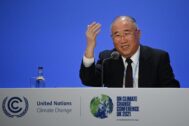
Joe Biden and Xi Jinping held a lengthy virtual meeting to discuss the bilateral relationship and agree on the importance of managing their competition responsibly. Demonstrating that the US and China can cooperate, the two countries signed a bilateral agreement on a common climate change agenda at COP26. USTR Katherine Tai rolled out the administration’s China trade policy. The US announced that it will not send an official delegation to the February 2022 Beijing Olympics. A few meetings were held between the US and Chinese militaries to discuss policy and operational matters. The US and its allies strongly condemned Hong Kong’s legislative elections held under new rules imposed by China that allow only “patriots” to run for office. Taiwan remained the most serious source of US-China tensions with strong warnings by both sides against challenging the interests of the other. After almost three years, Huawei Chief Financial Officer Meng Wanzhou was allowed to return to Canada in a deal struck between Meng’s lawyers and the US Department of Justice. Beijing released two Canadians who had been detained as retaliation for Meng’s arrest, and put them on a plane for Canada.
US - Korea
September — December 2021Peninsular Inertia
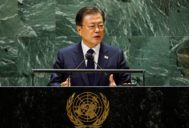
The final four months of 2021 US-Korea relations played out largely as anticipated: the US deprioritized creative outreach to North Korea and generally subordinated the Korean Peninsula (both South and North) to the US-China rivalry. North Korea was considered likely to continue its self-imposed isolation while advancing its nuclear and missile arsenal. And it was expected that South Korea would doggedly pursue inter-Korean diplomacy while building up its military capabilities, optimizing a calibrated approach to the US and China, and bracing for a period of political opacity leading up to the March 2022 presidential election. Standard set-pieces were also evident during the September-December reporting period: US and South Korean officials did the yeoman’s work of alliance management via frequent meetings and periodic performative statements of alliance cohesion. North Korea celebrated National Foundation Day and the anniversary of the Worker’s Party of Korea, and held an end-of-year party plenum. South Korean President Moon Jae-in used his UN General Assembly speech to encourage international support for inter-Korean reconciliation.
The third trimester of 2021 did have some surprises, however. The Moon administration’s full-court press for a declaration of the end of Korean War was out of step with US and North Korean priorities. Announcement of the AUKUS (Australia-UK-US) strategic pact caught all off-guard, including Seoul, which has jealously eyed Washington’s decision to work with Canberra on a nuclear-propelled attack submarine. US insistence on ensuring that South Korea’s technology industry comports with US geostrategic aims vis-à-vis China was more strongly visible—and friction-inducing—than expected. And Squid Game rocketed from obscurity to global sensation, proving that BTS does not have a monopoly on South Korea’s cultural exports.

US - Southeast Asia
September — December 2021Myanmar Spirals Downward While ASEAN Drifts
ASEAN unity wobbled in the final months of 2021, largely over the worsening conflict in Myanmar and the group’s inability to advance the five-point consensus plan it had forged in April. Vaccination rates for COVID-19 picked up, but governments that had hoped to return to pre-pandemic economic growth rates worried that the omicron variant would undo progress that had been made. Political challenges were no less daunting in several countries. The nomination process for May 2022 presidential elections in the Philippines showed that political dynasties are strengthening and may even merge. In Malaysia, the success of the United Malay Organization (UMNO) in state elections raised the prospect that the party will recover some of its former strength, although not its political monopoly. Anti-government demonstrations in Thailand became more perilous for protestors in November when the Constitutional Court ruled that advocating reform of the monarchy, one of the central planks of the protest movement, was tantamount to treason.
The region was also pressed to respond to great power dynamics, most notably to the announcement in September of the Australia/United Kingdom/United States (AUKUS) alliance and to China’s bid to elevate its relations with ASEAN to a comprehensive strategic partnership. At the Quadrilateral Security Dialogue Summit. the four nations opened a window to address nontraditional security threats, which could pull the ASEAN countries closer to the Quad. The Biden administration stepped up diplomacy with ASEAN with a virtual US-ASEAN Summit on the margins of the East Asia Summit in October and Secretary of State Antony Blinken’s first trip to Southeast Asia in his capacity as secretary. Although Southeast Asian leaders welcomed the attention, they are increasingly impatient for Washington to define its economic plans with the region.
China - Southeast Asia
September — December 2021China’s Growing Influence Overshadows US Initiatives
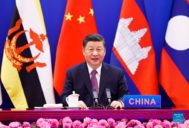
Beijing’s extraordinary high-level attention to Southeast Asia since last year continued in the current reporting period. It culminated in President Xi Jinping presiding over a special summit he convened to commemorate the 30th anniversary of ASEAN-China dialogue on Nov. 22, which featured an array of Chinese advances. Keenly attentive to US efforts to reverse its recent decline and compete more effectively with China in Southeast Asia, Beijing has relied on ever-expanding Chinese influence in Southeast Asia to eclipse and offset US initiatives. Beijing faced a setback when Philippines President Rodrigo Duterte sharply rebuked Chinese coercion in the disputed South China Sea during the November summit. Similarly, China’s role in the political turmoil in Myanmar got noticeable pushback from ASEAN leaders as the humanitarian situation in Myanmar remains unstable.

China - Taiwan
September — December 2021Taiwan Gains Ground Internationally, but Will China Retaliate?
At the end of 2021, Taiwan and President Tsai Ing-wen stand in as strong a position as they have enjoyed in years. Taiwan has parlayed its opening of a representative office in Lithuania and Beijing’s sanctions against Lithuania into public support from other European nations. For the first time Taiwan was invited to a US multilateral event, President Biden’s Democracy Summit. On Dec. 18 Tsai unexpectedly defeated four opposition Kuomintang (KMT)-sponsored referendums that would have reversed a series of her executive actions as president, one of which would have obstructed her efforts to move forward on a bilateral trade agreement with the US. These victories effectively gave the Tsai administration a mid-term vote of confidence and embarrassed newly elected KMT Chairman Eric Chu Lilun. Chinese President Xi Jinping used the anniversary of the 1911 Xinhai revolution to underscore that reunification of Taiwan with the mainland would be the measure of the Communist Party’s success in rejuvenating China. Repeated Chinese air sorties into Taiwan’s Air Defense Identification Zone (ADIZ) made clear China’s willingness to employ coercive tactics short of war to advance its aims. The combination of Taiwan’s successes and China’s determination to subjugate Taiwan may presage a contentious cross-Strait 2022.
North Korea - South Korea
September — December 2021Waning Moon, Supersonic Kim
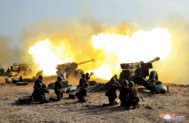
Korea’s leaders offered contrasting New Year addresses. While Moon Jae-in pledged to keep pursuing peace until he leaves the Blue House in May, Kim Jong Un said nothing about South Korea or the US. He sent his message soon after, however testing two hypersonic missiles. Moon kept pushing for a peace declaration, despite Washington being lukewarm and Kim Jong Un’s sister Yo Jong saying explicitly that the time is not ripe. Evaluating Moon’s nordpolitik more widely as his term winds down, his refusal to rethink policy after three years of Kim shunning him is puzzling. His successor, whoever it be, will pay Kim less heed. Voters will decide on March 9; the frontrunner is the liberal continuity candidate, Lee Jae-myung. Cocking a snook at both governments, a young gymnast who in late 2020 scaled and jumped border fences to escape from North Korea changed his mind and went back—the same way.