Archives
Category: Uncategorized

China - Southeast Asia
January — April 2018Xi Jinping Stresses Cooperation and Power – Enduring Contradiction?
Supported by Chinese officials and authoritative commentary, President Xi Jinping continued a moderate and cooperative posture toward Southeast Asia in early 2018, reaching a highpoint in Xi’s keynote address on April 10 at the annual Boao Forum for Asia in Hainan Province. Then, the posture switched dramatically to the surprise of many at home and abroad. On April 12, Xi appeared in military uniform addressing troops in the South China Sea participating in the largest naval review in China’s history. Perhaps signaling the United States, Vietnam, Japan, Taiwan, and others challenging Chinese activities in the South China Sea, the switch starkly showed the kind of power Beijing is prepared to use in pursuit of its national objectives. Most other Chinese actions toward Southeast Asia and involving the South China Sea in first four months of 2018 emphasized the positive, with China making major advances in relations, especially with the Philippines.
China - Taiwan
January — April 2018Taiwan Caught Between US and China
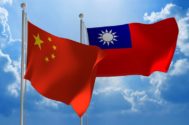
General Secretary Xi Jinping maneuvered the Chinese Communist Party (CCP) into removing term limits so that he can lead China indefinitely. Beijing has increased pressure on Taiwan, but also rolled out new measures aimed at increasing Taiwan’s economic and social integration with the mainland. On Taiwan, pro-independence elements continue pressing President Tsai Ing-wen. The passage of the Taiwan Travel Act (TTA), which was generally welcomed in Taipei, created a new US-China controversy. The appointment of John Bolton as national security advisor and the Trump administration’s tariff and technology actions against China have renewed fears in Taipei that Taiwan will become a bargaining chip or suffer collateral damage in a US-China confrontation.
North Korea - South Korea
January — April 2018Inter-Korean Summit: Third Time Lucky?
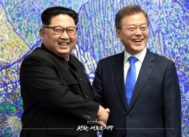
It is a new year and there is new hope for inter-Korean relations. Beginning with Kim Jong Un’s olive branch to Seoul in his annual New Year Address, followed by the carefully coordinated display of North-South cooperation at the PyeongChang Winter Olympics, and capped off with the sometimes unctuous display of bonhomie at the inter-Korean summit in Panmunjom, the shift has been stunning. Now comes the hard part: implementation. The product of the summit, the Panmunjom Declaration, lays out clear milestones to mark progress for improving inter-Korean relations. We expect the North this time to deliver with the South, as a ploy to help it postpone or spin out denuclearization. How these two diplomatic tracks – local and multifaceted on the peninsula, but single-mindedly nuclear on the global stage and especially in Washington – will play out and interact is the key issue.
Japan - China
January — April 2018Warmer Words, Continuing Defense Preparations
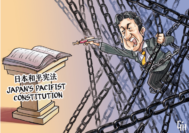
Chinese President Xi Jinping successfully presided over the Boao Forum indicating progress toward establishing China as the fulcrum of the international trading system. Meanwhile, Japanese Prime Minister Abe Shinzō’s political future was clouded by the Moritomo Gakuen scandal. Formal high-level dialogue between Beijing and Tokyo, interrupted since September 2010 was cautiously reinstated in April. In the same month, lower-level military exchanges resumed after a six-year hiatus. Despite talk of resetting relations, there was no resolution of key issues such as the disposition of disputed islands in the East China Sea or of present-day Japanese responsibility for the country’s conduct during World War II. As for trade, although both China and Japan are committed in theory to early conclusion of the Regional Economic Cooperation Partnership agreement, Japan favors a deal closer to the Trans-Pacific Partnership while China wants additional concessions to support its economic reform goals. Nonetheless, China hopes to obtain Japanese participation in its Belt and Road Initiative.
China - Korea
January — April 2018Moon’s Olympic Diplomacy
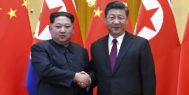
The early months of 2018 may well be remembered as Kim Jong Un’s coming-out party. Beginning with his New Year speech calling for better inter-Korean relations, he suddenly became the topic of global attention and the “must have” partner for summits with both friend and foe. After seven years without any direct contact, Kim managed to meet both President Xi Jinping and President Moon Jae-in, and get a commitment for a meeting with US President Donald Trump within the span of two months. With the PyeongChang Winter Olympic Games and the flurry of diplomatic activity surrounding the Kim-centered summits serving as the primary catalysts, the prospect for a “breakthrough on the peninsula” became the central focus for China-Korea relations.
Japan - Korea
January — April 2018The North Korea Factor
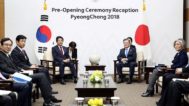
In the first four months of 2018, Japan’s relationship with South Korea was influenced more than ever by North Korea as a thaw in inter-Korean relations created a new dynamic for Japan-Korea relations. The shift began with Kim Jong Un’s expressed hope for improvement in Seoul-Pyongyang relations and inter-Korean talks in his 2018 New Year’s speech. The PyeongChang Winter Olympics created significant momentum and the inter-Korean summit in late April put an exclamation mark on the dramatic turnabout. While Moon Jae-in’s administration welcomed the initiative from the North with guarded optimism and facilitated the improvement in relations as the gracious host for both the Olympics and the summit, the Abe administration kept a skeptical and indeed critical stance toward North Korea’s “charm offensive.” However, Japan was forced to move away from its hardline policy in the face of inter-Korean bonhomie and when the US recognized the shift as an opportunity to move toward diplomacy with North Korea.
China - Russia
January — April 2018Absorbing Shock and Awe: Trump Style
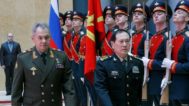
A year into Donald Trump’s presidency, both China and Russia have found themselves in a more difficult relationship with the United States. For the first time in history, the two large powers were characterized as “revisionists,” “strategic competitors,” and “rivals” in a series of US strategy documents: the 2017 National Security Strategy (NSS), 2018 National Defense Strategy (NDS) and 2018 Nuclear Posture Review (NPR). In practical terms, the US threatened Beijing with a trade-war and tried to play the Taiwan card, while punishing Russia with Syria bombings and diplomat expulsions. Meanwhile, Russian President Putin secured his next six years, his fourth term in office, with 77 percent of the vote while President Xi Jinping succeeded in ending a two-term limit on the PRC presidency. At the onset of 2018, the three largest powers in the world were in the hands of strongmen and the world was in uncharted waters as the US appeared ready to simultaneously take on China and Russia as its main rivals for the first time since the early 1970s.
Japan - Southeast Asia
May 2017 — April 2018Redirecting Strategic Focus in the Age of the Indo-Pacific
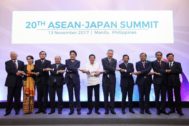
Japan and Southeast Asia faced a new regional dynamic in 2017 following the inauguration of President Donald Trump in the United States and Philippine President Rodrigo Duterte’s accommodative foreign policy toward China. US withdrawal from the Trans-Pacific Partnership and the Philippines’ unwillingness to discuss the 2016 South China Sea arbitration award forced Japan and some Southeast Asian states to redirect their strategic focus. Most Southeast Asian states increasingly welcome Japan’s regional initiatives in trade, security, and development to fill the vacuum created by these policy shifts. Japan has actively emphasized the “Free and Open Indo-Pacific Strategy,” the geographic scope of which goes well beyond East Asia and covers the entire Pacific Ocean to East Africa. This new strategic focus has revitalized Japan’s cooperation with Southeast Asia. Nevertheless, there are serious challenges that Japan needs to overcome, particularly in clarifying ASEAN’s roles in the strategy.

Regional Overview
September — December 2017The Best/Worst Trip Ever!
President Donald Trump’s inaugural visit to Asia in November was either “the best presidential trip, anywhere, ever” or “an absolute disaster and embarrassment,” depending on whose comments you read. The truth lies somewhere in-between. Objectively speaking, the trip turned out to be much better than many predicted or feared. The president reaffirmed the US commitment to its two key East Asia allies, Japan and South Korea, rallied international support at every stop for his “maximum pressure” campaign against North Korea, stayed on message in China, and reaffirmed support for friends and allies in Southeast Asia. For better or for worse, Trump clearly and unambiguously signaled his administration’s preference for “fair and reciprocal” bilateral trade agreements while dismissing the multilateral approach favored by most of his predecessors, thus opening the door for new trade champions – enter Chinese President Xi Jinping and Japanese Prime Minister Abe Shinzo, who will be vying for leadership. The administration’s National Security Strategy (NSS) report reinforced the “free and open Indo-Pacific” themes heard during Trump’s trip. The president’s unprecedented personal rollout of the report also underscored the mixed messages coming from Washington when official policy statements and Trump’s personal preferences and viewpoints fail to coincide.
US - Japan
September — December 2017Trump Visits Tokyo Amid North Korea Tensions
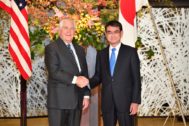
In the fall of 2017, the growing threat from North Korea garnered a lot of attention in the US and Japan. In Japan, Prime Minister Abe Shinzō used that threat to win yet one more election. North Korea also dominated discussions during President Donald Trump’s visit in November, although a reckoning on trade hovered in the background. Japan also worried about other stops on Trump’s extended Asian itinerary, especially his stay in Beijing. The Trump administration’s focus on its America First agenda was a significant factor in shaping Japan’s foreign policy. Abe seemed up to the challenge as Japan actively pursued its interests globally to ensure support for North Korea sanctions and to build trade agreements that will further Japan’s economic and trade interests. The US-Japan alliance remains in good shape, although there are difficulties to manage.