Archives
Category: Uncategorized
China - Southeast Asia
May — August 2021Pushing Regional Advantages Amid Heightened US Rivalry
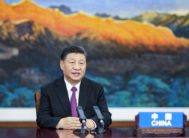
China’s recognition of the strategic challenge posed by close Biden administration relations with the Quadrilateral Security Dialogue (Quad) powers Australia, India, and Japan reinforced Beijing’s strong efforts to preserve and expand its advantageous position in Southeast Asia in the face of rising competition with the United States. Beijing used uniformly critical coverage of US withdrawal from Afghanistan to highlight US unreliability, and attempted to discredit Vice President Kamala Harris’ Aug. 22-26 visit to the region, the highpoint of Biden government engagement with Southeast Asia. It also widely publicized evidence of China’s influence in the competition with the United States in Southeast Asia, even among governments long wary of China, like Vietnam. That effort underlined the lengths Vietnam would go to avoid offending China in reporting that Hanoi allowed the Chinese ambassador to publicly meet the Vietnamese prime minister and donate vaccines, upstaging Vice President Harris, who hours later began her visit and offered vaccines.

China - Taiwan
May — August 2021Cross-Strait Tension Increasing Beneath a Surface Calm
Cross-Strait tensions intensified between May and August 2021, despite the superficial calm that generally prevailed after the dramatic confrontations earlier in the year. China again blocked Taiwan’s participation at the World Health Assembly (WHA), and Xi Jinping reaffirmed the Communist Party’s commitment to the peaceful reunification of Taiwan at the Party’s 100th anniversary. Chinese military flights into Taiwan’s Air Defense Identification Zone were almost routine until China launched 28 sorties in a single day to protest the G7 summit’s endorsement of Taiwan’s participation in the WHA. The Biden administration announced its first arms sales to Taiwan. Several countries, most notably Japan and Australia, made their strongest statements ever in support of Taiwan. Lithuania announced it would permit the opening of an unofficial “Taiwanese” representative office. Beijing withdrew its ambassador from Lithuania and told Lithuania to withdraw its ambassador from Beijing. The US dismissed fears that its withdrawal from Afghanistan might portend abandonment of Taiwan. In coming months, Taiwan faces three potential turning points: Taiwan’s opposition Nationalist Party will elect a new chair; a referendum could overturn the opening of Taiwan’s market to US pork; and the US has signaled it will invite Taiwan to President Biden’s democracy summit despite threats of military retaliation by China.
North Korea - South Korea
May — August 2021Summer False Dawn: On/Off Communications
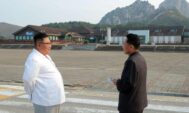
Summer 2021 saw a false dawn on the Korean Peninsula, hardly the first, but surely one of the shortest. On July 27 both North and South announced the reconnection of inter-Korean hotlines, severed for over a year. In Seoul, hopes were high—aren’t they always?—that this signaled a fresh willingness by Pyongyang to engage, not only with South Korea but also the US. Yet this “breakthrough” lasted barely a fortnight. When the US and ROK began their regular August military exercises—albeit scaled back and wholly computer-based—North Korea snarled and stopped answering the phone. Inter-Korean relations remain frozen, as they have been ever since early 2019. With Moon Jae-in’s presidency due to end next May, any real melting of the ice looks increasingly like a challenge for his successor.
China - Korea
May — August 2021Alliance Restoration and Summit Commemorations
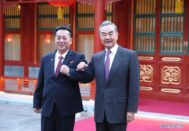
South Korea President Moon Jae-in’s meeting with Joe Biden and his participation in the G7 summit during May and June focused attention on Seoul’s strategy of balancing relations with China and the United States. While Beijing disapproved of the US-ROK joint statement released after the May summit, Chinese state media praised the Moon administration’s relative restraint in joining US-led coalition-building against China. Official remarks on core political and security issues, however, raised mutual accusations of interference in internal affairs. US-China competition and South Korean domestic political debates amplify Seoul’s dilemma regarding its strategic alignment ahead of the country’s 2022 presidential elections.
The China-North Korea relationship turned to commemorative diplomacy regarding summit meetings between Kim Jong Un and Xi Jinping in 2018 and 2019 in the absence of new meetings in 2021. Kim offered hearty congratulations to Xi on the occasion of the 100th anniversary of the founding of the Chinese Communist Party and both sides affirmed the value and historic contributions of the Sino-DPRK Treaty of Friendship, Cooperation, and Mutual Assistance on the occasion of the 60th anniversary of the signing of the treaty in 1961. Political messages underscoring China-North Korean strategic alignment included a North Korean statement affirming shared strategic priorities regarding both the US military withdrawal from Afghanistan and Chinese statements criticizing the continuation of annual US-South Korean military exercises in the context of rising China-US strategic rivalry.

Japan - China
May — August 2021A Chilly Summer
China and Japan continued to vie over a wide variety of issues including economic competitiveness, jurisdiction over territorial waters, World War II responsibilities, representation in international organizations, and even Olympic and Paralympic medals. The Japanese government expressed concern with the increasingly obvious presence of Chinese ships and planes in and around areas under its jurisdiction, with Chinese sources accusing Japan of a Cold War mentality. Nothing was heard of Xi Jinping’s long-planned and often postponed official visit to Tokyo. Also, Chinese admonitions that Japan recognize that its best interests lay not with a declining United States but in joining forces with a rising China were conspicuous by their absence.
Japan - Korea
May — August 2021Unrealized Olympic Diplomacy
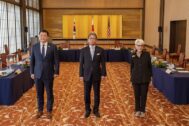
In the summer months of 2021, the big question for many observers was whether Prime Minister Suga Yoshihide and President Moon Jae-in would hold their first summit meeting during the Tokyo Olympic Games. Cautious hope was in the air, especially on the South Korean side. However, by the time the Olympics opened in late July, any such hope was dashed amid a series of unhelpful spats. Seoul and Tokyo decided that they would not gain much—at least not what they wanted from the other—by holding a summit this summer. With Suga’s announcement of his resignation as head of the Liberal Democratic Party (LDP) at the end of September, barring any sudden turn of events, his tenure as Japanese prime minister will be recorded as one that did not have a summit with a South Korean president.
China - Russia
May — August 2021Afghan Endgame and Guns of August
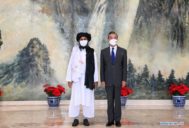
The summer of 2021 may be the best and worst time for Russia-China relations. There was much to celebrate as the two powers moved into the third decade of stable and friendly relations, symbolized by the 20th anniversary of both the Shanghai Cooperation Organization (SCO) and the “friendship treaty” (The Treaty of Good-Neighborliness and Friendly Cooperation Between the People’s Republic of China and the Russian Federation). This historical moment, however, paralleled a hasty and chaotic end to the 20-year US interlude in Afghanistan with at least two unpleasant consequences for Beijing and Moscow: a war-torn Afghanistan in their backyard with an uncertain future and worse, a United States now ready to exclusively focus on the two large Eurasian powers 30 years after the end of the Cold War. As the Afghan endgame rapidly unfolded in August, both sides were conducting large exercises across and around Eurasia. While Afghanistan may not again serve as the “graveyard of empires” in the 21st century, the end of the US engagement there will usher in an era of competition, if not clashes, between rival empires.
Australia-US/East Asia
September 2020 — August 2021COVID and China Chill, Alliance Anniversary and Afghanistan
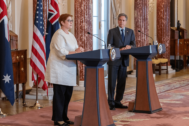
Australia closed its borders to confront COVID-19 and rode out recession, while China shut off key markets to punish Australia. The short recession caused by pandemic ended Australia’s record run of nearly three decades of continuous economic growth; Beijing’s coercion crunched the optimism of three decades of economic enmeshment. However, Australia’s economy rebounded while the China crunch continues, causing Australia to question its status as the most China-dependent economy in the developed world. The Canberra-Beijing iciness has built over five years, marking the lowest period since the establishment of diplomatic relations in 1972. In 2021, the language of “strategic partnership” died and the “strategic economic dialogue” was suspended by China. The Biden administration promised not to abandon Australia, saying that US-China relations would not improve while an ally faced coercion. Australia embraced Washington’s assurance, along with the elevation of the Quad with the US, Japan, and India.
Regional Overview
January — April 2021Change in Style, Continuity in Asia Policy
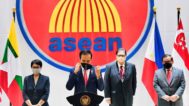
Quadrennially, we write to assure readers that there will be more continuity than change as a new foreign policy team takes office. Globally, this would not be the case this year. In its first few months, the Biden administration made 180-degree turns on issues such as climate change, World Health Organization membership, the role of science in the battle against COVID-19, immigration, and the Iran nuclear agreement. In our region, however, there has been more continuity. The Trump administration’s Indo-Pacific strategy focused on the Quad—the informal but increasingly structured grouping of Australia, India, Japan, and the US—and the Biden administration has doubled down on this effort, conducting the first (virtual) Quad summit. It has largely continued the “cooperate when we can but confront when we must” approach toward China. And while Trump appeared to have disdain for US alliances, every national security document from his administration underscored the central role US alliances played in its Asia strategy.
US - Japan
January — April 2021Suga and Biden Off to a Good Start
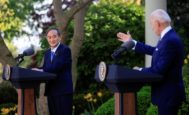
The early months of 2021 offered a full diplomatic agenda for US-Japan relations as a new US administration took office. Joe Biden was sworn in as the 46th president of the United States amid considerable contention. Former President Donald Trump refused to concede defeat, and on Jan. 6, a crowd of his supporters stormed the US Capitol where Congressional representatives were certifying the results of the presidential election. The breach of the US Capitol shocked the nation and the world. Yet after his inauguration on Jan. 20, Biden and his foreign policy team soon got to work on implementing policies that emphasized on US allies and sought to restore US engagement in multilateral coalitions around the globe. The day after the inauguration, National Security Advisor Jake Sullivan reached out to his counterpart in Japan, National Security Secretariat Secretary General Kitamura Shigeru, to assure him of the importance the new administration placed on its allies. The COVID-19 pandemic continued to focus the attention of leaders in the United States and Japan, however.