Archives
Category: Uncategorized
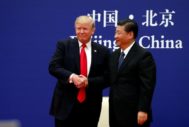
US - China
September — December 2017State Visit-Plus Summit Buys Time, But Friction Mounts
Donald Trump was hosted in Beijing for a “state visit-plus” summit in early November, the third stop on his almost two week-long Asia tour. In response to North Korea’s September nuclear test and December ICBM test, the US and China worked together at the United Nations to tighten sanctions. Cracks in their cooperation widened, however, as Trump pressed Beijing to cut crude oil supplies to North Korea and Xi called for negotiations. US investigations into alleged Chinese unfair trading practices continued and remarks by Trump administration officials suggest that there is a growing possibility of the US imposing harsh trade penalties on China in 2018. Major bilateral dialogues convened in the last four months of the year included the social and people-to-people dialogue, the cyber security and law enforcement dialogue, the inaugural US-China Consultation on Foreign Nongovernmental Organization Management, and the first talks between the joint staff departments of the US and Chinese militaries. The Trump administration issued its first National Security Strategy, which depicted China as a rival and a revisionist power that, along with Russia, is seeking to erode US security and prosperity.
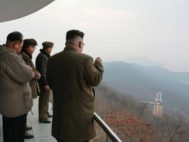
US - Korea
September — December 2017Tensions, Tests, and Drift
North Korea’s sixth nuclear test on Sept. 3 and its Nov. 29 ICBM test launch were unfortunate bookends to increased tension between North Korea and the US in the closing months of 2017. The missile test, which Kim Jong Un hailed as “completing the state nuclear force,” potentially placed the entire US within range, leading Chairman of the Joint Chiefs of Staff Gen. Joseph Dunford to warn of the likelihood of conflict. Two new UN Security Council resolutions tightened economic sanctions against North Korea. There seemed little prospect for a resumption of negotiations, despite senior US officials urging diplomacy and a visit to Pyongyang by UN Under Secretary General for Policy Jeffrey Feltman. President Trump’s September UN address and subsequent tweets challenged the DPRK leader personally and directly, renewing a war of words. Trump’s November visit to the ROK struck a more restrained tone and saw a positive ROK response. The US conducted several military exercises with its allies. Meanwhile, Seoul-Washington fissures grew over Trump’s criticism of the KORUS free trade agreement and President Moon’s eagerness to engage the DPRK – a drift that may grow after Kim Jong Un’s New Year’s call for talks and possible DPRK participation in the Pyeongchang Winter Olympics.
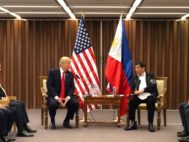
US - Southeast Asia
September — December 2017Abandoning Leadership
Concerned about what Southeast Asian leaders see as US neo-isolationism under President Donald Trump, the heads of government from Vietnam, Malaysia, Thailand, and Singapore all visited Washington in the last four months of 2017. Trump’s trip to Asia in November led to additional talks with Vietnam’s leaders and Philippine President Rodrigo Duterte. These activities could be termed “shopping diplomacy” in that each leader has sought to curry favor with the United States and all announced plans to purchase more US goods and invest in US companies to help Washington reduce its balance of payments deficit. They also emphasized that their economic infusions in the US would generate thousands of new US jobs. Politically, their combined message was that the US should not leave Southeast Asia to China’s tender mercies but that Washington should remain a major actor in the region’s security, economic activities, and political organizations.
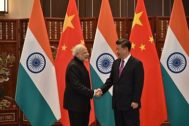
China - Southeast Asia
September — December 2017Xi Jinping, Li Keqiang Ease Regional Tensions, Consolidate Gains
President Xi Jinping’s marathon report at the 19th Chinese Communist Party Congress in October emphasized an ever more powerful and rejuvenated China strongly advancing territorial and other interests in regional and global affairs. China’s success in constructing artificial islands in the South China Sea was cited as one of Xi’s many notable accomplishments. Xi and Premier Li Keqiang adopted a more moderate and accommodating tone in November in their first foreign visits after the Congress. Xi made official visits to Vietnam and Laos concurrent with his participation at the APEC Economic Leaders Meeting in Vietnam. Li made an official visit to the Philippines in conjunction with his participation in the East Asia Summit (EAS), the ASEAN+ 3 Summit, the China-ASEAN Summit, and a meeting of the leaders of 16 nations involved in the Regional Comprehensive Economic Partnership (RCEP). Some commentators depicted the moderation as part of a broader trend in China’s foreign affairs; however, Beijing has traditionally adopted a softer approach during the annual Asia-Pacific leaders meetings, presumably to avoid unwanted controversy.
China - Taiwan
September — December 2017Continuity After 19th Party Congress
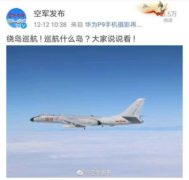
Defying some predictions, the outcome of the 19th National Congress of the Chinese Communist Party indicates there will be no significant change in Beijing’s policy toward Taiwan. Beijing will continue to demand that President Tsai Ing-wen accept the 1992 consensus and pressure on her administration will be sustained. In Taiwan, Tsai has supported domestic actions that Beijing fears are weakening cross-strait ties and her pro-independence supporters continue to press for steps that risk increasing tensions. Tsai has also urged Beijing to join in finding a new model for their relations. Beijing’s pressure on Taiwan is stimulating calls in Washington for policies that are more supportive of Taiwan. These developments in Taiwan and Washington have in turn triggered warnings from Beijing.

North Korea - South Korea
September — December 2017A Sporting Chance For Detente
The last four months in inter-Korean relations were a game of two halves, except the “halves” were vastly unequal in length. Despite hopes that the election of a left-leaning president in South Korea would be welcomed in Pyongyang, inter-Korean relations sustained their downward spiral until late December as North Korea continued to cold-shoulder South Korea. In the space of just a few days, Kim Jong Un’s New Year’s speech and his Olympic olive branch transformed at least the immediate atmosphere on the peninsula. Following a swift positive response from Seoul, the first high-level inter-Korean talks since Dec. 2015 agreed that North Korea will send a large contingent to the Winter Olympic Games. Working-level meetings and military talks are expected imminently to fine-tune the details.
China - Korea
September — December 2017Business As Usual
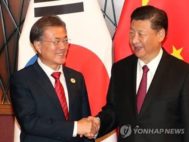
North Korea showcased its sprint toward the capability to launch a nuclear strike on the US with a sixth nuclear test and more missile launches. Beijing supported sanctions adopted under UN Security Council Resolution 2375 and Resolution 2397, but continued to rejected calls for further pressure on the North. China continues to call for the North’s suspension of nuclear and missile activities in exchange for the suspension of US-ROK military drills, along with dual-track denuclearization and peace talks. Seoul and Beijing’s Oct. 31 agreement to “normalize” ties was a step toward returning the relationship to normalcy following a year-long dispute over THAAD, and paved the way to two summits between Presidents Xi and Moon. While defense ministers’ talks resumed on Oct. 24, these efforts at reconciliation relied on setting aside core security differences to avoid the economic costs of conflict. But these differences persist despite Beijing and Seoul’s shared desire to promote dialogue with Pyongyang and find ways to address rising peninsular tensions and the prospect of US-DPRK military conflict.
Japan - China
September — December 2017Managing a Fragile Relationship
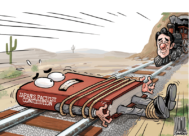
As China’s President Xi Jinping entertained national leaders in Beijing, Japan’s Prime Minister Abe Shinzō made appearances at the opening of the United Nations General Assembly and the New York Stock Exchange, and authored an op-ed in The New York Times. Abe’s common theme was denunciation of North Korea’s provocative behavior, adding that China must play a greater role in curbing its activities. Abe also indicated Japan would consider supporting companies that participated in the Belt and Road Initiative and partner with China in underwriting aid to African countries, while hinting strongly that he would like an invitation for a state visit. China is holding fast to its conditions for a formal meeting: Japan must agree there is a dispute over Diaoyu/Senkaku Islands ownership and show that it has come to terms with its misconduct during World War II. At yearend, Beijing’s Global Times asserted that bilateral ties had broken out of their slump while Japanese papers reported a senior LDP official as stating the two sides had pushed their relations to a new state, enabling them to discuss the future.
Japan - Korea
September — December 2017Continuation of Dual Track Approach
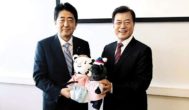
In the final four months of 2017, South Korea-Japan relations continued on the same trajectories as they had over the summer – both countries adopted a dual-track approach to bilateral relations. While controversy over the comfort women issue and Dokdo/Takeshima continued with numbing predictability, Seoul and Tokyo moved forward in developing what they called a “future-oriented relationship” centered on economics and North Korea. While officials on both sides regularly expressed hopes for reviving high-level shuttle diplomacy, the most significant element of the past few months has been how directly Washington was influenced by, but also influenced, Seoul-Tokyo relations. Although it has been an important element in Korea-Japan relations since the end of the Pacific War, recent events have demonstrated the importance of the triangular relationship.
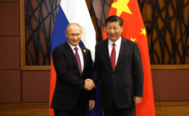
China - Russia
September — December 2017Between the Past and the Future
In the final months of 2017, the China-Russia strategic partnership continued to deepen and broaden. President Xi Jinping and President Vladimir Putin met at the September BRICS summit in Xiamen and at the annual APEC forum in Vietnam in late November. In between, the prime ministers exchanged visits. The potential to strengthen economic relations ran against a deteriorating situation on the Korean Peninsula. Security ties and coordination between the two militaries gained considerable traction as the two countries prepared for the worst. In the midst of unfolding danger, both Xi and Putin were readying themselves to lead their respective countries for the next five to six years. It remains to be seen how Xi and Putin will shape their countries in challenging times.