Archives
Category: Uncategorized
India - East Asia
September — December 2017Welcomed by Washington, Contested by China, Engaged with East Asia
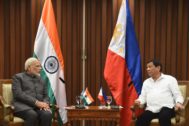
Progress was not dramatic, but the combination of a US-India relationship strengthened and networked in the context of the Indo-Pacific, ongoing China-India tensions, and India’s continued incremental advances in regional ties is consolidating India-East Asia relations. The Trump administration, in its first year in office, welcomed Prime Minister Modi and articulated India’s importance to both its South Asia and Indo-Pacific policies, including trilateral and quadrilateral arrangements among the US, Japan, India, and Australia. Mid-year, India and China engaged in a tense two-month standoff on the Doklam Plateau, highlighting yet another element of longstanding territorial and border disputes and adding to the list of accumulated grievances. India’s relations with other East Asian countries, however, advanced on the diplomatic and defense fronts. India’s own emphases in its East Asia outreach included maritime cooperation, seeking to engage East Asian partners in India’s states, building new bilateral mechanisms to harness relations, and participating in regional multilateral groupings to institutionalize regional relationships and engagements.
Regional Overview
May — August 2017Continuity (and Anxiety) Continue
In our last issue we argued that there had been more continuity than change in America’s Asia policy. The Trump administration’s senior national security team has tried to prove us right over the past four months. Defense Secretary James Mattis noted that the Asia Pacific remained “a priority region” for the US. Secretary of State Rex Tillerson reaffirmed the US commitment to democracy and human rights while laying out Washington’s “peaceful pressure” policy against Pyongyang. Acting Assistant Secretary of State Susan Thornton said that America’s “active engagement [in Asia] is frankly continuing and is not going to be changing anytime soon.” The major exception was the abandonment of the Trans-Pacific Partnership (TPP) and the president’s frontal attack on “bad” trade deals. These attacks, against the Korea-US Free Trade Agreement (KORUS) and the North America Free Trade Agreement (NAFTA) have continued, although the US has not (yet) withdrawn from either accord. The final statements from two major economic gatherings in recent months, the G7 and G20 Summits, endorsed the principles of free trade, although this was despite, rather than because of, the US, which used to champion this cause. The absence of US leadership has compelled others to speak up and carry the ball.

US - Japan
May — August 2017A Summer of Setbacks
The summer of 2017 was an uneasy one in both Tokyo and Washington. In Japan, Prime Minister Abe Shinzo struggled as public approval dropped precipitously following scandals and a miserable performance for his party in the Tokyo metropolitan elections. In the US, President Donald Trump moved from conflict to conflict, resulting in a historically low approval rating for a new administration and deep fissures within the Republican Party. Alliance cooperation largely focused on the continuing tensions with North Korea. A long-awaited Japan-US Security Consultative Committee (2+2 Meeting) between the defense and foreign policy principals could not be scheduled until after Abe reshuffled his Cabinet in August. While the discussions proved cordial, there was little indication that a strategic look ahead was in the making. Troubles at home for both administrations seemed to forestall any effort at a comprehensive US-Japan discussion about the Asia-Pacific region.
US - China
May — August 2017North Korea and Trade Dominate the Agenda
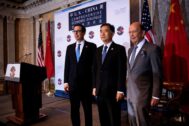
The Trump administration’s focus on increasing pressure on North Korea to abandon its nuclear and missile programs kept that issue at the top of the US-China agenda. In phone calls and a meeting between Presidents Trump and Xi Jinping on the margins of the G20 Summit, at the Diplomatic and Security Dialogue, and at the ASEAN Regional Forum, North Korea received the greatest attention as the US urged Beijing to use its economic leverage against Pyongyang in a bid to change Kim Jung Un’s calculus. After a seven-month hiatus, the US resumed freedom of navigation (FON) operations in the South China Sea, conducting one operation in the Spratly Islands in May and another in the Paracel Islands in July. Marine Corps Gen. Joseph Dunford made his first visit to China as chairman of the US Joint Chiefs of Staff. The first Comprehensive Economic Dialogue convened, but made little progress in easing bilateral economic friction. In August, the Trump administration formally initiated a Section 301 investigation into China’s theft of intellectual property.
US - Korea
May — August 2017Missiles Fire and Fury
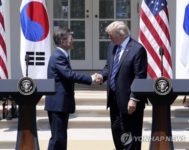
Tensions rose to new levels on the Korean Peninsula as North Korea fired multiple missiles demonstrating markedly enhanced capabilities and crowned the Labor Day weekend with a sixth nuclear test with a significantly larger yield than previous tests. The United States tackled its most significant global security challenge by reinforcing its deterrent capabilities, tightening the financial noose on the North, President Trump tweeting stern warnings, and military and diplomatic leaders calling for dialogue. South Korea responded by reiterating its military readiness, expanding its own missile capabilities, and reeling from Trump’s rhetoric that likened President Moon Jae-in’s push for talks to “appeasement” and his threat to scrap the KORUS trade agreement. Despite joint military exercises, live fire drills, B-1 dispatches, and shared statements condemning Pyongyang to signal alliance strength, the relationship between the United States and South Korea appears frayed in dramatic new ways.
US - Southeast Asia
May — August 2017Regional Skepticism
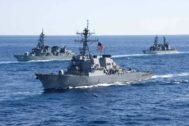
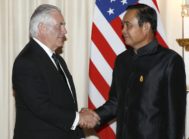
Unlike its predecessor, the Trump administration has not devoted much attention to Southeast Asia; there is no clear policy toward the region. Instead, two areas have been emphasized: an increase in the number of Navy ship-days in the South China Sea and regular economic pressure on Southeast Asian states based on the president’s “America First” principle. Insofar as there is a security policy, it has been to gain support for Washington’s efforts to isolate North Korea. US relations with the Philippines have improved because there have been limited complaints about President Duterte’s war on drugs and increased support for the Philippine Armed Forces’ counterterrorism actions in Mindanao. Vietnam Prime Minister Nguyen Xuan Phuc’s trip to Washington focused on reducing Hanoi’s trade surplus, and, in August, Secretary of Defense Mattis promised a visit by a US aircraft carrier to Vietnam, the first since the end of the Vietnam War. Washington applauded the ASEAN-China agreement on a framework for a code of conduct for the South China Sea, urging that the actual code be legally binding, a stipulation opposed by China.
China - Southeast Asia
May — August 2017Steady Gains in South China Sea
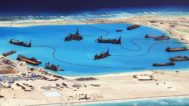
Though periodically distracted by the North Korea crisis that intruded on deliberations during the ASEAN Regional Forum and other ASEAN meetings in Manila, China-Southeast Asia relations remained focused on the South China Sea. China and ASEAN reached agreement on a framework for a code of conduct in the South China Sea that supported Beijing interests. Modest advances in Chinese control of the territory and resources of the South China Sea continued while Beijing rebuffed Philippine and Vietnamese efforts to unilaterally drill for oil and gas in their exclusive economic zones that fall within China’s broad claim. Challenges posed by US freedom on navigation exercises and statements by US and allied leaders at odds with China’s policies and practices were dismissed as Chinese propaganda outlets highlighted Xi Jinping’s personal leadership in China’s success in the South China Sea amidst the hagiography for him prior to the 19th Party Congress that will be held this fall.
China - Taiwan
May — August 2017China Increases Pressure, Tsai Holds the Line
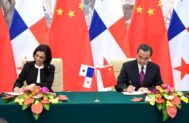
In the run-up to the 19th Party Congress, Beijing has pursued an inflexible policy toward Taiwan, consistently blocking its international participation, establishing diplomatic relations with Panama, and conducting military exercises around Taiwan. Despite such pressures, President Tsai, whose priorities are domestic economic and social reform, has not changed her policy that neither accepts nor explicitly challenges Beijing’s one-China principle, and she has urged Beijing to join in seeking a new formula. With the US Congress expressing increased support for Taiwan, the Trump administration approved a new arms sales package and took other steps to improve ties with Taiwan. Beijing has warned Washington about closer ties with Taipei, raising the prospect that Taiwan will again become a divisive issue in US-China relations. In the absence of dialogue, unstable and risky cross-strait relations will continue in the months ahead.
North Korea - South Korea
May — August 2017Has Kim Jong Un Made Sunshine Moonshine?
Despite dreaming that the inauguration of Moon Jae-in as the new president in South Korea would lead to an improvement in North-South relations, events over the summer of 2017 precluded any semblance of reconciliation on the Korean Peninsula. In the context of Kim Jong Un’s aggressive pursuit of the North’s ballistic missile and nuclear weapon programs, Moon’s olive branches were consistently rebuffed while Kim exchanged bombastic rhetoric with US President Donald Trump and thumbed his nose at the UN Security Council. By summer’s end, there was little prospect for a return to the “sunshine” era in the South. Instead, South Koreans were increasingly interested in having their own nuclear weapons and the South Korean military openly talking about a decapitation unit to deal with the North Korean leadership.
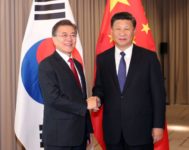
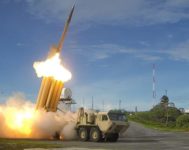
Days after Moon Jae-in’s presidential victory in Seoul on May 9, Pyongyang continued a series of missile tests that demonstrated the range and capability of its weapons, including an intercontinental ballistic missile capable of striking the United States. Early exchanges between Chinese leaders and the new Moon administration provided a chance to reset bilateral ties, including at Beijing’s Belt and Road Forum in June and South Korea’s hosting of the AIIB meeting in Jeju a month later. China supported the adoption of new UN Security Council Resolutions 2356 and 2371 on North Korea, pledging to enforce expanded sanctions and announcing domestic measures to enhance sanctions enforcement. The China-ROK strategic dialogue in June and the first Xi-Moon meeting in July, however, failed to narrow differences over THAAD, clouding Beijing and Seoul’s 25th anniversary celebrations of diplomatic normalization in August. Meanwhile, public attacks between Chinese and North Korean media indicate continued deterioration in the China-DPRK relationship.