Archives
Category: Uncategorized
Japan - China
May — August 2017No Setbacks, No Progress
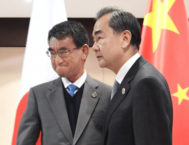
The pattern of warm trade and cold politics continued over the summer of 2017. No discernible progress was made in resolving issues between Japan and China. Leadership interaction was limited, while economic relations showed some signs of improving and tensions in the East China Sea dominated defense activity. At the end of September, the government-sponsored China Daily opined that it was “no exaggeration to say that the past five years have been among the darkest days in Sino-Japanese ties since the two established formal diplomatic ties.”

Japan - Korea
May — August 2017On Board for a Dual Track Approach
With the inauguration of Moon Jae-in in South Korea on May 10, relations between Seoul and Tokyo witnessed a significant turnaround over the summer months of 2017. In particular, the dispute over the “comfort women” agreement reached in 2015 escalated as the Moon administration reversed course, launching a task force on July 31 to review the agreement. Meanwhile, concerns that measures the Park administration had adopted to improve security ties with Japan might be revoked were dispelled when Seoul and Tokyo agreed to maintain close security cooperation on the North Korea issue. In addition, despite the continued tension over Dokdo/Takeshima and Japan’s wartime crimes, Seoul and Tokyo chose to “pursue forward-looking relations” through diplomatic exchanges. Given that the Moon administration has indicated that it wants relations to go smoothly regardless of the comfort women issue, we expect diplomatic exchanges and security cooperation to continue. Sustained improvement will depend on South Korea’s “final” decision on the 2015 comfort women agreement.
China - Russia
May — August 2017“Best and Worst Time” for Beijing and Moscow?
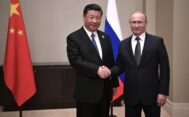
Between April and early September, top Chinese and Russian leaders met four times: in Beijing (BRI Summit), Astana (SCO Summit), Moscow (Xi’s official visit), and Xiamen (BRICS Summit). Each time, Xi and Putin hammered on the “best-ever” theme for Sino-Russian relations. Meanwhile, the two militaries signed a four-year guideline for military cooperation and conducted their first naval exercise in the Baltic Sea. The world according to Beijing and Moscow, however, was being turned upside-down and inside-out as threats of nuclear war were hurled between the US and North Korea. Moscow and Beijing tried hard to coordinate their Korea policies. In May, China’s Belt and Road Initiative (BRI) Forum received Russia’s public if not enthusiastic support. India’s unambiguous objection, however, turned out to be the precursor to a protracted standoff between India and China over a remote road on the Doklam plateau. The crisis was defused only a few days before the BRICS Summit in Xiamen. Few, if any, of those gathered at the summit’s 10th anniversary expected to be jolted by North Korea’s hydrogen bomb test on Sept. 3. Welcome to a brave new world of strong, and sometimes strange, leaders whose decisions have serious consequences for the world.
Australia-US/East Asia
May — August 2017The Donald Dichotomy: US Leadership Without the Leader
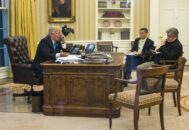
The uncertainty generated by President Donald Trump has made Australia cling ever tighter to the US alliance. The Trump effect hit Canberra within days of Trump taking office. The phrase “shock and awe” springs to mind – rendered in the alliance realm as “shake and appall.” The first phone conversation between Trump and Prime Minister Malcolm Turnbull was a version of “shake, rattle and roll.” Canberra wants to play nice with The Donald, and say nothing publicly that is critical of the president. The template for the Australian approach was on display early when the president withdrew the US from the Trans-Pacific Partnership. The Turnbull government expressed great regret at the decision but said nothing about the man who’d made it. While striving not to affront the president, Australia’s language about China has become shriller. Tongue-tied by Trump, Canberra gives stronger voice to concerns about China. Turnbull has referred to the “dark view” of a “coercive China” seeking Asia domination. Stern words about China’s threat to the rules-based system serve a dual purpose: speak to Beijing about the value of the system while implicitly pleading with the US not to abandon what it has built and policed – and mightily profited from.
Regional Overview
January — May 2017The Pivot is Dead, Long Live the Pivot
While it hasn’t always been pretty or (gasp) consistent, US Asia policy under the Trump administration is, with one major exception, pretty much where the Obama administration left it. America’s Asian alliances remain the foundation of its security strategy and “our one-China policy” has been reaffirmed. Even regarding North Korea, the objective – bringing Kim Jong Un “to his senses” – remains the same, although the approach seems to display less patience. The exception centers on the one promise that Trump (regrettably in our view) has kept: abandonment of the Trans-Pacific Partnership (TPP). On economic policy more generally, the promised trade war with China has (thus far) failed to materialize since “the Chinese have made some improvements on currency in recent months”; okay, Chinese currency manipulation actually stopped several years ago, but you get the point. While the search for a new buzz word to replace the “pivot” or “rebalance” continues, the vice president and secretaries of State and Defense have been to the region and the White House has confirmed President Trump’s plan to attend a trio of regional summits this fall. Asia remains a high priority region, for better and for worse.
US - Japan
January — May 2017Tokyo Transitions to Trump
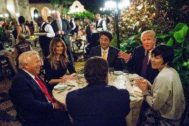
The transition to the new Trump administration was far smoother for Japan than for other US allies. Prime Minister Abe Shinzo’s visit to Trump Tower the week after the election in November undoubtedly helped smooth the way, and his visit in February proved to be a successful confirmation of Tokyo’s highest priorities for alliance cooperation. Secretary of Defense James Mattis and Secretary of State Rex Tillerson both headed to Northeast Asia, reassuring Tokyo and Seoul of the administration’s commitment to its Asian allies. This early effort helped ensure continuity rather than disruption would be the theme for the US-Japan alliance for the next four years. North Korea, of course, helped that return to normalcy. Yet not all was settled in these early months. How the new administration was going to define its approach to trade remained ill-defined. The Japanese government, however, was not interested in a conversation that focused only on trade.
US - China
January — April 2017Trump and Xi Break the Ice at Mar-a-Lago
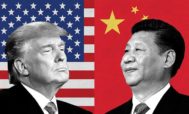
The US-China relationship got off to an active, albeit fitful start after Donald Trump assumed the presidency on Jan. 20. Once Trump agreed to honor the US “one China” policy, Chinese officials engaged positively with their US counterparts, and planning began for the inaugural Trump-Xi meeting. China’s top diplomat, Yang Jiechi, visited Washington at the end of February, and Secretary of State Rex Tillerson traveled to Beijing in mid-March. The highlight of this period was the Trump-Xi summit, which took place at Mar-a-Lago on April 6-7. One of the major summit deliverables was the creation of a new high-level mechanism, the US-China Comprehensive Dialogue, which will be overseen by Trump and Xi. North Korea emerged as the pressing issue for the Trump administration as well as in the bilateral US-China relationship. Trump apparently made clear to Xi that if China is unwilling to cooperate, the US would seek to solve the North Korea threat unilaterally, including by pursuing penalties against Chinese banks and companies doing business with North Korea. After the summit, Trump called Xi twice to discuss North Korea and to urge him to put greater pressure on Pyongyang.
US - Korea
January — April 2017Peninsula Tensions Spike
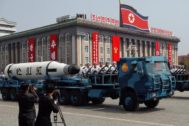
North Korea tested President Trump’s new administration with a New Year promise of imminent ICBM capability and subsequent missile launches. Tensions rose to the highest level since 1993/1994 with missile launches, the assassination of Kim Jong Nam, and a possible ICBM on display at a military parade to celebrate the 85th anniversary of the DPRK’s Korean People’s Army. Washington offered Seoul assurances of support, sending Defense Secretary Mattis, Secretary of State Tillerson, and Vice President Pence in early 2017. Yet, Trump’s comments about sending an “armada” with the dispatch of the USS Carl Vinson carrier strike group led South Koreans to fear blowback if the US conducted a preemptive or preventive strike against DPRK facilities. South Korea saw deployment of the first stages of THAAD, but the missile defense system and broader policy differences with May 9 ROK presidential victor Moon Jae-in will be challenges for US-South Korea relations.
US - Southeast Asia
January — April 2017Mixed Messages
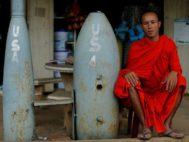
In its early months, the Trump administration has devoted little attention to Southeast Asia and US relations with the region have generally followed a trajectory set by the Obama administration. The US continued naval operations in the South China Sea and joint exercises with most ASEAN states with US air and naval forces rotating through bases in northern Australia and the Philippines and deploying from Singapore. There have been mixed signals between Manila and Washington. With the ASEAN states and China moving toward completion of a Code of Conduct (COC) on rules of engagement in the South China Sea, it is hoped that the new document would be “legally binding,” but little specific about its provisions has been published. Following Washington’s abrogation of the Trans-Pacific Partnership (TPP), Hanoi has sought to alleviate its disappointment, saying that it understands the US need to create more jobs and that it will try to accommodate Washington in future trade negotiations.
During the Obama administration’s two terms (2009-2016), the president’s “rebalance” to Asia featured Southeast Asia as its centerpiece. President Obama made 11 separate trips to the Asia-Pacific, visiting a total of 14 countries, nine of which were members of ASEAN. His secretaries of state and defense also made multiple journeys to the region. Among many successes during these years were US accession to ASEAN’s Treaty of Amity and Cooperation, participation in the East Asia Summit for the first time in 2011, the establishment of the first diplomatic mission to ASEAN, and realization of the historic transition to democracy in Myanmar. The United States also increased the deployment of ships and aircraft to the region, particularly in Singapore, the Philippines, and Australia. In Obama’s final year, the US began distributing resources under the Maritime Security Initiative to assist Southeast Asian countries with their maritime domain awareness by transferring patrol vessels and surveillance aircraft as well as creating a system whereby these countries could share information on the region’s maritime security picture.
While it’s still early for the Trump administration, there have been virtually no policy statements dealing with Southeast Asia, nor at this time (April) has the State Department chosen a deputy secretary – the number two position – or a permanent assistant secretary for East Asian and Pacific affairs. Direction from Washington for a region that was so important during the preceding eight years seems to be absent.
China - Southeast Asia
January — April 2017China Consolidates Control and Advances Influence
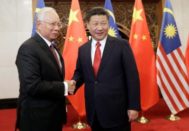
Chinese officials showed confidence and satisfaction that the cooling tensions in the South China Sea demonstrated increasing regional deference to Beijing’s interests while China’s economic importance to Southeast Asia loomed larger in a period of anticipated international retrenchment. They remained alert to possible actions by the United States, Japan, Australia and South China Sea claimant states that might upset the recent positive trajectory, but generally saw those states preoccupied or otherwise unwilling to push back strongly against Chinese ambitions. The way seemed open for steady consolidation and control of holdings and claimed rights along with a Chinese supported code of conduct on maritime activity in the South China Sea, diplomatic initiatives to promote closer ties and reduce regional suspicion of Chinese intentions, and an array of economic blandishments in line with Beijing’s ambitious Silk Road programs.