Archives
Category: Uncategorized

China - Taiwan
May — August 2020Taiwan Navigates US-China Tensions as it Manages the Effects of COVID-19
Simmering tensions across the Taiwan Strait were a concern in May at the World Health Assembly meeting, along with President Tsai’s second inauguration, China’s National People’s Congress, and the 15th anniversary of the Anti-Secession Law. The beginning of Tsai’s second term was defined by Taiwan’s success in overcoming the health and economic impacts of COVID-19. Taiwan failed to win a seat at the World Health Assembly, but won unusually broad and public support from Washington and other typically silent partners. Taiwan offered assistance to victims of the Beijing’s National Security Law for Hong Kong, prompting Beijing to warn of Taiwan’s “black hand.” Taiwan’s ties with the US were showcased by the August visit of Secretary of Health and Human Services Alex Azar to Taipei.
Elsewhere, seeking to jumpstart negotiations on a bilateral trade agreement with the US, Tsai announced that Taiwan will allow imports of US pork and beef. The Nationalist Party’s recent presidential candidate Han Kuo-yu was recalled as Kaohsiung mayor and replaced by DPP candidate Chen Chi-mai. Meanwhile, the new KMT leadership’s initiative to sever ties to the “1992 Consensus” provoked generational dissension and a sharp warning from Beijing. Lee Teng-hui was mourned at his death as a democratic hero.

North Korea - South Korea
May — August 2020A Tempestuous Summer
This was a tempestuous summer on the Korean Peninsula in more ways than one. Relations between the two Koreas, already bad, reached a new nadir in June. Claiming to be suddenly furious about defector activists sending propaganda via balloon across the Demilitarized Zone (DMZ), North Korea issued ever more violent threats against the South. These culminated in the symbolic but extreme act of physically blowing up the (by then unoccupied) joint liaison office in Kaesong, just north of the DMZ, on June 16. Moon Jae-in’s government deplored that and other aggressive Northern acts, like opening dams to send floodwaters downstream into the South without warning. Yet its tone was more pained than sharp, and Moon remained oddly emollient toward Pyongyang overall. In July he named a new minister of unification (MOU) in Lee In-young, who had allegedly been pro-North in his student days, as well as reshuffling three other top security posts. Although the new appointees were all even more strongly pro-engagement than their predecessors, North Korea showed little sign of being impressed.
No doubt Kim Jong Un was preoccupied elsewhere, by tempests of a more literal kind. After the longest summer monsoon season ever recorded, the peninsula was buffeted by back-to-back typhoons in August and early September. Both Koreas suffered—separately, since Kim refused all aid from the South (or anyone), citing COVID-19 concerns, just as he had rebuffed Moon’s offer to help regarding the virus itself. With North Korea turning inward and focused on reconstruction—a new Party Congress, set for January, looks like an attempt at a fresh start—and the clock starting to tick on Moon’s term of office which must end in May 2022, the chances of inter-Korean cooperation reviving any time soon seem sadly small.
China - Korea
May — August 2020US-China Rivalry Divides the Two Koreas
The Korean Peninsula appears divided in what some analysts call a “new cold war” as US-China tensions escalate over issues ranging from COVID-19 to Hong Kong. Washington’s new China strategy prompted Pyongyang to voice its alignment with China while heightening Seoul’s dilemma of choosing sides. As the North Korean economy suffered the combined effects of ongoing sanctions, the global pandemic, and severe weather, a leaked UN report in August sharpened international criticism of China’s sanctions enforcement. The region’s current domestic political priorities reinforce Beijing, Seoul, and Washington’s trilemma over alternative approaches to DPRK denuclearization.
Japan - China
May — August 2020The Velvet Gloves Fray…Slightly
Major concern in this period centered around the future of Sino-Japanese relations in the post-Abe era, with most analysts predicting that there would be little change. China’s impressive, though credit-fueled, rebound from the coronavirus pandemic as Japan’s economy sharply contracted indicates that Tokyo will seek to maximize trade with the PRC.
Xi Jinping’s long-awaited state visit to Japan is on indefinite hold, with concern for the pandemic a convenient explanation for underlying multiparty opposition due to Beijing’s assertive actions in contested areas and its repressive measures in Hong Kong and Xinjiang. Differences of opinion remain on the wording of a so-called 4th Sino-Japanese Communique that is much desired by Beijing.
Japan - Korea
May — August 2020History, Trade, and Distrust
“Cold economics, cold politics” has become the new normal in Japan-South Korea relations. Instead of the practical stability that they maintained in the first months of this year, latent tension became the defining force as Seoul and Tokyo followed through their earlier decisions made in 2018 and 2019. The twin decisions—South Korea’s Supreme Court ruling on forced labor during Japan’s occupation of the Korean Peninsula and Japan’s export restrictions on key materials used for South Korea’s electronics industry—planted the seeds of discord and deterioration of bilateral ties during the summer months of 2020. In June, following the 2018 Supreme Court’s order, the Daegu District Court released a public notice to Nippon Steel, formerly known as Sumitomo Metal, a move to seize and liquidate the local assets of the company. In response to Japan’s imposition of export controls in 2019, South Korea filed a complaint with the World Trade Organization. This downward spiral will likely continue for the remainder of the year unless South Korea and Japan take decisive action to address these disputes. On the North Korea front, Japan’s newly published Defense of Japan 2020 assessed North Korea’s nuclear and missile capabilities as posing greater threats to Japanese national security than previous years.
China - Russia
May — August 2020Age of Triangular Politicking
While the coronavirus raged throughout summer 2020, China and Russia found themselves entangled in two separate triangular dynamics with the US and India. China faced off with India along the long mountainous border, culminating in the June 15 deadly brawls. Meanwhile, the “whole-of-government approach” of the Trump administration against China led to a near-freefall in bilateral relations, featuring the highly ideologized, militarized connotations of the Cold War (1947-1991). In both cases, China’s strategic space was increasingly constrained.
Russia, however, found itself in a curiously pivotal position within the two geopolitical triangles: an “innocent” bystander in the Beijing-New Delhi-Moscow trio and a useful, delicate balancer in the Washington-Beijing duel. Between its strategic partner (China) and persistent yet unrequited courter (the Trump administration), Russia carefully played its cards from a position of strategic weakness. By end of summer, the US-China-Russia triangle made its way into the US 2020 presidential elections as presidential candidates played the “Russia” and “China” cards. No matter who wins the 2020 US election, the stakes are high for China and Russia.
Australia-US/East Asia
September 2019 — August 2020Coronavirus, China and the US New Normal
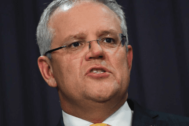
Challenged by COVID-19 and China, Australia confronts deteriorating strategic prospects and its first economic recession in nearly 30 years. The pandemic has worsened strained relations between Australia and China. Canberra’s call for an inquiry into the origins of COVID-19 was attacked by Beijing as a betrayal and Chinese trade retaliation has followed. Even before the pandemic hit, Australia talked of a “new normal” with China of “enduring differences.” Whatever the US election result, the phrase “new normal” is also being applied to changes wrought by President Trump. The US alliance is hugged anew as Canberra abandons a central strategic tenet held for 50 years—the idea that Australia would have 10 years warning of any direct military threat.
Regional Overview
January — April 2020The Pandemic Spreads and the World Responds
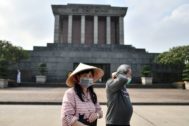
This trimester’s regional overview focuses on the coronavirus pandemic and its impact on regional security affairs. But as the other chapters attest, international focus on the pandemic should not cause us to overlook other significant events that transpired during this reporting period: increased Chinese assertiveness in the South China Sea and vis-a-vis Hong Kong and Taiwan, growing China-Australia tensions, the non-summit between President Trump and the leaders of ASEAN, South Korean elections (with an outcome closely tied to its handling of the pandemic, but with far-reaching implications in other areas), and the dispute over host nation support, which has raised questions about the vitality (indeed, even the survivability) of the ROK-US alliance, to cite just a few. Meanwhile, the (somewhat) unusual but not unprecedented disappearance of Kim Jong Un from the public eye raised questions about how prepared the US (among others) is for dealing with a sudden leadership change on the peninsula.
US - Japan
January — April 2020COVID-19 Overtakes Japan and the United States
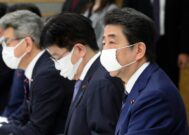
It took time for Tokyo and Washington to understand the scope of the COVID-19 crisis, as the virus continues to spread in both Japan and the United States. The routine that would normally define US-Japan relations has been set aside, but it is too early to draw inferences about what this pandemic might mean for the relationship, for Asia, or indeed for the world. At the very least, the disease confounded plans in the United States and Japan for 2020. COVID-19 upended the carefully developed agenda for post-Abe leadership transitions in Japan and threw President Trump, already campaigning for re-election in the November presidential race, into a chaotic scramble to cope with the worst crisis in a century.
US - China
January — April 2020US-China Relations Hit New Lows Amid Pandemic
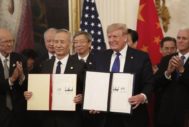
The COVID-19 virus sent US-China relations into a tailspin as 2020 opened. Recriminations flew over who was responsible for the virus that killed hundreds of thousands of people and brought economic activity to a halt. The Trump administration took a series of measures against Chinese media organizations and journalists in the United States, which provoked Beijing to expel US journalists working in China. The Phase 1 trade deal was signed, and some tariffs were lifted, though the COVID-19 outbreak hampered China’s ability to purchase the promised amount of US goods and services. With the 2020 US presidential election picking up speed, Trump campaign strategists are actively targeting China.