Archives
Category: Uncategorized
US - Korea
January — April 2020Failing to Find Common Cause
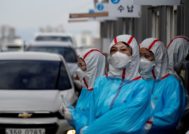
The US impasse with both Koreas carried over into 2020, with little official contact with North Korea and negotiations with South Korea over troop burden-sharing going into overtime. The global pandemic forced all three governments to make sharp adjustments, with President Trump reaching out to both Seoul and Pyongyang to either offer or solicit assistance. But in both cases, the rifts appear too deep to forget, even in the face of a shared catastrophe like COVID-19.

US - Southeast Asia
January — April 2020Fighting the Pandemic, ASEAN Braces for Economic Pain
Many Southeast Asian countries’ growth rates have been stripped to near zero by COVID-19, and leaders expect a crisis that could exceed that of the Asian Financial Crisis. The pandemic defined Southeast Asia’s diplomatic relations from March, with high-level meetings moved to video conferences. The US-ASEAN summit, scheduled for March 24, was postponed but no new date has been announced. With US elections ramping up and questions about the COVID-19 pandemic outstanding, a 2020 US-ASEAN summit appears unlikely.
China - Southeast Asia
January — April 2020From Low Priority to High Tensions
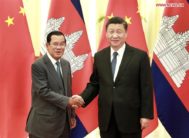
For most of the first four months of 2020, China’s generally low priority treatment of Southeast Asia featured cooperation on the coronavirus, standard treatment of South China Sea issues, and a visit by Xi Jinping to Myanmar. However, April saw tensions rise in the South China Sea, with an increase in US criticism of Chinese actions and US military moves against Chinese challenges as well as Chinese initiatives and ongoing provocations.

China - Taiwan
January — April 2020Coronavirus Embitters Cross-Strait Relations
After President Tsai Ing-wen won re-election and her Democratic Progressive Party retained its legislative majority, COVID-19 dominated the news, further embittered cross-strait relations, and provoked a sharp confrontation over Taiwan’s involvement in the World Health Organization. Beijing conducted more military operations near the island in response to concern that Taiwan is pushing independence, and the Trump and Tsai administrations strengthened ties. The opposition Kuomintang chose a younger, reform-minded leader following the latest in a series of defeats.

North Korea - South Korea
January — May 2020Testing Times
Inter-Korean relations stayed frozen in the early part of 2020. ROK President Moon Jae-in’s outreach was hardly reciprocated by Kim Jong Un, whose sister snapped back when Seoul mildly criticized Pyongyang’s missile launches in March. For both Koreas the challenge of COVID-19 was overwhelming, yet the North refused any cooperation on this. In April Moon’s liberal party scored a big win in parliamentary elections; two DPRK defectors gained seats for the conservative opposition. Kim caused a global media frenzy by briefly vanishing from view. Moon has less than two years left in office, so Kim’s shunning of him looks short-sighted.
China - Korea
January — May 2020China-Korea Relations Under Quarantine
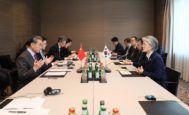
The outbreak of COVID-19, first in China and then in South Korea, placed plans for a highly anticipated summit between Xi Jinping and Moon Jae-in on hold. Beijing and Seoul’s priorities focused on fighting the virus together through aid exchanges, a new inter-agency mechanism led by their foreign ministries, and multilateral cooperation with Japan and ASEAN. As cases spread across borders, political frictions emerged over entry bans and relief supplies. The public health crisis triggered efforts to mitigate its socioeconomic repercussions, raising questions over long-term US influence. The virus also dramatically interrupted the normal diplomatic and economic interactions between China and North Korea.

Japan - China
January — April 2020Sino-Japanese Relations: In a Holding Pattern
Politically, the major news in Japan-China relations was that Xi Jinping’s long-anticipated state visit was postponed. While the coronavirus was a factor, the two sides had also been unable to agree on the text of the Fourth Communiqué, and there was considerable opposition within Japan to the visit due to issues between them. Several major Japanese companies announced major investments in the People’s Republic of China, even as the Japanese government agreed to subsidize companies to move their supply chains out of the country.
Japan - Korea
January — May 2020Pragmatic Stability, Latent Tensions
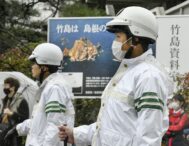
In the first months of 2020, Japan and South Korea maintained pragmatic stability despite a brief flare-up over travel restrictions. The need to prioritize recovery from COVID-19 weighed heavily in favor of both countries seeking to focus on domestic issues. With the landslide victory of the ruling Democratic Party in the April parliamentary elections in South Korea, it is not likely that Seoul’s approach to the bilateral disputes with Tokyo will undergo a fundamental change anytime soon. With the US presidential election now six months away, continuing stalemate in US-South Korea military cost-sharing talks and volatility surrounding North Korea form an important backdrop to uncertainties in the South Korea-Japan bilateral relationship. By September, we may know whether it is pragmatic stability or latent tension that is the defining force in South Korea-Japan relations in 2020.
China - Russia
January — April 2020Ending Strategic Distancing in the Era of Social Distancing
In the first four months of 2020, as COVID-19 raged throughout the world, Russia and China increased, and even intensified, their diplomatic interactions, mutual support, and strategic coordination. The patience for maintaining an informal entente, rather than an alliance, seemed to be running thin. This happened even as the city of Moscow’s own brief “Chinese exclusion” policy evoked sharp dissonance in China’s public space. These developments occurred against the backdrop of a Middle East crisis and political shakeup in Russia. As the world beyond them sank into a state of despair, disconnect, and devastation, the two large powers moved visibly toward each other amid an increasing backlash from the US, particularly regarding China’s early actions in the pandemic.
Japan - Southeast Asia
May 2019 — April 2020Great Disruption: Uncertainty over the Indo-Pacific
Japan and Southeast Asia faced completely different situations in 2019 and 2020 because of the emergence of the COVID-19 pandemic. In 2019, Japan-Southeast Asia relations were positive. One of the major developments among Southeast Asian states was the creation of the “ASEAN Outlook on the Indo-Pacific” (AOIP), which resonated with the principles in Japan’s “Free and Open Indo-Pacific” (FOIP) concept; as a result, Japan expressed explicit support for AOIP. Functionally, they made progress, particularly in defense, infrastructure development, and digital fields, as illustrated by various Japanese initiatives—“Vientiane Vision 2.0,” “Initiative on Overseas Loan and Investment for ASEAN,” and “Data Free Flow with Trust.” As such, Japan and Southeast Asian states began to synthesize their respective visions toward the Indo-Pacific and to establish concrete cooperative mechanisms. However, diplomatic momentum was put on halt in 2020 as the COVID-19 pandemic occurred. While Japan, Southeast Asian states, and ASEAN made efforts to coordinate counter-measures, share information and best practices, and provide mutual assistance through teleconferences such as the Special ASEAN Plus Three Summit on Coronavirus Disease 2019 in April 2020, each state faces different social and political situations, making it difficult to cooperate. As such, great uncertainty looms over Japan-Southeast Asia cooperation in the Indo-Pacific.