Archives
Category: Uncategorized
North Korea - South Korea
May — August 2019Pyongyang Shuns and Snarls; Seoul Seems in Denial
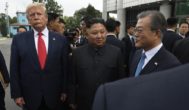
North Korea continued to freeze out the South over the summer months. Kim Jong Un did meet Moon Jae-in once, very briefly, but only on the sidelines of his third summit (also brief) with Donald Trump at Panmunjom on June 30. He also sent his sister, Kim Yo Jong, to the same venue with a wreath and condolences for a former ROK first lady – but with no message for Moon, whom in August DPRK media derided as “an impudent guy.” Meanwhile Pyongyang was deaf to Seoul’s entreaties on all fronts, including their agreed joint teams for the 2020 Tokyo Olympics. It also reverted to missile tests, specifically of new short-range weapons that could target the South. Despite all this Moon remained publicly upbeat. John Bolton’s departure from the White House may improve prospects, if Trump now offers some sanctions relief. But as this shows, inter-Korean relations are now (by Kim’s choice) subordinate to US-DPRK ties, not important in their own right.
China - Korea
May — August 2019A New Chapter?
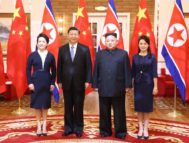
Beijing and Pyongyang celebrate 70 years of diplomatic relations this year. Xi Jinping traveled to Pyongyang in June for a fifth summit with Kim Jong Un, the first visit to North Korea by China’s top leader in 14 years. The meeting aimed to advance the bilateral friendship to a new phase of comprehensive development and drive regional coordination on the Korean Peninsula. In contrast, Xi’s 40-minute meeting with South Korean President Moon Jae-in on the sidelines of the G20 Summit in Osaka seemed to marginalize Moon, subordinate the relationship with South Korea, and place Xi as an intermediary between North Korea and the rest of world. Pyongyang’s missile tests, however, showed the limited effects of such diplomacy, even after surprise exchanges between US, North Korean, and South Korean leaders in Panmunjom on June 30. The current expansion of China-DPRK political, military, economic, and cultural exchanges also presents challenges to sanctions implementation and human rights promotion.
Japan - China
May — August 2019External Smiles, Internal Angst
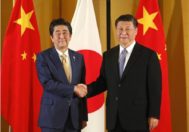
Chinese and Japanese relations have been cordial during the summer months, but tensions over history, economics, disputed territories, and military expansion continue to simmer. Several meetings failed to reach consensus on issues. China continued to tighten its de facto control over disputed territories as Japan reinforced its capabilities to defend those areas. Several major Japanese corporations announced plans to move production out of China, citing concerns with the US-China trade war. Worsening relations between Seoul and Tokyo, and in particular Seoul’s decision to end an intelligence-sharing agreement, could weaken plans for joint resistance to Chinese and North Korean activities. No date has been set for Chairman Xi Jinping’s long-delayed reciprocal state visit to Japan.

Japan - Korea
May — August 2019Cold Economics, Cold Politics
It is hard to find anything truly unprecedented in a South Korea-Japan relationship that has long seen periods of elevated tension. That is what makes the recent escalation of disputes into the economic relationship a moment of outsize significance in the history of the relationship. As recently as the last update for Comparative Connections in May, we concluded that “South Korea-Japan economic and trade relations have remained … largely unrelated to political developments and driven by practical considerations.” That assessment reflected the fact that, however high the political tensions, there have been two unwritten red lines: first, allowing political tensions to harm existing, mutually beneficial security cooperation for deterring North Korean provocations, especially when working jointly with the US; second, bringing those tensions into the economic relationship. Over the last four months, those red lines have been blurred in a series of escalating retaliatory moves with direct consequences for both countries and the regional economic and security order as a whole.
China - Russia
May — August 2019Beautiful Relationship in a Brave/Grave New World
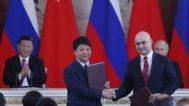
China-Russia summit diplomacy was in overdrive this June when Chairman Xi Jinping and President Vladimir Putin met on four separate occasions. In early June, they declared that the Russian-Chinese strategic partnership relationship entered a “new age,” while celebrating the 70th anniversary of diplomatic relations. Barely a week later, Putin and Xi attended the 19th SCO Summit in Bishkek. From there, they joined fifth Interaction and Confidence-Building Measures in Asia (CICA) Summit in Dushanbe. At the end of June, they were part of the G20 Summit in Osaka, where they joined in a mini Russia-India-China (RIC) gathering with Indian PM Narendra Modi before meeting separately with US President Donald Trump. There was also a significant upgrade in joint activity by the militaries. It began with the maritime stage of the annual Joint Sea naval drill in the Yellow Sea in early May and ended with China’s participation in Russia’s Center-2019 exercises on Sept. 16-21. In between, Russian and Chinese bombers conducted the first-ever joint patrol over the Sea of Japan and the East China Sea. Meanwhile, Chinese analysts actively deliberated the nature, scale, depth and limits of China’s “best-ever” relationship with Russia. The consensus seemed to move ahead with closer ties across board.

Australia-US/East Asia
September 2018 — August 2019Scott Morrison, Donald Trump, and the Indo-Pacific
Echoing uncertain geopolitical times, Australian politics confounded opinion polls and pundits at the May 18 federal election. Re-election of the Liberal-National coalition government was a “miracle” result, according to Prime Minister Scott Morrison. The surprise victory transformed Morrison’s authority within his party and the country – and burnished his relationship with US President Donald Trump. Morrison says the shift in the US-China relationship from engagement to competition is “inevitable,” calling for the Indo-Pacific to deepen patterns of cooperation so the competition does not become adversarial. Australia was an early adopter of the Indo-Pacific concept, describing it as a useful geographic construct. Now Australia is embracing the Indo-Pacific not merely as construct, but as a US strategy – the Free and Open Indo-Pacific.
Regional Overview
January — April 2019Free and Open, but not Multilateral
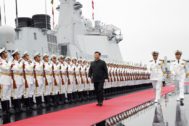
We are focusing on regional trade and economics because it’s important to look at the consequences of the current US administration’s antipathy toward multilateral trade agreements. Beijing has shown no such hesitancy, with President Xi Jinping hosting visitors from more than 100 different countries (including 37 heads of state) at his Second Belt and Road Initiative (BRI) International Forum. Ships from 19 different navies (but not the US or France) participated in a naval flotilla commemorating the 70th anniversary of the Peoples’ Liberation Army Navy (PLAN). One area where Washington might actually embrace a multilateral agreement would be a follow-on to the soon-to-be defunct Intermediate Range Nuclear Forces (INF) Treaty but only if it involves, among others, China.

US - Japan
January — April 2019Treading Water in Choppier Surf
The US and Japanese governments continued to work at maintaining a steadfast alliance, yet there were issues that could upend the relationship. After several months of anticipation, there was some progress on trade negotiations. While the US hoped to close the deal before President Trump visits Japan in late May, differences over the scope of the agreement and a number of difficult issues related to automobiles, agriculture, and currency rates remained. Meanwhile, domestic pressure over the Futenma relocation project returned to the news with a new referendum that strongly rejected the move. The introduction of the Reiwa era at the end of April served as a brief respite as the alliance partners sought to align interests following the “no deal” US-DPRK summit in Hanoi.
US - China
January — April 2019Is a Trade Deal Imminent?
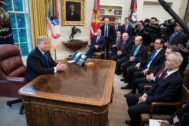
Intense trade talks in the first four months of 2019 made progress, raising hopes that a deal will be reached in May, and signed by Presidents Donald Trump and Xi Jinping soon thereafter. Remaining sticking points include the enforcement mechanism, which is a key US demand, and a schedule for lifting the tariffs, which is a Chinese priority. The US Department of Justice unsealed an indictment charging Huawei and its CFO Meng Wanzhou with financial fraud, money laundering, obstruction of justice, sanctions violations, and other crimes. Tensions increased over Taiwan as the Trump administration took steps to strengthen ties with Taipei and warn Beijing to back off its coercive and destabilizing policies. President Trump welcomed China’s decision to add fentanyl-related substances to a supplementary list of controlled drugs and substances beginning May 1. Growing US concerns about Chinese espionage were highlighted publicly in speeches by senior Trump administration officials.
US - Korea
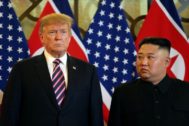
January — April 2019From Hanoi to Hiatus
Late February summitry gave way to stalemate, raising the specter of increased tension on the Korean Peninsula. President Donald Trump and North Korean Chairman Kim Jong Un signaled warmth around their Hanoi meeting – their second summit in a year – but Trump’s walkout hours short of the planned conclusion and the absence of an agreement left everyone struggling to define next steps. South Korea’s surprise at the lack of a deal gave way to efforts at facilitation with calls for inter-Korean economic engagement and President Moon Jae-in’s April visit to Washington. Trump and Moon urged patience and diplomacy and the US and ROK canceled spring military exercises, allowing space for North Korea negotiations. The DPRK still criticized the more limited exercises, announced an end-of-year deadline for the US to change its approach, snubbed South Korea on the first anniversary of the Panmunjom summit, and condemned US Secretary of State Mike Pompeo and National Security Advisor John Bolton. Meanwhile, the US and ROK reached an agreement on host nation financial support for US forces stationed in Korea, quieting discord in an otherwise sound alliance.