Archives
Category: Uncategorized
China - Taiwan
January — April 2017Adrift Without Dialogue
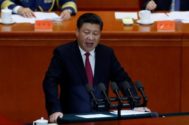
In February, President Trump told President Xi Jinping that the US would honor its one-China policy. This eased concern that the new administration would radically change US policy toward Taiwan, but it remains unclear how the Trump administration will deal with specific Taiwan issues. Relations between Beijing and Taipei have continued to be in an unstable but calm state in the early months of 2017. The formal channels of dialogue remain closed and no significant effort has been made to reopen them. In the meantime, practical issues have been dealt with, sometimes constructively but often in ways that exacerbate the lack of trust. This unstable and risky situation will likely continue in the months ahead.
North Korea - South Korea
January — April 2017Can Moon Restore Sunshine?
The first four months of 2017 have been a momentous and tumultuous period for Korea. As of mid-May, the peninsula remains in a state of high anxiety and no little tension. A crisis? Maybe. Yet without counseling complacency, recent history suggests that that term tends to be over-applied to this part of the world’s recurring episodes of tension: amply chronicled down the years (for the present century) in successive issues of Comparative Connections.
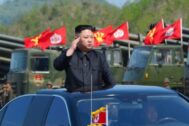
The reasons for this latest bout of tension are partly local but most global, or more precisely trans-Pacific. The local causes derive from both Koreas, if as usual mainly the North. During the past four months as in the previous five years, Kim Jong Un’s regime has shown little sign of a wish to lower tensions, mend fences, or even pursue normal relations with other states, friend or foe. Now in his sixth year in power, the third Kim remains unique as a 21st-century leader who in this era of globalization – and despite his own years of schooling in Europe – has neither ventured abroad nor met any other head of state or government, even on his home turf. The DPRK’s boasts of self-reliance may be mendacious on the economic front, where (as widely canvassed) Chinese sustenance remains vital. Yet diplomatically it does indeed stand alone; the more so as Pyongyang has begun bombarding even Beijing with the aggressive insults long hurled by Pyongyang at Seoul, Tokyo, and Washington. Kim seems to share the stance of Millwall FC, a notoriously ‘hard’ London soccer club whose fans chant: “No one likes us, we don’t care.” His father and grandfather were more subtle, at least in not picking fights Bruce Lee-style with all comers simultaneously. But just as success has long eluded Millwall, showing the finger to everyone can hardly work for Kim Jong Un long-term.
It is not just words that North Korea lobs. This Kim has markedly accelerated the DPRK’s development of both nuclear weapons – an unprecedented two tests in 2016, after three in the decade from 2006 – and the ballistic missiles (BM) that might one day carry them. True to form, the first four months of 2017 saw half a dozen BM tests, not all successful. Yet contra many predictions, Kim has not (so far) marked the recent transitions of political power in two of his main foes – Washington first, and now Seoul too – with a nuclear test; unlike in May 2009 when Barack Obama faced that challenge, or February 2013 when a nuclear blast greeted both the re-elected Obama and the incoming Park Geun-hye. Still, with most of 2017 to go, it might be premature to seek to explain what may be a temporary non-event.

China - Korea
January — April 2017Two Koreas Defy Chinese Sanctions
Pyongyang tested regional and domestic politics on six separate occasions by conducting missile launches between February and April. The latest tests coincided with the Xi-Trump summit in Mar-a-Lago and Vice President Pence’s visit to South Korea. They also marked the 105th birth anniversary of Kim Il Sung on April 15 amid intense speculation that North Korea might conduct a sixth nuclear test. In addition to supporting five UN Security Council statements on North Korea this year, Beijing on Feb. 18 announced a suspension of DPRK coal imports through December. DPRK military threats also catalyzed US-ROK plans to deploy THAAD, a source of mounting tension that affected all aspects of the China-South Korea relationship. Beijing’s retaliation took the form of restrictions from March on business and tourism. South Korea appealed to the WTO for redress and South Korean lawmakers passed resolutions condemning China’s retaliation. THAAD emerged at the center of domestic political debate in Seoul after Park Geun-hye’s ousting on March 10, following which PRC nuclear envoy Wu Dawei in April engaged major presidential contenders ahead of the May 9 elections. Beijing’s falling out with both Koreas presents a major challenge for coordinating regional policy with new administrations in Washington and Seoul.
Japan - China
January — April 2017No Pyrotechnics, No Progress
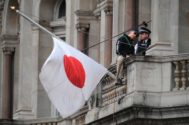
Though free of the large-scale anti-Japanese demonstrations and acerbic exchanges that have characterized the recent past, the cold peace between China and Japan continued in the early months of 2017. There were no meetings of high-level officials, and none were scheduled. Mutual irritants continued on familiar topics: defense and territorial issues, Taiwan, trade and tourism, and textbooks and history.

Japan - Korea
January — April 2017Running on Rivalry: Presidential Hopefuls Capitalize on Disputes
With South Korean presidential election scheduled for May 9, the early months of 2017 witnessed not only avid campaigning by candidates, but also a deepening diplomatic conflict between Seoul and Tokyo. In particular, the installation of a “comfort woman” statue facing the Consulate General of Japan in Busan last December perturbed bilateral relations, calling into question the landmark “comfort women” agreement. While the anticipated installations of additional statues by provincial and civic actors risked escalating tensions further, the presidential candidates have made nominal efforts to quell the concerns of Japanese diplomats. As the Blue House prepares to greet its new occupant, prospects for a significant turnaround in bilateral relations remain uncertain.
China - Russia
January — April 2017Trilateral Politics: Trump Style
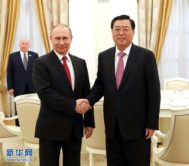
US relations with Russia and China flip-flopped in the first few months of 2017 as newly-inaugurated President Donald Trump injected fresh dynamics into the Washington-Beijing-Moscow triangle. In just one strike (the missile attack on Syria) with nearly “perfect” timing in early April, the Washington “outsider” surprised the visiting Chinese president, minimized the “Russian factor” in US domestic politics, and assumed the moral high ground while sending a strong signal to a still defiant North Korea. While the long-term effect of Trump’s action has yet to be determined, it did set in motion diplomatic maneuvering and mind games between Washington, Moscow, and Beijing. For the first time since the end of the Cold War, Washington, or more precisely Trump, was actively and dramatically pulling the strings of this “not-so-strategic triangle.” However, before anything substantial happened to the triangle, the Korean nuclear crisis deepened and broadened, and Pyongyang assumed the characteristics of China’s “rogue ally.” To defuse this time-bomb in Northeast Asia, the three geostrategic players may need to go beyond the traditional “great games” in the age of WMD.
Japan - Southeast Asia
May 2016 — April 2017Both Push and Pull: Japan Steps Up in Southeast Asia
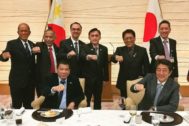
Two political surprises in 2016 will affect Japan’s relations with Southeast Asia. The first, the election of President Rodrigo Duterte in the Philippines and his subsequent turn toward China, has likely not disturbed Japan’s role as the Philippines’ largest investor, trading partner, and aid donor. However, Duterte’s abrasiveness toward Washington could have a negative effect on the newly-forged Japan-Philippines security partnership and dampen the possibility of triangulating US, Japan, and Philippine cooperation in the South China Sea. A greater and more long-term impact could be the election of Donald Trump and the resulting uncertainty in US relations with Southeast Asia. Beyond that broad concern, Trump’s withdrawal of the US from the Trans-Pacific Partnership (TPP) throws the economic architecture of the Asia-Pacific region into question and could stymie the growth Japan had expected in trade relations with TPP members in Southeast Asia, particularly Vietnam and Malaysia. In January 2017, just days before Trump’s inauguration, Prime Minister Abe embarked on a swing through Southeast Asia to make “strategic adjustments” in Japanese relations with the Philippines, Indonesia, and Vietnam.
Regional Overview
September — December 2016US Asia Policy, Symbolically Speaking
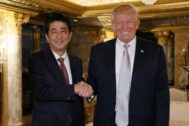
Once every four years, our Regional Overview attempts to reassure our readers that, despite a new US administration and/or new secretary of state, US Asia policy will remain generally consistent. This year we are trying to reassure ourselves. It is, of course, premature to be making firm pronouncements about an incoming administration’s policies, but by now signals are usually becoming pretty clear. It seemed safe to assume (as we did at the time), that the incoming Obama administration would pursue the same general policies and national security objectives in the Asia-Pacific as its predecessor: support for existing alliances as the foundation of regional security policy, constructive engagement with China, support for free trade and promotion of human rights, and a strong deterrence posture regarding North Korea, combined with firm support for nonproliferation regimes. This could yet be the case for the incoming Trump administration, but the signals are, at best, mixed, in part because we find ourselves responding to tweets – which transition team spokesmen caution should be taken “symbolically” not literally – rather than clear policy pronouncements. As a result, regional leaders, while hoping for the best (or at least more of the same) seem to be preparing themselves for a variety of outcomes, even as some try to shape the future environment.
US - Japan
September — December 2016US-Japan Relations and the Trump Effect
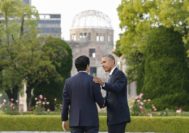
The US presidential election was the primary influence affecting US-Japan relations in the fall of 2016. Japan was brought into the spotlight during the campaign with Trump repeatedly criticizing Tokyo for unfair trade practices and free riding in the alliance. The outcome of the election left many Japanese worried about the future of the alliance. Prime Minister Abe quickly reached out to President-elect Trump, arranging a meeting with him in New York on Nov. 18. Beyond the attention given to the election, the LDP and Abe also sought to support the Obama administration by ratifying the Trans-Pacific Partnership and promoting maritime capacity building in Southeast Asia. President Obama and Prime Minister Abe met for the last time in Hawaii on Dec. 27. Uncertainty abounds on the economic and strategic fronts in the coming year, but the biggest unknown for the bilateral relationship will be the new US president and his approach to Asia.
US - China
September — December 2016China Prepares for Rocky Relations in 2017
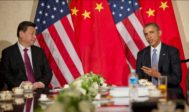
Summits between Barack Obama and Xi Jinping in September and November helped to keep tensions in check in the last four months of 2016. Despite persisting differences over how much pressure to impose on North Korea after Pyongyang conducted its fifth nuclear test, the US and China agreed on a new UN Security Council sanctions resolution. The US Navy conducted another freedom of navigation operation (FONOP) near the Paracel Islands in the South China Sea. A Chinese Navy vessel snatched a US drone, claiming it was threatening the safety of the Chinese ship and its crew, and returned it to the US five days later. Incremental progress was made on trade disputes at the 27th annual US-China Joint Commission on Commerce and Trade (JCCT) in Washington, DC. Meanwhile, the election of Donald Trump as the next US president threatened to inject significant uncertainty into US-China relations as Trump received a phone call from Taiwan’s President Tsai Ing-wen and suggested that he might use Taiwan as a bargaining chip to extract concessions from China on other issues.