Archives
Category: Uncategorized

US - India
January — April 2023An Even Larger Role in Everything
This chapter was made possible through a grant from the Hindu American Foundation.
On May 24, 2022, President Joe Biden met Indian Prime Minister Narendra Modi on the sidelines of the Quad summit in Tokyo. According to the White House readout of the meeting, “The leaders reviewed the progress made in the US-India Comprehensive Global Strategic Partnership. They committed to deepen the Major Defense Partnership, encourage economic engagement that benefits both countries, and expand partnership on global health, pandemic preparedness, and critical and emerging technologies.” While such statements are often aspirational and lag in implementation, the first four months of 2023 show the renaissance in US-India ties to be real.

US - Southeast Asia
January — April 2023Washington Zeroes in on Manila
With an apparent renaissance in the US-Philippine alliance, spurred by rising tensions in the South China Sea and the Taiwan Strait, the Biden administration ramped up diplomatic activity with Manila as the two countries moved toward an official visit from President Ferdinand “Bongbong” Marcos, Jr., in May. At the same time, the 42nd iteration of Cobra Gold, which returned to full strength for the first time since the 2014 coup in Bangkok, suggested momentum in the US-Thailand alliance, albeit with a lower profile. While the international environment continued to be roiled by US-China rivalry, the Russian war in Ukraine, and high food and commodity prices, Southeast Asia’s own internal turmoil was evident. The junta in Myanmar extended the state of emergency and stepped up aerial bombing of areas held by the opposition and armed ethnic groups. As Indonesia takes up the ASEAN chair, prospects for implementing the Five-Point Consensus Plan are dim, if not dead. Vietnam and Thailand began leadership transitions—Hanoi with an anti-corruption purge and Bangkok with the launch of general elections—while Cambodian Prime Minister Hun Sen continued to eviscerate the opposition ahead of his near-certain re-election in July.
China - Southeast Asia
January — April 2023China Strengthens Regional Leadership Countering US Challenges
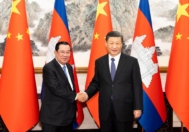
Southeast Asia featured prominently in Beijing’s increasingly strong international efforts to portray China as a source of strategic stability and economic growth with comprehensive global governance plans supportive of interests of developing countries and opposing the United States. These efforts intensified after the landmark 20th Party Congress in October and the 14th National People’s Congress in March. They were reinforced as Xi Jinping emerged from COVID restrictions and preoccupation with domestic matters to engage actively in summitry with leaders of Vietnam, Laos, the Philippines, Cambodia, Malaysia, and Singapore. China’s economic importance for regional countries grew as did its dominance over the contested South China Sea. Its show of force against Taiwan in April had little discernible impact on China-Southeast Asia relations, while notable US advances in military cooperation with the Philippines warranted Chinese warnings that escalated during the reporting period.

China - Taiwan
January — April 2023Confrontation Muted, Tensions Growing
As 2023 began, cross-Strait confrontation was muted. Travel began returning to pre-COVID levels across the Strait and between the mainland and Taiwan’s offshore islands. At China’s annual National People’s Congress, outgoing Premier Li Keqiang and reanointed President Xi Jinping eschewed inflammatory rhetoric about reunification with Taiwan. Taiwan and the US kept Taiwan President Tsai Ing-wen’s transit of the US low-key. Tsai met House Speaker Kevin McCarthy in California, deflecting the speaker’s expressed interest in visiting Taiwan and avoiding the destabilizing Chinese military exercises around Taiwan that followed Speaker Pelosi’s visit last August. Despite this calm, seeds of confrontation proliferated. China cut a communications cable to Taiwan’s offshore islands and announced a coast guard drill to inspect commercial shipping in the Taiwan Strait, both interpreted as practice for gray-zone coercion. China persuaded Honduras to sever its longstanding diplomatic ties with Taiwan. Taiwan increased its military budget and expanded training with US forces. Former Taiwan President Ma Ying-jeou visited China and met Chinese officials, endorsing the 1992 Consensus and signaling that the upcoming election campaign for Taiwan’s president will again offer two very different visions of Taiwan’s future relationship with mainland China.

North Korea - South Korea
January — April 2023North Cranks up Nukes—and Slams Down the Phone
The first four months of 2023 brought no progress or respite in inter-Korean relations. Pyongyang sent no further drones into Southern airspace as it had in December, but continued to rattle Seoul with tests of advance weaponry and ever more lurid nuclear rhetoric. South Korea hardened its language and stance, with a restored emphasis on human rights in the North—now officially defined as an enemy once more. ROK President Yoon Suk Yeol also found enemies within: leftists who made contact with the DPRK in third countries were no longer ignored but prosecuted. More ominously, so were four top officials who served the previous president, Moon Jae-in, over how they handled two difficult inter-Korean incidents in 2019-20. Elsewhere, Seoul complained in vain about Pyongyang’s abuse of its assets in two defunct joint ventures: stealing some, destroying others. Soon after, the North stopped answering the phone. It is hard to see how North-South relations will improve, but all too easy to imagine them getting even worse.

China - Korea
January — April 2023Deepening Suspicions and Limited Diplomacy
China and South Korea began 2023 with the temporary imposition of tit-for-tat restrictions by both governments on travel to the other country after China lifted its zero-COVID policy. Although the restrictions proved temporary, they pointed to the reality of a sustained downward spiral in China-South Korea relations accompanied by increasingly strident public objections in Chinese media to the Yoon Suk Yeol administration’s steps to redouble South Korean alignment with the United States regarding Indo-Pacific strategy, supply chain resiliency, and shared values. South Korean Minister of Foreign Affairs Park Jin’s congratulatory call to newly appointed Chinese Minister of Foreign Affairs Qin Gang on Jan. 9 was one of the few positive senior-level interaction between the two countries in early 2023; by the end of April, the main diplomatic interactions between China and South Korea had devolved into a dueling exchange of private demarches and public assertions that the other side had committed a “diplomatic gaffe.”
Japan - China
January — April 2023Talking—But Talking Past Each Other
The 17th China-Japan Security Dialogue resumed in late February after a four-year pause but produced no resolution to outstanding problems. In early April, Chinese and Japanese foreign ministers also met for the first time since 2019, with the four-hour meeting similarly unproductive. The Chinese side expressed annoyance with Tokyo for its cooperation with the United States, its support of Taiwan, the release of Fukushima nuclear-contaminated wastewater into the ocean, and Tokyo’s recent restrictions on semiconductor equipment exports. The Japanese foreign minister sought, but did not obtain, information on a Japanese national who had been arrested on spying charges, complained about Chinese intrusions into the territorial waters around the disputed Diaoyu/Senkaku Islands, and stressed the importance of stability in the Taiwan Strait. There was no mention of the long-postponed state visit of Xi Jinping to Tokyo as a matter of reciprocity for former Prime Minister Abe Shinzo’s visit to Beijing.
Japan - Korea
January — April 2023The Return of Shuttle Diplomacy
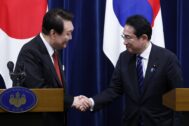
In March 2023, Japan and South Korea had a long-awaited breakthrough in their bilateral relations, which many viewed as being at the lowest point since the 1965 normalization. On March 16, South Korean President Yoon Suk Yeol and Japanese Prime Minister Kishida Fumio held a summit in Tokyo and agreed to resume “shuttle diplomacy,” a crucial mechanism of bilateral cooperation that had been halted for about a decade. Behind the positive developments was President Yoon’s political decision on the issue of compensating wartime forced laborers. The two leaders took steps to bring ties back to the level that existed prior to actions in 2018 and 2019, which precipitated the downward spiral in their relationship. Japan decided to lift the export controls it placed on its neighbor following the South Korean Supreme Court ruling on forced labor in 2018. South Korea withdrew its complaint with the World Trade Organization on Japan’s export controls. Less than a week after the summit, Seoul officially fully restored the information sharing agreement (GSOMIA) that it had with Tokyo. They also resumed high-level bilateral foreign and security dialogues to discuss ways to navigate the changing international environment together as partners.
China - Russia
January — April 2023War and Peace for Moscow and Beijing
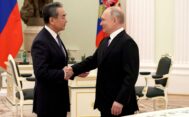
Perhaps more than any other time in their respective histories, the trajectories of China and Russia were separated by choices in national strategy. A year into Russia’s “special military operation” in Ukraine, the war bogged down into a stalemate. Meanwhile, China embarked upon a major peace offensive aimed at Europe and beyond. It was precisely during these abnormal times that the two strategic partners deepened and broadened relations as top Chinese leaders traveled to Moscow in the first few months of the year (China’s top diplomat Wang Yi, President Xi Jinping, and newly appointed Defense Minister Li Shangfu). Meanwhile, Beijing’s peace initiative became both promising and perilous as it reached out to warring sides and elsewhere (Europe and the Middle East). It remains to be seen how this new round of “Western civil war” (Samuel Huntington’s depiction of the 1648-1991 period in his provocative “The Clash of Civilizations?” treatise) could be lessened by a non-Western power, particularly after drone attacks on the Kremlin in early May.
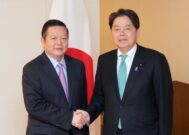
Japan - Southeast Asia
May 2022 — April 2023Great Power Politics: The Indo-Pacific, Southeast Asia, and the Global South
2023 marks the 50th Year of ASEAN-Japan Friendship and Cooperation, and there are expectations that their relationship will be upgraded to a “comprehensive strategic partnership.” Given the good diplomatic, security, and economic relations between Japan and Southeast Asian states, ties are likely to be strengthened. However, Japan is now taking a more competitive strategy toward China, as indicated in the three security documents issued in December 2022, while Southeast Asian states generally continued the same strategic posture by which they have good relations with all great powers in the Indo-Pacific region. Also, while Japan issued the “New Plan for the Free and Open Indo-Pacific” that emphasizes the “Global South,” it remained silent about ASEAN centrality and unity in the Indo-Pacific, and it was unclear what roles Japan expects ASEAN to play. Although both Japan and Southeast Asian states need to adjust their roles in the Indo-Pacific region, it remains to be seen whether the 50th anniversary becomes an opportunity for clarification.