Archives
Category: Uncategorized
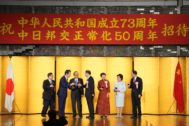
Japan - China
September — December 2022A Period of Cold Peace?
In the sole high-level meeting in the reporting period, on the sidelines of the APEC meeting in Bangkok in November, General Secretary/President Xi Jinping and Prime Minister Kishida Fumio essentially talked past each other. At an earlier ASEAN+3 meeting in Phnom Penh, Premier Li Keqiang and Kishida not only talked past each other but pointedly walked past each other. There was no resolution of major issues: the Chinese position is and remains that Taiwan is a core interest of the PRC in which Japan must not interfere. Japan counters that a Chinese invasion would be an emergency for Japan. On the islands known to the Chinese as the Diaoyu and to the Japanese as the Senkaku, Tokyo considers them an integral part of Japan on the basis of history and international law while China says the islands are part of China. On jurisdiction in the East China Sea, Japan says that demarcation should be based on the median line and that China’s efforts at unilateral development of oil and gas resources on its side of the median are illegal. Beijing does not recognize the validity of the median line.
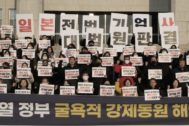
Japan - Korea
September — December 2022Japan and South Korea as Like-Minded Partners in the Indo-Pacific
The last four months of 2022 saw a flurry of bilateral diplomatic activities between Japan and South Korea in both nations’ capitals and around the world. They focused on 1) North Korea, 2) the issue of wartime forced labor, and 3) the future of Seoul-Tokyo cooperation in the Indo-Pacific region. Despite mutual mistrust and the low approval ratings of Prime Minister Kishida Fumio and President Yoon Suk Yeol, both leaders had the political will to see a breakthrough in bilateral relations. Another signal came in the form of new strategy documents in which Seoul and Tokyo explained their foreign and security policy directions and goals. On Dec. 16, the Kishida government published three national security-related documents—the National Security Strategy (NSS), the National Defense Strategy (NDS), and the Defense Buildup program. On Dec. 28, the Yoon government unveiled South Korea’s Strategy for a Free, Peaceful, Prosperous Indo-Pacific Region, its first-ever Indo-Pacific strategy. Although each document serves a somewhat different purpose, it is now possible to gauge how similarly or differently Japan and South Korea assess challenges in the international security environment, and how they plan to respond to them.
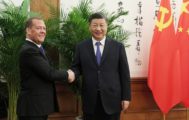
China - Russia
September — December 2022Ending the War? Or the World?
As the Ukraine conflict was poised to expand, the “extremely complicated” situation at the frontline (in Vladimir Putin’s words on Dec. 20) gave rise to intensified high-level exchanges between Moscow and Beijing as they searched for both an alternative to the conflict, and stable and growing bilateral ties. As the Ukraine war dragged on and mustered a nuclear shadow, it remained to be seen how the world would avoid what Henry Kissinger defined as a “1916 moment,” or a missed peace with dire consequences for not only the warring parties but all of civilization.
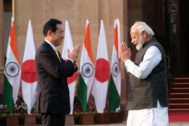
India - East Asia
January — December 2022India’s Ongoing “Strategic Correction to the East” during 2022
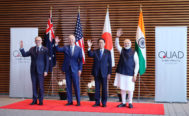
India’s East Asia relations in 2022 followed the arc articulated by External Affairs Minister S. Jaishankar’s address at Chulalongkorn University in Thailand in August. He recalled three decades ago India made a “strategic correction to the East…[o]riginally…contemplated as an economic measure, with trade and investment at its core” and mostly focused on ASEAN. He said the geography, concepts, and assessments of India’s Indo-Pacific vision have expanded “to cover Japan, Korea and China, and in due course, Australia as also other areas of Pacific Islands…[and] facets of cooperation also increased…now cover[ing] connectivity in various forms, people-to-people ties and more recently, defense and security.” And while dutifully referencing India’s Indo-Pacific policies including Security and Growth for All in the Region (SAGAR) and the Indo-Pacific Oceans’ Initiative (IPOI), he gave the most attention to the revitalized Quadrilateral Security Dialogue (“Quad”). The highlights of India in East Asia in 2022 were numerous Quad meetings, the inaugural India-ASEAN Defense Ministers’ Meeting, the second India-Japan 2+2 Ministerial Dialogue, the Australian deputy prime minister and minister for defense’s visit to India, and India’s defense minister visits to Vietnam and Mongolia. Defense and security engagement included numerous exercises, defense dialogues, military-to-military exchanges, and navy ship visits.
Regional Overview
May — August 2022Washington “Pivots” to Asia
The Biden administration has rediscovered Asia. And, for better or worse, so has the US Congress. While the administration’s national security documents (or at least their unclassified sneak previews) have identified the Indo-Pacific as a priority theater vital to US national security and China as “our most consequential strategic competitor and the pacing challenge,” Europe continues to steal headlines and the lion’s share of the administration’s (and international media’s) attention, thanks to Vladimir Putin and his unwarranted (and so far unsuccessful) invasion of Ukraine.
While many eyes remain on Putin’s war (and NATO’s US-led solid support for Kyiv), this reporting period saw President Biden finally make his first trip to Asia to visit longstanding US allies and attend the second in-person Quadrilateral Security Dialogue (“Quad”) Summit. Prior to his trip, Biden hosted his first US-ASEAN Summit in Washington. Meanwhile Secretary of Defense Lloyd Austin and Secretary of State Antony Blinken were both in Southeast Asia, respectively for the Shangri-La Dialogue and for various ASEAN-driven ministerials. These administration trips were largely overshadowed, however, by US Speaker of the House Nancy Pelosi’s controversial trip to Taiwan, the first by a House Speaker in 25 years, which was sure to—and clearly did—draw Beijing’s ire.
The US administration also (finally) put some meat on the bones of its Indo-Pacific Economic Framework, even though (like Obama’s earlier pivot) the trade and economic dimension of the administration’s Indo-Pacific Strategy remains the least developed. The military dimension of the strategy was much more in evidence, highlighted by the Rim of the Pacific (RIMPAC) exercise and a number of other multilateral training events throughout the region. Multilateralism will continue to capture the headlines as we move into the year’s third trimester with the ASEAN-driven East Asia Summit and Asia-Pacific Economic Cooperation (APEC) Leaders’ Meeting sharing pride of place with the Indonesia-hosted G20 Summit.

US - Japan
May — August 2022Abe’s Legacy and the Alliance Agenda
It was a busy summer for the United States and Japan. President Joe Biden visited Asia, stopping first in Seoul to meet new South Korean President Yoon Suk Yeol, and then spending two days in Tokyo for a bilateral summit with Prime Minister Kishida Fumio and a follow-on meeting with the two other leaders of the Quad, Indian Prime Minister Narendra Modi and Australia’s newly elected prime minister, Anthony Albanese. Biden announced his Indo-Pacific Economic Framework in Tokyo with Kishida by his side. Economic security legislation in both Japan and the United States revealed the unfolding strategic calculations for the alliance. National efforts to enhance economic productivity and resilience included efforts to ensure reliable supply chains for Japanese and US manufacturers as well as the desire for greater cooperation among the advanced industrial economies to dominate the next generation of technological innovation. State investment in attracting semiconductor suppliers to Japan and the United States demonstrate the urgency with which both governments seek to diminish reliance on critical technology imports.
Despite all the diplomatic planning that accompanied these developments, the summer was not without surprises. In Japan, the sudden death of former Prime Minister Abe Shinzo, at the hand of a lone gunman, shocked a nation known for its relatively low rate of gun violence. Across the globe, leaders praised Abe’s statesmanship and his strategic vision—his ability to meet Japan’s moment of challenge as the rules-based order was under threat.
Only weeks later, the United States and China found themselves in a high-stakes military standoff over Taiwan. US Speaker of the House Nancy Pelosi rescheduled her Asia tour after having to cancel it in April due to COVID-19. Her itinerary leaked, and her intention to visit Taiwan drew China’s ire. A top commentator for the Global Times tweeted that China’s People Liberation Army (PLA) had the right to shoot down Pelosi’s plane if she did. And a highly charged demonstration of Chinese military power ensued. The PLA exercises conducted after her departure directly involved Japan as missiles landed in its exclusive economic zone (EEZ). The United States ensured that its military was close at hand to dissuade miscalculation.
US - China
May — August 2022US-China Relations Sink Further Amid Another Taiwan Strait Crisis
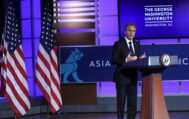
Nancy Pelosi’s August visit to Taiwan—the first visit by a speaker of the US House of Representatives in 25 years—was met by a strong response from China that included provocative military exercises, punitive economic measures against Taiwan, and the suspension and cancellation of a series of dialogues with the United States. Just prior to Pelosi’s visit, Presidents Joe Biden and Xi Jinping held their fifth virtual conversation since Biden’s inauguration. Secretary of State Antony Blinken delivered a comprehensive speech on the administration’s China strategy in late May. Biden officials debated whether to lift some of the tariffs imposed on China under the Trump administration, but as of the end of August, there was no decision to do so. Human rights remained on the US agenda, with statements issued on the anniversary of the June 4, 1989 Tiananmen massacre and on the 25th anniversary of the handover of Hong Kong to the PRC, and a ban imposed on imports into the US of products made by forced labor in Xinjiang. US Secretary of Defense Lloyd Austin held his first face-to-face meeting with Chinese Defense Minister Wei Fenghe at the Shangri-La Dialogue in Singapore.

US - Korea
May — August 2022Split Images
Lopsided: such was the state of US relations with the two Koreas during May-August 2022. The Washington-Seoul axis mostly flourished on the military/security, diplomatic, economic, and cultural fronts, while Washington and Pyongyang deepened doldrums whose depths had been plumbed in prior reporting periods. For the former, the most significant items included the May inauguration of conservative South Korean President Yoon Suk Yeol and quick follow-on summit with US President Joe Biden, increasing trilateral US-South Korea-Japan cooperation, a raft of announcements on US-South Korea economic and technology cooperation, the resumption of field maneuvers in US-South Korea joint military exercises, and South Korea’s continuing growth as a serious middle power player in foreign policy, including stepped-up engagement with NATO. In US-North Korea relations, a COVID-19 outbreak failed to lead the Kim Jung Un regime to open up to outside humanitarian assistance, as Pyongyang remained content to keep borders mostly closed and allow the virus to course through the population with only basic prophylactic measures. On the positive side, Pyongyang’s hyperactive missile testing in spring slowed during summer, and a feared (yet still expected) seventh nuclear test failed to materialize.
US - India
May — August 2022Relations at 75: Hawaii to the Himalayas
This chapter was made possible through a grant from the Hindu American Foundation
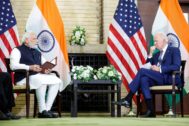
Like the saying, “after the storm comes the calm,” US-India relations witnessed four months of productive talks, cooperation, and collaboration. This contrasted with the previous trimester, mired as it was by Cold-War era differences brought about by the Russia-Ukraine conflict. There were thriving Indo-Pacific synergies and the decline of Cold War-era differences. The US and India continued and expanded cooperation on a wide array of regional and global issues, such as climate change, supply chains, and the Sri Lankan crisis. They solidified their defense partnership from Hawaii to the Himalayas through navy and military exercises. The US turned down pressure on India over Russian oil purchases and recalibrated the dialogue to address other pressing challenges. They did not avoid tough conversations, however. India reinforced its view of the US and other Western nations’ role in keeping the Indo-Pacific a safer and more open region.
While minor differences remain, the two democracies found common ground in addressing what they both consider to be the most pressing challenges: China’s belligerent actions and the existential threat of climate change. Their targeted actions to address the two issues became more overt and coordinated. Through the launch of initiatives such as the Indo-Pacific Economic Framework (IPEF), the Biden administration reentered the Asian economic architecture—though not through a trade agreement—bringing otherwise-hesitant economies, including India, into the fold.
Domestically, Biden and Modi were both preoccupied with amending historic injustices and preparing their societies and economies for 21st century challenges.

US - Southeast Asia
May — August 2022Washington Revs Up Diplomacy with Southeast Asia
The Biden administration’s diplomatic campaign in Southeast Asia kicked into high gear in the late spring and continued through the summer. On May 12-13 President Biden co-hosted, with Cambodian Prime Minister Hun Sen as the 2022 ASEAN chair, the first-ever US-ASEAN Special Summit to be held in Washington, DC. US relations in the region were also boosted when the Biden administration launched the long-awaited Indo-Pacific Economic Framework (IPEF) on May 23; seven Southeast Asian countries indicated interest in joining, although few are likely to accede to all four pillars of the framework in the near-term. Two Cabinet officials made visits to two US treaty allies: Secretary of Defense Lloyd Austin to Thailand in June and Secretary of State Anthony Blinken to the Philippines in August. Notwithstanding continuing differences over human rights, the visits served to reaffirm the bilateral alliances. However, global and regional tensions remained high, over the persistent crisis in Ukraine; brinksmanship in the Taiwan Straits; and the internal conflict in Myanmar which has only deteriorated further. These pressures only divided ASEAN further as the region looks ahead to a trifecta of international meetings—APEC, East Asia Summit, and the G20—in the fall.
Political activity was also at high levels, with elections in the Philippines; a surprise move by the Constitutional Court of Thailand to suspend Prime Minister Prayuth Chan-ocha; and a prison sentence for former Malaysian Prime Minister Najib Razak. In Thailand, Cambodia, Malaysia, Indonesia and possibly Myanmar, current political dynamics will help set the stage for elections in 2023 and 2024.