Archives
Category: Uncategorized
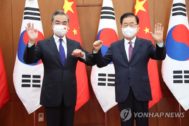
China - Korea
September — December 2021Economic Stabilization, End-of-War Declaration, and the Ongoing “Joint Struggle”
During the waning months of 2021, China and South Korea worked together to stabilize and strengthen their economic relationship and the Moon administration reached out to China as part of its full-court press to achieve an end-of-war declaration prior to the end of Moon’s term in May of 2022. Through several foreign minister-level meetings between Chung Eui-young and Wang Yi, including Wang’s visit to Seoul for a meeting with President Moon, an exchange held in Tianjin between national security advisors, and regular bilateral economic consultations, the two countries improved economic cooperation and sustained close consultation on peninsula-related issues. The most significant outcomes of these discussions included the first release of a major Korean movie in Chinese theaters since 2015 and ongoing efforts to bilaterally support the digital, technological, and climate change dimensions of Sino-South Korean economic cooperation. China offered support for Moon administration efforts to end the Korean War through pursuit of phased and synchronized actions and discouraged relevant countries from taking destabilizing unilateral moves.
Meanwhile, North Korea’s missile tests in September-October frustrated hope for regional diplomacy as Beijing and Pyongyang jointly commemorated their 72-year-old “joint struggle to defend and glorify socialism” by marking national and bilateral anniversaries. Their official statements, however, lacked substantive outcomes in China-DPRK diplomatic exchanges. Post-pandemic trade remained stalled as both leaderships turned to self-reliance in their national development strategy.
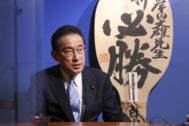
Japan - China
September — December 2021Red Lines Are Tested
Chinese Communist Party leader Xi Jinping’s long-expected and often postponed—even before the pandemic—state visit to Japan was not even spoken of during the reporting period. In the closing days of the year, the defense ministers of the two countries met virtually but, at least according to published accounts, simply reiterated past positions and hopes for cooperation in the interests of regional stability. Japan did not receive the assurances it sought on the implications of the PRC’s new Coast Guard law. China repeatedly pressed the Japanese government for support for the Beijing Winter Olympics, expressing dissatisfaction with the lack of official representation announced by Tokyo. Although trade was brisk, economic growth in both countries remained impacted by quarantines and the uncertain investment climate in China. China complained about closer Taiwan-Japan relations

Japan - Korea
September — December 2021Awaiting a Breakthrough? PM Kishida and South Korea’s Presidential Candidates
The year 2021 ended with no breakthroughs in Japan-Korea relations. Bilateral ties remain stalled over South Korea’s 2018 Supreme Court ruling on forced labor during Japan’s occupation of the Korean Peninsula and Japan’s export restrictions placed in 2019 on key materials used for South Korea’s electronics industry. The inauguration of Kishida Fumio as Japan’s new prime minister in September did not lead to a new momentum for addressing these bilateral issues, as both Tokyo and Seoul adhered to their positions. Prime Minister Kishida, while acknowledging that Japan’s relationship with South Korea should not be left as is, largely reiterated Tokyo’s official stance from the Abe and Suga governments that Seoul should first take steps on the forced labor issue. South Korean President Moon Jae-in sent a letter congratulating Kishida on his inauguration, signaling willingness to talk about bilateral challenges. Developments in the final months of 2021 are a reminder that there is no easy solution to these issues in sight.
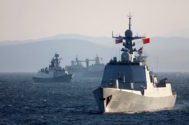
China - Russia
September — December 2021Not So Quiet in the Western Pacific
For Moscow and Beijing, relations with Washington steadily deteriorated toward the yearend. This was in sharp contrast from early 2021 when both had some limited expectations for relaxed tensions with the newly inaugurated Biden administration. For Russian President Vladimir Putin and his Chinese counterpart Xi Jinping, each of their meetings (real and virtual) with Biden was frontloaded with obstacles: US sanctions, a boycott of the 2022 Winter Olympics, and screw-tightening at strategic places (Taiwan and Ukraine). Biden’s diplomacy-is-back approach—meaning US-led alliance-building (the Quadrilateral Security Dialogue and AUKUS for China) or reinvigorating (NATO for Russia)—turned out to be far more challenging than Trump’s erratic go-it-alone style. It was against this backdrop that China and Russia enhanced their strategic interactions in the last few months of 2021, particularly mil-mil relations at a time of rising tensions in the western Pacific.
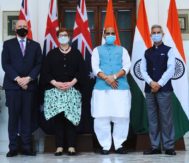
India - East Asia
January — December 2021Focused on the “Quad” and Border Disputes with China
India’s relations with East Asia during 2021 were characterized by two major developments; increasing interaction with the United States, Japan, and Australia as part of the “Quad” and painstaking efforts at border disengagement and dispute management with China. Within these preoccupations, India continued a robust if undramatic set of engagements (mostly virtually) across East Asia. India’s active East Asia engagements were notable, coming as they did amid New Delhi taking up a nonpermanent seat of the United Nations Security Council, finding its footing with the new Biden administration, addressing a February coup next door in Myanmar, battling a major wave of the delta variant of the COVID-19 virus, and contending with the fallout of the US withdrawal from Afghanistan in the summer, as well as participating in the COP26 Summit and the Summit for Democracies that President Biden hosted at the end of the year.
Regional Overview
May — August 2021Europe “Discovers” Asia and Washington “Discovers” SEA, Amid Afghan Anxiety
Joe Biden pledged that the US would resume its traditional role as leader of US alliances, supporter of multilateralism, and champion of international law and institutions. Throughout its first nine months, his administration has labored to turn those words into reality, and for the first six months the focus was on Asia, at least Northeast Asia. During this reporting period, Biden himself worked on multilateral initiatives and while the primary venues were Atlanticist–the G7 summit, NATO, and the European Union–Asia figured prominently in those discussions. Chinese behavior loomed large in European discussions as NATO allies conducted ship visits and military exercises in the region to underscore these concerns. Meanwhile, a number of senior US foreign policy and security officials visited Asia, and Southeast Asia in particular, amidst complaints of neglect from Washington. Concerns about Chinese pressure against Taiwan also grew in the region and beyond. The impact of the US withdrawal from Afghanistan, messy as it appeared to be, has thus far not resulted in a crisis of confidence regarding US commitment to the region.
US - Japan
May — August 2021Summer Takes an Unexpected Turn
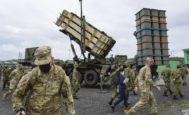
By the end of spring, the US-Japan relationship was centerstage in the Biden administration’s Indo-Pacific diplomacy. From the first Quad (virtual) Summit to the visit of Prime Minister Suga Yoshihide to Washington, DC, relations between Tokyo and Washington could not have been better. A full calendar of follow-up meetings for the fall suggested even further deepening of the partnership. And on Aug. 20, President Joe Biden announced that he intended to nominate Rahm Emanuel, former mayor of Chicago and chief of staff for President Obama, as ambassador to Japan. Throughout the summer, the US and Japan continued to deepen and expand the global coalition for Indo-Pacific cooperation. The UK, France, and even Germany crafted their own Indo-Pacific visions, as did the EU. Maritime cooperation grew as more navies joined in regional exercises. Taiwan featured prominently in US-Japan diplomacy, and in May the G7 echoed US-Japan concerns about rising tensions across the Taiwan Straits. Japanese political leaders also spoke out on the need for Japan to be ready to support the US in case tensions rose to the level of military conflict.
US - China
May — August 2021The Descent Continues
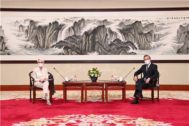
The downward slide in US-China relations continued as the two countries wrangled over Hong Kong, COVID-19, Taiwan, the South China Sea, Xinjiang, and cyberattacks. US Deputy Secretary of State Wendy Sherman and Chinese officials met in Tianjin but appeared to make no progress toward managing intensifying competition between the two countries. The US rolled out a series of measures against alleged Chinese forced labor practices and strengthened the prohibition against US investments in the PRC’s military industrial complex. Deteriorating freedoms in Hong Kong prompted the Biden administration to impose more sanctions on Chinese officials and issue a business advisory warning US companies of growing risks to their activities in Hong Kong.
Beijing retaliated by imposing sanctions on US citizens under its new Anti-Foreign Sanctions Law. In close coordination with its European allies, the US condemned the PRC’s use of criminal contract hackers to conduct unsanctioned cyber operations around the world, including attacks on Microsoft’s Exchange Server in March 2021. Chinese and US officials in charge of trade and economic relations held virtual meetings, but tariffs imposed by both sides during the Trump administration remained in place. Biden officials maintained that they are conducting “a robust, strategic review” of the US economic relationship with China. As the Taliban assumed control in Afghanistan, US and Chinese officials exchanged views, but the prospects for coordination and cooperation appeared dim.
US - Korea
May — August 2021Stir Not Murky Waters
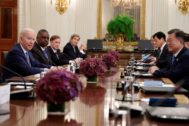
US relations with both South and North Korea were—with a few notable exceptions—uneventful during the May-August 2021 reporting period. If US-Korea relations displayed some excitement, it was largely along the Washington-Seoul axis. An inaugural leader summit between Presidents Joe Biden and Moon Jae-in took place in Washington, producing significant deliverables for the short, medium, and long term. Biden and Moon then participated in the June G7 summit in Great Britain. The US withdrawal from Afghanistan in August also provided South Korea with challenges and ponderables. Washington-Pyongyang communication was subdued, aside from standard North Korean criticism of US-South Korea joint military exercises. Even when the US and North Korea addressed each other with respect to dialogue, it was usually to underline for the other party how Washington or Pyongyang is willing to talk under the right circumstances, but capable of waiting out the other side. Late August added some spice, however, as the IAEA issued a credible report confirming what many had expected: North Korea has likely re-started fissile material production at the Yongbyon complex. Finally, outside the reporting period, Pyongyang tested a potentially nuclear-capable land-attack cruise missile on Sept. 11. Are these signs that sleeping dogs are stirring?

US - Southeast Asia
May — August 2021Washington Finds Its Feet in Southeast Asia
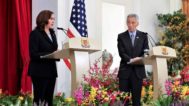
In the months immediately following Joe Biden’s inauguration, Southeast Asia was on the backburner in US foreign policy, but in May the administration heeded calls for a stronger voice and more active role in the region with a succession of visits by high-level officials, culminating in Kamala Harris’s first trip to the region in her role as vice president. The cumulative impact remains to be seen, but one key “deliverable”—the renewal of the US-Philippines Visiting Forces Agreement (VFA) during Secretary of Defense Lloyd Austin’s visit to Manila—was enough to label the summer strategy a success. More broadly, the administration responded to the surge of the COVID Delta variant in Southeast Asia with donations of vaccines, making considerable strides in the “vaccine race” with China and Russia.