Archives
Category: Uncategorized
North Korea - South Korea
May — August 2023In Both Pyongyang and Seoul, an Ominous Hardening
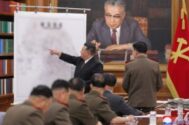
In mid-2023, the (non-existent) relations between the two Koreas got even worse, if that were possible. Confronting enlarged US-ROK military exercises, and the first visit of a US nuclear-armed submarine to the peninsula since 1981, Pyongyang’s nuclear threats grew ever more frenzied. In Seoul, President Yoon Suk Yeol institutionalized his hard line by downsizing and repurposing the Ministry of Unification (MOU). Criticizing MOU for acting in the past as a support department for North Korea, Yoon evidently conceives its future role as being to hinder Kim Jong Un’s regime—publicizing its human rights abuses, for instance—rather than help. Much as the DPRK’s ever-expanding WMD threat requires robust deterrence, for Seoul to start emulating Pyongyang’s unalloyed hostility hardly seems conducive to peace. The period under review also saw two attempts by North Korea to put a spy satellite into orbit; both failed. By contrast, the North’s missile launches hardly ever go wrong these days. The large solid-fuel Hwasong-18 ICBM, with a 15,000-km (9,300-mile) range, which first flew in April, had a second successful test on July 12.
China - Korea
May — August 2023Economic Security Dilemmas
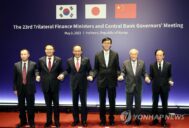
PRC Ambassador to South Korea Xing Haiming’s public statement in June sharpened Beijing-Seoul frictions following President Yoon Suk Yeol’s Taiwan remarks in an April interview, sparking mutual accusations of interference in internal affairs. Multilateral engagements offered opportunities to reaffirm China-ROK relations through bilateral talks between China’s Commerce Minister Wang Wentao and South Korea’s Trade Minister Ahn Duk-geun (May), Defense Ministers Li Shangfu and Lee Jong-sup (June), Foreign Ministers Wang Yi and Park Jin (July), Finance Ministers Liu Kun and Choo Kyung-ho (July), and Trade Ministers Wang Shouwen and Ahn (August). The revival of high-level exchanges, Beijing’s lifting of travel restrictions on South Korea in August, and North Korea’s border reopening that same month are sources of optimism in China-Korea relations despite overarching tensions. Discord remains on regional security priorities, South Korea’s overt alignment with the United States under the Yoon administration, and the escalating US-China technology war. Meanwhile, Chinese and Russian delegations joined Kim Jong Un in Pyongyang to celebrate the 70th anniversary of the end of the Korean War, reflecting the shape of North Korea’s first post-COVID diplomatic activity.
Japan - China
May — August 2023From Talking Past Each Other to Barely Talking
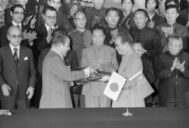
China’s mid-August decision to allow group travel to Japan days ahead of the 45th anniversary of the Treaty of Peace and Friendship between the two nations as well as indications that China would be open to a meeting between Xi Jinping and Fumio Kishida on the sidelines of the Group of 20 (G20) leaders’ summit in India in September gave hope for improvement in China-Japan ties. The optimism proved short-lived. Chinese media responded that Japan would first have to turn away from following the US lead, stop encouraging Taiwanese pro-independence forces, and strictly abide by the four communiques signed between Beijing and Tokyo. China’s protests over Japan’s release of radioactive water culminated in a total ban on Japanese marine products. The PRC also expressed annoyance with Japanese restrictions on the export of computer chips, the ministry of defense’s release of its annual Defense of Japan 2023 white paper, Tokyo’s closer relations with NATO, and its tripartite agreement with South Korea and the US. Japan expressed uneasiness with Russia-China cooperation and became concerned with renewed Chinese interest in Okinawa, with its purchases of Japanese land, cyberattacks, and its refusal to import Japanese seafood products.

Japan - Korea
May — August 2023Camp David: Institutionalizing Cooperation Trilaterally
Japan-South Korea relations are going strong. In the months leading up to the historic Camp David trilateral summit in August, we saw the return of shuttle diplomacy between Korea and Japan. If President Yoon Suk Yeol’s March visit to Japan was groundbreaking, Prime Minister Kishida Fumio’s May visit to Seoul signified the continued momentum of improving bilateral ties. The Aug. 18 trilateral summit meeting, where President Biden, President Yoon, and Prime Minister Kishida announced bold steps to cement trilateral cooperation into the institutional fabric of the relationship, represents the deepest attempt in recent memory. A successful trilateral summit like this one was possible only because Seoul and Tokyo mended their bilateral ties. A positive cycle is expected the other way around, as well. For example, the “Commitment to Consult” —to expeditiously “share information, align messaging and coordinate response actions” among the three leaders—will likely create more incentives and opportunities for Seoul and Tokyo to keep bilateral relations friendly and cooperative.
China - Russia
May — August 2023Testing the Limits of Strategic Partnership
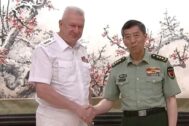
In the summer months, both the upper and lower limits of the China-Russia strategic partnership were put to considerable tests. In the West, China’s peace-probing effort continued despite virtual stalemate in the Ukraine war and its sudden twists and turns (drone attacks on the Kremlin and Wagner mutiny). Beijing treaded carefully in restoring relations with Kyiv with the new Ukrainian ambassador in place. In the East, Russian and Chinese militaries conducted a series of aerial and naval exercises/operations with unprecedented scope and closer interoperability for almost three months (from early June to late August), something not seen even at the peak of the Sino-Soviet alliance in the 1950s. All of this occurred against the backdrop of increasingly hardened US-led alliance networks both in Indo-Pacific and beyond.

Australia has peeled back China trade coercion as it ramps-up the alliance with the United States to balance China. The Labor government, elected in May 2022, claims a diplomatic thaw with China as a key achievement. The major defense step was agreeing for Australia to get nuclear submarines under the AUKUS agreement with Britain and the United States. The government’s 2023 National Defense Statement describes “an intense contest of values” in the Indo-Pacific, with growing “risks of military escalation or miscalculation.” Because of the worsening strategic environment, the Australian Defense Force is judged “not fully fit for purpose” as the government seeks greater long-range strike capability. The era of alliance integration will see more US troops, planes, and ships in Australia, and the creation of a US-Australia combined intelligence center in Canberra. The contest with China in the South Pacific frames a new Australian aid policy and a greater US role in the islands.

Regional Overview
January — April 2023“Like-Minded Minilateralism” Coming of Age
As broad-based multilateral organizations seem to be increasingly unable (or unwilling) to tackle the major security challenges of the day—Russia-Ukraine, China-Taiwan, North Korea, and Myanmar, to list but a few—more focused “minilateral” efforts involving “like-minded” allies and partners are coming to the fore. Foremost among the dysfunctional are the United Nations Security Council (UNSC) and broader UN mechanisms, thanks to Russian and Chinese intransigence. Sadly, ASEAN-led mechanisms like the East Asia Summit and ASEAN Regional Forum, not to mention ASEAN itself, also fall into this category, as does the G20, whose foreign ministers failed to reach any meaningful conclusions at their early March 2023 meeting, their first with India at the helm. Enter the Quadrilateral Security Dialogue (or “Quad,” involving Australia, India, Japan, and the United States), AUKUS (Australia-United Kingdom-US technical cooperation agreement), various minilateral cooperative efforts (including US-Japan-Philippines and US-Japan-Korea), and a resurgent like-minded G7, now that its (failed) experiment of drawing Russia and China into its process has come to an inglorious end. But not all new efforts are succeeding. President Biden hosted his second “Summit of Democracies” which drew little fanfare or attention.
US - Japan
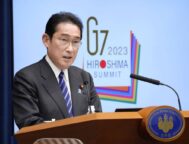
January — April 2023The US and Japan Build Multilateral Momentum
2023 brings a renewed focus on the US-Japan partnership as a fulcrum of global and regional diplomacy. With an eye to the G7 Summit in Hiroshima in mid-May, Prime Minister Kishida Fumio began the year with visits to G7 counterparts in Europe and North America. Later in the spring, he toured Africa in an effort to gain understanding from countries of the Global South. The Joe Biden administration looks ahead to a lively economic agenda, as it hosts the APEC Summit in November on the heels of the G20 Summit in New Delhi in September. National Security Advisor Jake Sullivan laid out in detail the economic ambitions of the Biden national strategy on April 27, giving further clarity to how the administration’s foreign policy will meet the needs of the American middle class. Regional collaboration continues to expand. Both leaders will gather in Australia on May 24 as Prime Minister Anthony Albanese hosts the third in-person meeting of the leaders of the Quad. Also noteworthy in this first quarter of 2023 is the progress in ties between Japan and South Korea.

US - China
January — April 2023US-China Effort to Set “Guardrails” Fizzles with Balloon Incident
The proposed “guardrail” that Joe Biden and Xi Jinping sought to erect last fall in Bali failed to emerge in the bitter aftermath of a wayward Chinese surveillance balloon that overflew the United States and violated its sovereignty. Though Antony Blinken and Wang Yi met on the sidelines of the Munich Security Conference afterward, aspersions cast by each side against the other, including a series of disparaging Chinese government reports, fed the chill in ties. Taiwan President Tsai Ing-wen’s meeting with House Speaker Kevin McCarthy during the return leg of her US transit added to bilateral and cross-strait tensions and were met with Chinese sanctions. Issues pertaining to Taiwan, be it arms sales or a speculated Chinese invasion date of the island, remained contentious. The administration’s attempt to restart constructive economic reengagement with China, including via an important speech by US Treasury Secretary Janet Yellen, appears to have fallen on deaf ears in Beijing.
US - Korea
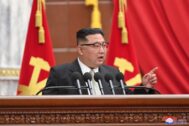
January — April 2023Nuclear New Year
South Korean president Yoon Suk-yeol has tried to make a priority of transforming the traditional US-South Korea military alliance into a “global, comprehensive strategic alliance” with increasing ambitions beyond hard security issues on the Korean Peninsula and in Northeast Asia in general. Yoon and his foreign policy team get an “A” for vision and effort—joining the NATO Asia-Pacific Four (AP4) and releasing an Indo-Pacific Strategy in 2022 are evidence. But, like Michael Corleone trying to go legit in The Godfather III, every time they make progress getting out, they get pulled back into the Peninsula. To wit, during the first trimester of 2023 Korean Peninsula security issues again commanded disproportionate attention from Seoul and Washington. The proximate cause for this dynamic is North Korea’s mafioso-in-chief, Kim Jong Un, who started 2023 with a January 1 missile launch and kept at it throughout the winter. This, of course, followed record-breaking 2022 North Korean missile tests and demonstrations, which totaled approximately 70 launches of around 100 projectiles. Given the near-zero prospects for North Korean denuclearization and the growing arsenal at Pyongyang’s disposal, it is understandable that any South Korean president would be distracted from interests further afield.