Archives
Category: Uncategorized
China - Southeast Asia
May — August 2022Countering US Initiatives, Taiwan Crisis Complications
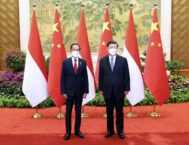
Chinese enhanced activism in Southeast Asia in this reporting period focused on countering Biden administration efforts to enhance influence in the Indo-Pacific. The Chinese government intensified its depiction of the United States as disrupting regional order and portraying itself as the regional stabilizer. Beijing’s effort faced complications and uncertain prospects as Chinese military forces in August launched large-scale provocative shows of force amid strident media warnings targeting the United States over Taiwan.
China - Taiwan
May — August 2022Pelosi’s “Ironclad Commitment” or “Political Stunt” Leads to Crisis and Promises Instability in the Taiwan Strait
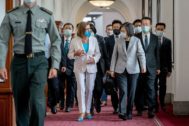
Between May 1 and Sept. 1, tensions between Taiwan and China exploded in ways few anticipated but were in retrospect the culmination of well-established dynamics. The US once again was right in the middle. On Aug. 2, US Speaker of the House Nancy Pelosi arrived in Taiwan, which Taiwan’s government celebrated as the most important visit in at least 25 years by a US politician. She promised Taiwan President Tsai Ing-wen that US support for Taiwan’s security would remain “ironclad.” On Aug. 4, the day after Pelosi departed Taiwan, China signaled its displeasure by conducting the most extensive military exercises ever conducted near Taiwan, closer to the island than any before, and launching ballistic missiles over Taiwan’s capital to land in waters east of the island. Throughout these exercises, the Chinese, Taiwan, and US militaries avoided any interactions that might have provoked confrontation. On Aug. 10, the Chinese military announced that the exercises had concluded, achieving their objectives, but that the military would continue its activities around Taiwan.
This crisis occurred three months after US Secretary of State Antony Blinken delivered a long-awaited speech on US China policy, claiming that policy toward Taiwan and China, and the US commitment to peaceful resolution of any disputes between them, remained unchanged. China rejected Blinken’s claims of US consistency and insisted that Washinging was hollowing out its commitment to respect Beijing’s position as the only legal government of China, including Taiwan. China expressed particular anger at President Biden’s pledges to defend Taiwan and at the continuing series of high-level US officials visiting Taiwan. Beijing warned it would react harshly if Pelosi visited Taiwan, as she had promised to do. She visited, and China reacted, calling her visit a “political stunt.” China laid out its familiar claims to Taiwan in a celebration of the 30th anniversary of the 1992 consensus and again in its third White Paper on cross-Strait relations. All this comes as Chinese commentators repeat expectations that the 20th Congress of the Chinese Communist Party, scheduled for this fall, will reaffirm the party’s tough Taiwan policy.
Largely obscured by these dramatic developments, Taiwan continued to expand its legitimacy as a constructive international actor, attracting more public support from major international actors beyond the US, such as the G7, the European Union, the United Kingdom, Australia, Japan, and South Korea.
North Korea - South Korea
May — August 2022An Inauspicious Start
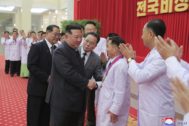
On May 10 Yoon Suk Yeol took office as ROK president, and rapidly lost popularity. While talking tough on North Korea, he also offered aid to fight COVID-19—but was ignored. His “audacious plan,” wholly unoriginal, to reward Pyongyang materially if it denuclearizes, had very little detail. For months the DPRK did not even mention Yoon. In late July Kim Jong Un sharply warned him against any pre-emptive strike. In August, his sister Kim Yo Jong put the boot in: ludicrously blaming materials sent by ROK activists for bringing COVID-19 into the DPRK, savaging Yoon’s proposal as insulting and unoriginal, and saying the North will never talk to him. At home, meanwhile, the new government chose to reopen two contentious inter-Korean episodes from the recent past, seemingly to punish its predecessor’s policies. It was hard to see how good could come of that, or to hold out hope for any thaw on the peninsula.
China - Korea
May — August 2022A Muted 30-Year Anniversary
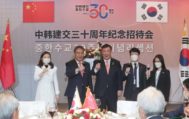
Beijing and Seoul marked 30 years of diplomatic ties on Aug. 24 as South Korea transitioned to a new administration under President Yoon Suk Yeol, who took office in May. Although early high-level exchanges reaffirmed partnership, the two leaderships confront growing pressures from US-China competition, economic uncertainty, and public hostility. Domestic priorities in China in light of the 20th Party Congress and South Korea’s shift to conservative rule amplify these concerns. The impact of US-China rivalry on the China-South Korea relationship extends from security to economic coordination, including approaches to THAAD and global supply chains, and export competition, especially in semiconductors, challenges new Xi Jinping-Yoon economic agreements. Moreover, public hostility is strongest among South Korea’s younger generation, raising pessimistic prospects for future China-South Korea ties.
Despite mixed signals, false starts, and the continued absence of leader-level meetings marking the recovery of economic ties between China and North Korea, geopolitical developments have pushed the two countries closer together. Such engagement features mutual reinforcement of each other’s positions on issues of vital interest and solidarity in response to US policies.
Japan - China
May — August 2022Few Positive Signs and Much Negativity
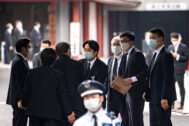
The tone of China-Japan relations became more alarmist on both sides with long-anticipated plans to commemorate the 50th anniversary of the normalization of diplomatic relations still clouded with uncertainty. Several related events were canceled or postponed sine die.
Internationally, Prime Minister Kishida was exceptionally active, attending meetings of the Quad, the G7, NATO, and Shangri-La Dialogue, where he delivered the keynote address. A common theme was attention to a Free and Open Pacific (FOIP) and the need for stability in the region, both of which Beijing sees as intended to constrain China. At NATO, Kishida met with US and South Korean representatives for their first trilateral meeting in nearly five years and suggested the possibility of joint military exercises.
Meanwhile, China continued pressure on Taiwan and the contested Diaoyu/Senkaku Islands. Although Foreign Minister Wang Yi and State Councillor Yang Jieqi were active internationally, Xi Jinping himself has not ventured outside the Chinese mainland since January 2020 save for a brief, tightly controlled visit to Hong Kong, which is unquestionably part of China. Speculation ranged from concern with his health to worries that he might be toppled by unnamed enemies—who these enemies are and what degree of influence they wield are the topics of much discussion, since Xi has through selective arrests of potential rivals and the country-wide imposition of his thoughts, effectively silenced public expression of dissident opinions.
After former Prime Minister Abe was assassinated on July 8 in an incident unrelated to foreign policy, the Chinese government sent condolences, though no Chinese representative attended the wake. A state funeral is to be held in the fall, with much speculation on who will represent the PRC.
Japan - Korea
May — August 2022The Passing of Abe and Japan-Korea Relations
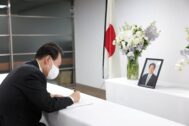
How might the passing of former Prime Minister Abe Shinzo impact Tokyo’s approach to Seoul? This unexpected turn of events loomed large in the minds of many who have been cautiously optimistic that Japan and South Korea would take steps toward a breakthrough in their stalled relations. In our last issue, we discussed how this summer could provide good timing for Seoul and Tokyo to create momentum in this direction after Yoon Suk Yeol’s inauguration as president in South Korea and the Upper House election in Japan. However, the results from this summer were mixed. Seoul and Tokyo have not yet announced whether Yoon and Kishida will hold a summit any time soon. Both leaders ended the summer juggling domestic politics amid declining approval ratings. However, there were some meaningful exchanges between the two governments, signaling that both sides were interested in improving relations.
China - Russia
May — August 2022Embracing a Longer and/or Wider Conflict?
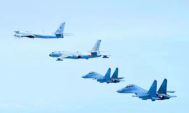
Unlike in 1914, the “guns of the August” in 2022 played out at the two ends of the Eurasian continent. In Europe, the war was grinding largely to a stagnant line of active skirmishes in eastern and southern Ukraine. In the east, rising tension in US-China relations regarding Taiwan led to an unprecedented demonstrative use of force around Taiwan. Alongside Moscow’s quick and strong support of China, Beijing carefully calibrated its strategic partnership with Russia with signals of symbolism and substance. Xi and Putin directly conversed only once (June 15). Bilateral trade and mil-mil ties, however, bounced back quickly thanks to, at least partially, the “Ukraine factor” and their respective delinking from the West. At the end of August, Mikhail Gorbachev’s death meant so much and yet so little for a world moving rapidly toward a “war with both Russia and China,” in the words of Henry Kissinger.

Australia-US/East Asia
September 2021 — August 2022Australia’s New Government: Climate, China and AUKUS
Australia has changed government and the political war over climate change draws to a close after raging for 15 years. The new Labor government led by Anthony Albanese promises continuity on foreign and defense policy, delivered with a different tone. In the government’s first 100 days, it chipped some ice from the frosty relationship with China. Ending a Beijing ban on meetings with Australian ministers that was in its third year, Chinese ministers had face-to-face talks with Australia’s foreign minister and defense minister. Albanese’s observation that dealing with China will continue to be difficult was demonstrated by a diplomatic duel in the South Pacific, as Canberra pushed back at Beijing’s ambition for a greater security role in islands. Two major defense announcements are due in the first months of 2023: the plan for an Australian nuclear submarine, based on the AUKUS agreement with the US and UK, plus a re-set of Australia’s military and strategic posture because of the toughest security environment in decades. Labor says the alliance with the US should go “beyond interoperability to interchangeability” so the two militaries can “operate seamlessly together at speed.”

Regional Overview
January — April 2022Ukraine Seizes the Headlines Amid Mounting Concerns About China
International attention during the first trimester of 2022 quite naturally focused on the Russian invasion of Ukraine, amid heavy (and often breathless) speculation regarding its political, security, and economic implications for Asia in general and China-Taiwan in particular. Largely overlooked (except by us) has been the release of the Biden administration’s Indo-Pacific Strategy and the classified versions of the National Defense Strategy (NDS), Nuclear Posture Review (NPR), and Missile Defense Review (MDR). Still missing in the Indo-Pacific Strategy are specifics regarding the Indo-Pacific Economic Framework (IPEF), first unveiled (sans details) by President Biden at last October’s East Asia Summit, which supposedly encompasses the trade and economic dimension of the administration’s Asia policy. Also still missing is the all-encompassing National Security Strategy (NSS), which traditionally precedes these documents. It was reportedly sent back to the drawing board following the Russian attack.
Events in the opening trimester of the year also raised both hopes and concerns regarding the viability of the Quad, the increasingly more formal collaboration among Australia, India, Japan, and the United States. The Australia-UK-US (AUKUS) enhanced security partnership also made progress, to the delight of its members.
US - Japan
January — April 2022Russian Invasion Accelerates Alliance Review
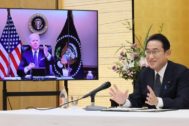
The US and Japan began the year with a 2+2 meeting, continuing their close coordination on alliance preparedness and regional coalition-building. COVID-19 affected the two allies’ diplomatic schedule, however, as the omicron variant spread quickly in Washington, DC. Once again, an in-person meeting between the secretaries of state and defense and their counterparts, ministers of foreign affairs and defense, had to be moved online. Moreover, resolving the management of COVID by US Forces Japan with Japan’s own protocols was on the agenda. But the US and Japanese governments met another challenge with alacrity: the conclusion of a new Host Nation Support agreement. With an emphasis on alliance resilience, this five-year provision of Japanese support for the US military in Japan handily sidestepped some of the political difficulties that have colored talks in the past.
Much is ahead for Japan this year in updating its strategic planning. Prime Minister Kishida Fumio began a strategic review late last year, and the National Security Council as well as the Ministry of Defense got to work on laying out the aims of a new National Security Strategy, 10-year defense plan, and an accompanying procurement plan. Shaped by the accelerating shift in the military balance in Japan’s vicinity and across the Indo-Pacific, this strategic review is expected to be momentous. The Liberal Democratic Party (LDP) also initiated its own study of Japan’s strategic needs and produced a draft that highlights doubling Japan’s defense spending to match NATO’s target of 2% of GDP.
But President Biden and Prime Minister Kishida have focused on Europe since Russia invaded Ukraine. Both allies have been in sync as the G7 mobilized to impose sanctions against Russia and aid to Ukraine. Framing this crisis as a violation of the postwar international order, Kishida firmly committed Japan to ongoing and comprehensive engagement with not only the US but also European nations. Moreover, Putin’s war against Ukraine has galvanized dialogue between US allies in NATO and in Asia, creating a deepening diplomatic opportunity for Japan to develop European support should a similar crisis erupt in the Indo-Pacific.